
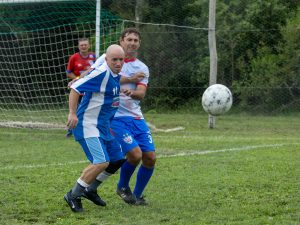
Dubai in April sits on the edge of unbearable. By mid-afternoon the thermometer at Rashid Stadium reads forty-one Celsius. The grass is watered twice before training. Sardar Azmoun arrives in an air-conditioned Cadillac Escalade, nods to the security staff, changes quickly, and jogs onto the pitch with the same unhurried gait he’s used since he was nineteen. The tattoos on his forearms haven’t changed. The nickname has. He was, for a time, the “Iranian Messi,” a label hung on him by Russian broadcasters and later by breathless Iranian social media in 2016. He is now, more simply, the Shabab Al Ahli number twenty, at thirty-one years old, trying to remember what he was good at.
The Messi comparison was never fair and mostly worked against him. Azmoun was never a dribbler. He was a classic centre-forward in the mould of a 1990s Serie A striker: strong in the air, smart in the box, willing to make the ugly runs. At his peak, for Zenit in 2018–2020, he was scoring at better than a goal every two matches in the Russian Premier League and Europa League. A career that began in Sepahan, moved through Rubin Kazan and Rostov and Zenit, passed through Bayer Leverkusen and José Mourinho’s Roma, and has now settled into its late chapter in the UAE Pro League has been, by any serious measurement, one of the most successful of any Asian footballer in the modern era.
That doesn’t mean the current chapter is comfortable.
The Iranian Messi and the Weight of the Label
When Azmoun signed for Rubin Kazan in 2013 at eighteen, he was barely known outside Iranian domestic football. By 2016, after eighteen months at Rostov under Kurban Berdyev, he had become the most-hyped young forward in Russia. A Russian broadcaster used the “Iranian Messi” phrase on-air after a hat-trick. Iranian media picked it up instantly. Within months, the nickname had calcified into something neither Azmoun nor his coaches particularly liked.
The problem with nicknames borrowed from the greatest player in football history is that they invite constant comparison at a scale the real player can never meet. Azmoun’s game bore no resemblance to Messi’s. He was six feet tall, powerful, predominantly right-footed, a penalty-box finisher rather than a playmaker. But the name stuck because he was young, because his hair was good, and because Iran was starved for a modern superstar to follow Ali Karimi into the next decade.
His best single season was 2018–19. Between Rubin and a short post-winter spell back at Rostov before the full move to Zenit, he scored consistently, including on his debut start for Zenit against Fenerbahçe in the Europa League, where he provided two goals and an assist and was named UEFA Player of the Week. That match is the high-water mark of his European club career.
Zenit, the Plateau, and Leverkusen’s Promise
Azmoun’s Zenit years, 2019 through early 2022, cemented his standing as one of the best African-Asian forwards in Europe. He won three Russian Premier League titles. He scored in the Champions League. He was a regular for Iran through the 2022 World Cup qualifying cycle.
The January 2022 move to Bayer Leverkusen, on a pre-contract agreement signed months earlier, should have been his elevation into a true top-five European league. The timing, however, was catastrophic. The Russian invasion of Ukraine began six weeks after Azmoun’s arrival in Germany. His then-teammate at Zenit, and his new teammates at Leverkusen, were suddenly at the centre of a sporting geopolitics he had not signed up for. His minutes at Leverkusen were limited. His form was inconsistent. A hamstring injury cost him several weeks. By the time Xabi Alonso had rebuilt Leverkusen into a title contender in 2023/24, Azmoun was on loan at Roma and unable to contribute to the Bundesliga triumph.
His August 2023 loan to Roma was arranged partly by José Mourinho personally. The Portuguese manager had been a long-term admirer. The reality, however, was that Roma’s attack was crowded, Mourinho himself was sacked midway through the season, and Azmoun never established himself. In May 2024 Roma declined the purchase option. In July he joined Shabab Al Ahli for a reported €5 million on a three-year deal.
Shabab Al Ahli: The Honest Brief
The UAE Pro League is not the Bundesliga. It is not pretending to be. It is a competitive, well-funded regional league that pays top-tier salaries and produces its own legitimate football drama. Shabab Al Ahli, based in Dubai, is among its most consistent top-four clubs. For Azmoun, the move offered three things: financial stability, guaranteed starting minutes in principle, and a route to the Asian Champions League — a competition in which Iranian players regularly star.
The first season, 2024/25, went reasonably well. Azmoun scored, started regularly, and was nominated for UAE Pro League season awards. The second season has been different. In the 2025/26 Pro League, according to FotMob, Azmoun has recorded approximately two goals and two assists in around 274 minutes through the spring, with rating data suggesting uneven match-by-match output. Another data source placed him at one goal from two matches in the same season. The exact totals depend on the measurement date and the methodology, but the honest summary is that he has not played as much as anyone expected.
Why the Minutes Have Shrunk
Three factors converge. The first is injury management. Azmoun has carried minor muscular issues intermittently since his Leverkusen years, and Shabab’s medical staff have reportedly prioritised conservative handling. The second is squad competition: Shabab Al Ahli’s import quota is competitive, and when all their foreign forwards are fit, Azmoun has been rotated rather than locked in. The third, and least discussed, is tactical fit. The club’s manager in the current cycle has favoured a pressing centre-forward who stays high; Azmoun, historically, drops deeper to link play. The roles haven’t always matched.
None of this is a story of decline. Azmoun at training reportedly still hits the standard he always has. What has changed is situational. The Dubai version of his career is quieter, less spotlighted, more managed. For a player who has won titles in Russia, shared a dressing room with Paulo Dybala at Roma, and been on the teamsheet at Leverkusen for European nights, the professional surroundings are modest. The pay is not.
Azmoun’s Numbers, Club by Club
| Period | Club | Competitive apps (approx.) | Goals (approx.) | Status |
|---|---|---|---|---|
| Jan 2022 – Jul 2024 | Bayer Leverkusen | ~35 | ~6 | Interrupted by injuries and loan |
| Aug 2023 – May 2024 | Roma (loan) | ~18 | ~2 | Option not exercised |
| Jul 2024 – present | Shabab Al Ahli Dubai | ~40+ | 15+ | Contract through 2027 |
| 2025/26 only | Shabab Al Ahli | ~10 | 2 | Reduced role; rotational |
The first-season UAE figures were respectable. The second-season figures are the ones that matter for his national team future. Amir Ghalenoei and his staff cannot build a World Cup match plan around a player who is not starting regularly at club level. What they can build, and appear to be building, is a contingency: Azmoun as an impact substitute, as the forward who comes on in the seventieth minute when Iran need a target in the box and the scoreline demands aerial presence.
The Iran Context: Still Essential, No Longer First Choice
For Team Melli, Azmoun is the second name on the team sheet after Taremi. He remains one of Iran’s leading active international scorers. In Amir Ghalenoei’s 4–2–3–1, the expectation is that Taremi starts as the lone nine, with Azmoun entering either from the bench or, in specific matchups, partnering Taremi in a 4–4–2 variation.
The Belgian fixture on 21 June is precisely the kind of match in which Azmoun’s late-stage impact could be decisive. Belgium’s centre-backs, for all their quality, are vulnerable to physical target play in the final twenty minutes. Iran will likely defend deep and counter. If the score is 0–0 entering the final half hour, the substitution of Azmoun for Mohebi or Gholizadeh gives Ghalenoei a second centre-forward who can convert a single high ball. The plan writes itself.
What the plan requires is match fitness. Azmoun’s May matches for Shabab, and the pre-tournament camp in Antalya, will determine whether he arrives in California ready. Early reports from Iranian outlets cover both possibilities. Some note his enthusiasm. Others caution that his minutes at club level are the lowest of his career since 2012.
The Persona, the Politics, the Public Silence
Azmoun was among the Iran players who supported the domestic protest movement most visibly during the 2022 Qatar tournament. Like his teammate Hajsafi, he participated in the symbolic anthem protest before the match against England. Unlike Hajsafi, he remained more publicly outspoken on social media in the months that followed. The reaction from Iranian authorities was mixed, and his subsequent national team minutes fluctuated in ways that Iranian football journalists attribute to political caution as much as sporting selection.
In April 2026, Azmoun has been publicly quiet on political matters. His focus, in interviews, has been on the World Cup and his fitness. The Iranian federation is reportedly content with that posture. What happens if the 2026 tournament produces another flashpoint — the United States venue, the political backdrop, the visibility of the Iranian diaspora in Los Angeles — remains, as with the rest of the squad, an open question.
What a Reinvention Looks Like
The honest way to describe Azmoun’s current chapter is not as a revival but as a reinvention. He is no longer the sprint-past-centre-backs finisher of his Zenit years. He is still capable of that, on his days, but not every week. What he is becoming, in Dubai, is the kind of forward many successful late-career strikers become: someone who contributes in more subtle ways, whose value is situational, whose best work is in the final twenty minutes of close matches.
For Iran, that is not a downgrade. It is the version of Azmoun the 2026 World Cup squad needs. A thirty-one-year-old forward who can come off the bench and change a match. A player with fifty-plus international goals and the calm that comes from having been in big tournaments before. A substitute whose appearance, from the Iranian supporters’ section of SoFi Stadium, will draw the biggest cheer of the tournament.
The Iranian Messi label has long since faded. What replaces it is less exciting and more accurate: Sardar Azmoun, experienced striker, Shabab Al Ahli number twenty, Team Melli’s most dangerous substitute.
The Rostov Years That Built Him
Before Zenit, before Leverkusen, before Dubai, Sardar Azmoun spent the formative years of his European career under Kurban Berdyev at Rostov. The Dagestani coach, famous for his quiet intensity and his habit of clutching Islamic prayer beads during matches, shaped Azmoun’s game more than any subsequent manager. Berdyev’s Rostov played a reactive, disciplined, physically demanding style. Forwards were expected to press, to win second balls, to score ugly goals from corners, and to make every touch count.
Azmoun’s evolution under that system is visible in his subsequent career. The aerial dominance he has always carried was weaponised at Rostov in a way his raw technique at Sepahan had never demanded. His movement off the shoulder of the last defender, a skill he arrived with, was sharpened into something closer to elite Serie A ball-over-the-top running. His work rate, which in his early Iran national team appearances had looked inconsistent, was drilled into something his teammates at Zenit later described as “first in, last out” of every training session.
The 2015–16 Rostov season, in which the club finished second in the Russian Premier League and qualified for the Champions League, was the platform from which Azmoun’s European profile emerged. He was twenty-one. He was scoring with regularity. He was, for a brief window, genuinely one of the most exciting young strikers in European football. That window closed quickly — Rostov could not retain him at a wage Zenit was willing to pay — but it was real while it lasted, and it explains why his subsequent career has remained visible even in its quieter chapters.
The Bundesliga Loss That Stung Most
Bayer Leverkusen’s 2023–24 Bundesliga title, won under Xabi Alonso with one of the great unbeaten seasons in European football history, was a victory that passed Sardar Azmoun by. He watched most of it from Rome. His name appears in none of the title celebration photographs. His medal came from a squad technicality rather than a season of contribution. The loan to Roma, which had looked like a short-term career revival, became in hindsight the moment he missed his one chance to be part of a genuinely historic European campaign.
Iranian football journalists who cover him closely argue that the missed Leverkusen title is the single largest regret of his career. Not the Inter-era frustrations of Taremi, not the injury-interrupted Roma loan, but the simple fact that he was not on the pitch in Leverkusen during the weeks that defined modern Bundesliga history. Alonso’s system, built around a front line of movement and interchange, would arguably have suited him. He never got to test the hypothesis.
The psychological weight of that near-miss is the sort of thing that can quietly reshape the later career of an ambitious player. The Dubai move, filed publicly as a career choice and privately as something closer to a graceful exit from European top-flight ambition, has to be read partly in that context. Azmoun did not choose the UAE because he wanted to leave European football. He chose it because European football, after the Leverkusen timing and the Roma non-option, had effectively stopped wanting him at the level he was used to.
The Sepahan Origin Story
Before Rubin Kazan, before any of the European labels, Azmoun was a teenager at Sepahan in Isfahan. He had arrived at the club from his home in Gonbad-e Kavus, a Turkmen-majority city in northern Iran, and integrated into a youth setup that produced several subsequent internationals. His early form caught the attention of Iran’s national team scouts and, more decisively, of Rubin Kazan’s recruitment department. The 2013 transfer, at eighteen, was unusual for its time: direct moves from Iran to the Russian top flight were rare, and most Iranian players of his generation arrived in Europe via Persian Gulf clubs or Portuguese second-tier pathways.
The Sepahan-to-Rubin route became, in retrospect, a template. Subsequent Iranian players have followed similar paths, with clubs in Belgium, the Netherlands and Poland increasingly willing to sign directly from the Persian Gulf Pro League. Azmoun was, in that sense, a pioneer as much as a prodigy. The Iranian football federation has since used his case as a reference point in discussions about youth player development and European exposure.
The Tactical Question Ghalenoei Has Not Fully Answered
Amir Ghalenoei faces one of the more interesting selection problems in the Iran squad when it comes to Azmoun. The straightforward path is to leave him on the bench and deploy him as a late-game physical option. The more adventurous path, which some Iranian analysts have floated, is to build a specific Belgium-plan around a front-two of Taremi and Azmoun, with Gholizadeh dropping to left midfield and the shape shifting to a 4–4–2.
The arguments on each side are serious. Against Belgium’s centre-backs, the double centre-forward threat would force them wider and deeper than their positional preferences. Taremi’s movement combined with Azmoun’s aerial presence at the far post is a proven goalscoring combination from their previous Iran appearances together. Belgium, historically vulnerable to high crosses when pressed in their own third, is precisely the opponent against whom the 4–4–2 makes most sense.
The counter-argument is tactical consistency. Iran’s entire qualification campaign was built in a 4–2–3–1. Switching shape for a single match introduces rehearsal costs the April camp may not fully absorb. Ghalenoei is, by temperament, a consistency-first coach. The betting money inside Iranian football journalism is that he will stick with the 4–2–3–1 and use Azmoun exactly as expected: a sixty-eighth-minute substitution, shirt already over his head by the time he reaches the touchline.
Frequently Asked Questions
How old is Sardar Azmoun?
Azmoun was born on 1 January 1995, making him thirty-one years old during the 2025/26 season and thirty-one at the start of the 2026 World Cup.
Where did Azmoun start his career?
At Sepahan in Iran’s Persian Gulf Pro League, before moving to Rubin Kazan in 2013 at age eighteen. His European career then passed through Rostov, Zenit Saint Petersburg, Bayer Leverkusen and Roma on loan, before his 2024 move to Shabab Al Ahli.
Has Azmoun ever been considered for a move to the Premier League?
Brighton and Arsenal were reportedly linked with him at different times, particularly during his Zenit peak. No formal bid ever became public, and the 2022 Bayer Leverkusen move effectively closed the window during which he was most attractive to English clubs.
What number does Azmoun wear for Shabab Al Ahli?
Number twenty. For Iran he has at different times worn number twenty and, earlier in his career, number ten. His Team Melli shirt number for the 2026 World Cup has not yet been confirmed.
Sources
Further SportsPersia reading: our Iran at the 2026 World Cup preview, our feature on Iranian players across Europe, and our spring 2026 tournament coverage.