
Two Flags, Two Bronzes: The Kimia Alizadeh Story From Rio to Paris
By Fatemeh Kianpour — Published April 28, 2026
Grand Palais, Paris, August 2024. The overhead lights are harsh in the way Olympic venue lighting always is, designed to throw no shadows on the mat. Kimia Alizadeh stands in the red corner, her back to the Bulgarian flag that hangs above the scoreboard. Opposite her, in the blue corner, is Luo Zongshi of China, the reigning world champion and the favorite for the bronze. The referee raises his hand. The clock starts. Alizadeh, 26 years old and on her third Olympic Games under three different sets of circumstances, moves forward with the economy of an athlete who has been here before.
She wins the bronze 2-1. Bulgaria, a nation that had never won an Olympic taekwondo medal in its history, now has one. The Bulgarian team staff in the stands stand and applaud. Iranian fans watching in Tehran, Karaj, Istanbul, and Bonn watch a more complicated scene — a woman they once cheered for in a red-white-green singlet now in a red-white-green-of-a-different-order.
It is, by any sporting measure, an extraordinary achievement. It is also the final chapter in one of the more complicated athlete biographies of the last decade.
Karaj, 2015
Kimia Alizadeh was born on July 10, 1998, in Karaj, an industrial city west of Tehran. She came into taekwondo through a school program at the age of nine. By fourteen she was a junior national champion. By seventeen she was a senior international medalist. The Iranian taekwondo federation — one of the country’s best-resourced women’s sport programs, historically — identified her as a likely Olympic contender well before Rio 2016.
She made the team. She qualified for the women’s -57kg division. And at Rio in August 2016, she won a bronze medal, defeating Nikita Glasnović of Sweden in the bronze-medal match.
The significance of the result was immediate. She became the first Iranian woman to win an Olympic medal. In a country where women’s sport had grown substantially over two decades but had not yet produced a podium at the Summer Games, Alizadeh’s bronze was a national story. Tehran Times called her “a daughter of the nation.” Posters of her, mid-kick in her Iranian kit, appeared in gyms across the country.
The Departure
In January 2020, on her Instagram account, Alizadeh posted a long statement announcing her departure from Iran. She wrote that she had chosen to leave for reasons that combined personal, political, and professional considerations. She described the decision as difficult and permanent.
The statement drew immediate international coverage. Iranian officials expressed a mixture of surprise and criticism. Some Iranian athletes and coaches publicly defended her. Some criticized her. The federation itself issued brief, carefully worded statements that acknowledged her departure without commenting on the specific grievances she had raised.
Alizadeh relocated to Germany, where she trained for the Tokyo 2020 Olympic cycle. The IOC accepted her into the Refugee Olympic Team, and she competed at Tokyo in 2021 under the refugee flag. She defeated Jade Jones of Great Britain in the round of 16 — an upset result over a two-time Olympic champion — before falling in the quarterfinals. She did not medal.
The Bulgarian Path
In 2023 Alizadeh began training with Bulgarian taekwondo coaches, working out of a federation-supported gym in Sofia. Bulgaria’s taekwondo program, traditionally modest, had been actively seeking to build a presence at World Taekwondo Federation events. Alizadeh’s availability offered the federation a rare opportunity: an experienced Olympic-medal-caliber athlete, still in her mid-twenties, willing to compete under their flag.
The Bulgaria Taekwondo Federation announced in March 2024 that Alizadeh would represent Bulgaria at Paris 2024. In April 2024, the Bulgarian government formally granted her citizenship, clearing the final administrative hurdle for Olympic eligibility under the new flag. World Taekwondo confirmed her eligibility shortly thereafter.
The decision made Alizadeh Bulgaria’s first-ever Olympic taekwondo athlete. The federation treated her arrival as a significant investment in a program that had historically operated at the margins of the European taekwondo scene.
Paris, and a Familiar Opponent
The -57kg draw in Paris produced a remarkable coincidence. Nahid Kiani, a 24-year-old Iranian athlete who had trained alongside Alizadeh during their junior years, was also competing — representing Iran. The two had been close friends in their early teens. Their paths had diverged sharply in the years since.
Both reached the medal rounds. Kiani advanced to the gold-medal final, where she lost to South Korea’s Kim Yu-jin to take silver — becoming the first Iranian woman to win an Olympic silver at the Summer Games. Alizadeh, in the bronze-medal match, defeated Luo Zongshi 2-1.
Two Iranian-born athletes, now representing different flags, standing on adjacent steps of the same Olympic podium. The visual spread quickly across international media. Iranian outlets, particularly those with a nationalistic editorial line, emphasized Kiani’s silver. Bulgarian outlets emphasized Alizadeh’s bronze. International coverage, particularly from Al Jazeera and the BBC, presented the story in its full complexity: two friends, two flags, two medals in a single weight class.
The Legacy Ledger
| Year | Event | Representing | Result |
|---|---|---|---|
| 2016 | Rio Olympics — women’s -57kg | Iran | Bronze — first Iranian female Olympic medalist |
| 2020 | Announced departure from Iran | — | Relocated to Germany for training |
| 2021 | Tokyo Olympics — women’s -57kg | Refugee Olympic Team | Quarterfinalist; defeated Jade Jones in R16 |
| 2024 | Bulgarian citizenship granted | Bulgaria | First Bulgarian Olympic taekwondo athlete |
| 2024 | Paris Olympics — women’s -57kg | Bulgaria | Bronze — Bulgaria’s first Olympic taekwondo medal |
What Her Coaches Say
The coaching team that worked with Alizadeh in Sofia during her Paris preparation has been relatively open about the technical work involved in her transition. Bulgarian head coach Nikolay Enchev, in interviews with national outlets, described her as a highly disciplined training partner who contributed to the program far beyond her own competition preparation.
Alizadeh herself, in post-match interviews, emphasized the welcome she received from the Bulgarian federation and the athletes she trained alongside. She spoke about wanting to raise Bulgarian taekwondo’s international profile and about the responsibility she felt to younger Bulgarian athletes now looking at taekwondo as a medal-plausible sport.
On her Iranian past, she has been restrained in recent interviews. The January 2020 statement remains the fullest account she has given in her own words. Her more recent public remarks focus on sport rather than politics.
The Reaction in Iran
Iranian sports media coverage of Alizadeh’s Paris bronze was muted. Some outlets covered the result factually. Others focused exclusively on Nahid Kiani’s silver and declined to mention Alizadeh’s bronze at all. State television, which had celebrated her Rio 2016 medal with extensive primetime coverage, did not broadcast footage of the Paris bronze match.
Private reaction among Iranian taekwondo practitioners, as reported by several Persian-language outlets, was more mixed and more generous. Many former training partners publicly congratulated her. Some younger Iranian female athletes cited her as an influence on their own careers. The federation itself did not issue a formal statement.
Outside Iran, in the substantial Iranian diaspora in Europe and North America, reaction was overwhelmingly positive. Diaspora community outlets covered both Kiani’s silver and Alizadeh’s bronze as parallel achievements.
What Comes Next
At 26, Alizadeh is in the middle of her competitive athletic life. The LA 2028 Olympic cycle is the obvious horizon. She has already indicated, in Bulgarian and international interviews, that LA is her next target. The Bulgarian federation has confirmed that her training pipeline is structured toward it.
The -57kg division is among the deepest in women’s taekwondo. South Korea, China, Great Britain, France, and a handful of rising African nations all send competitive athletes to each Olympic cycle. A second Bulgarian medal at LA would require Alizadeh to remain in the top tier of the division for another two seasons — challenging but not implausible given her demonstrated competitive longevity.
Kiani, her Iranian counterpart, is five years younger and already holds a silver. Their division will likely cross paths again at World Championships and, potentially, at LA 2028. Whether they meet on the mat one more time is, for now, an open question.
The Meaning of Two Flags
Alizadeh’s career has become a case study in the complicated interaction between athlete identity, state sport systems, and international competition. There is no single framework that captures her story neatly. She is simultaneously an Iranian sports success, an international refugee-athlete narrative, a Bulgarian pioneer, and — in her own telling — a person who made a difficult personal choice.
What is not in dispute is her record. Three Olympic Games. Two bronze medals, eight years apart. Two national flags. One career built entirely before her twenty-seventh birthday.
The Grand Palais’s lights will eventually be dismantled. The Bulgarian flag will have been folded and put away. But the footage of a young woman winning Bulgaria’s first taekwondo Olympic medal, eight years after winning Iran’s first by a female athlete, will remain on the record of both countries for as long as there is a sporting archive to hold it.
What the Bulgarian Federation Built
The Bulgarian Taekwondo Federation’s investment in Alizadeh was not a one-off recruitment. The federation has used her presence as the foundation for a broader development project. Junior clinics across Sofia, Plovdiv, and Varna have expanded. Coaching-education partnerships with South Korean and Turkish federations have been signed. A formal mentorship programme pairs young Bulgarian female taekwondo practitioners with senior athletes, with Alizadeh serving as one of the designated mentors.
The federation’s medium-term ambition, as outlined by federation president Slavi Binev in interviews, is to qualify multiple Bulgarian taekwondo athletes for LA 2028 and to position the country as a competitive European taekwondo programme within the next two Olympic cycles. Alizadeh’s presence has accelerated this ambition. Her Paris medal has given the federation the kind of public profile that attracts sponsorship, government funding, and youth participation.
Whether the investment produces a second Bulgarian Olympic medal in taekwondo — from Alizadeh herself or from a younger athlete she has helped develop — is one of the open questions of the LA 2028 cycle. The federation has set the target publicly. The pipeline is being built. The first institutional fruits are already visible in the junior programme’s expanded participation numbers.
The Coaches Who Shaped Her
Alizadeh’s career has involved several distinct coaching relationships, each of which contributed different elements to her technical identity. In her Iranian youth years, she was trained primarily by Mahroo Kamrani, one of the senior women’s coaches in the Iranian taekwondo system. Kamrani’s emphasis on disciplined footwork and precise point-scoring technique formed the basis of Alizadeh’s early competitive style.
During her refugee period in Germany, she worked with local club coaches who adapted her training to European tactical approaches. The shift produced a broader offensive repertoire but, by her own description, required significant adjustment to match the technical vocabulary she had grown up with.
Her Bulgarian coaching relationship, built around the national federation’s senior technical staff and supplemented by periodic South Korean and Spanish consultation, represents the most integrated coaching setup of her career. The Paris medal is, among other things, a technical validation of this final coaching arrangement. The combination of her accumulated experience, the Bulgarian federation’s consistent support, and the multi-national technical input produced a more complete competitive athlete than she had been at any prior point.
The Bronze Match in Detail
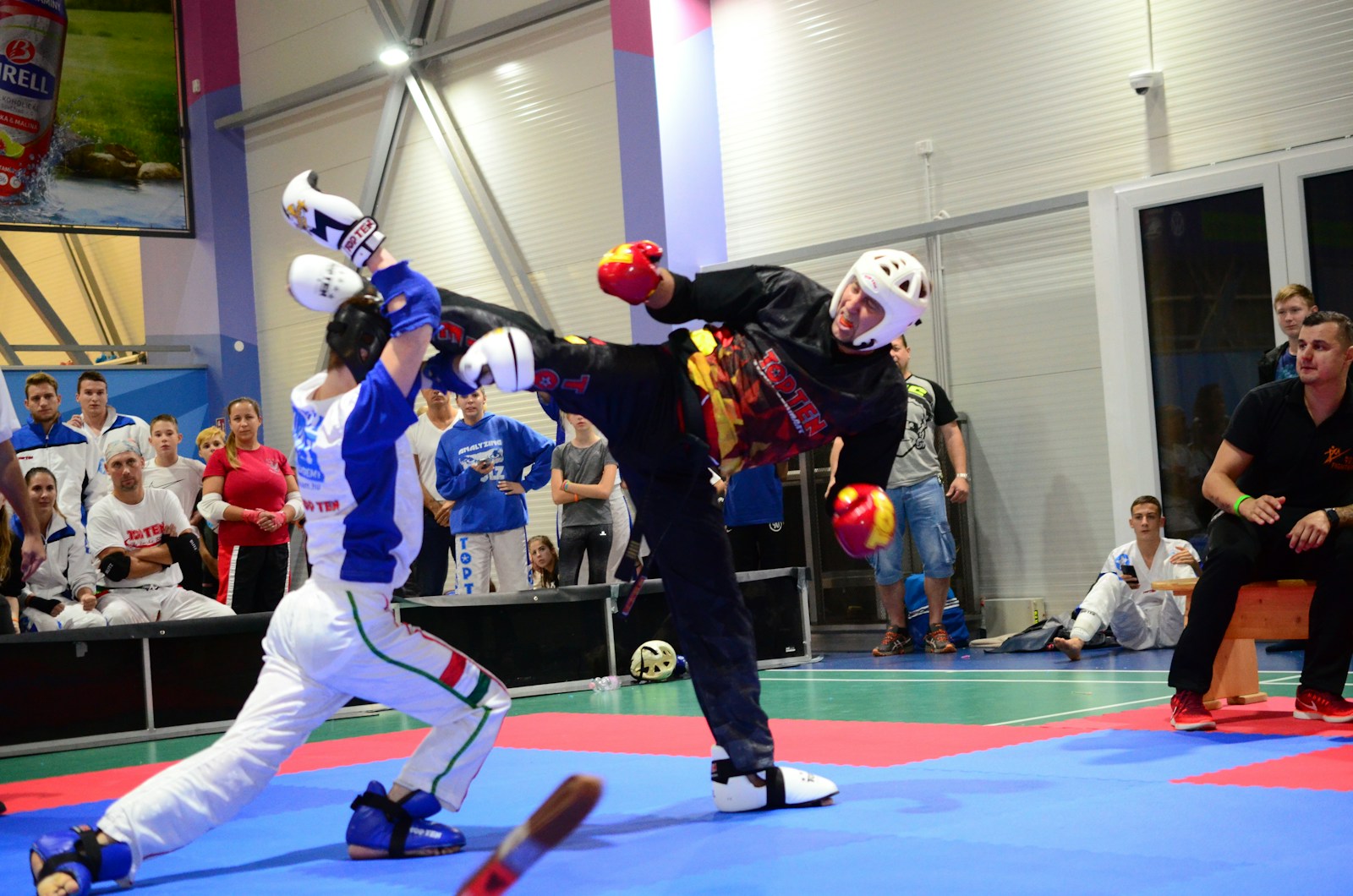
The bronze-medal match at the Grand Palais deserves a closer look on its own terms. Luo Zongshi, the 2022 world champion, entered the match as the heavy favorite based on recent form and head-to-head history. The match opened cautiously, with both athletes testing range rather than committing to early exchanges. Alizadeh scored first, a back-leg turning kick to the hogu (body protector) that registered a two-point score.
Luo equalized in the second round with a series of front-leg attacks that pressed Alizadeh backwards. The round closed with Luo slightly ahead on exchange volume, and the third-round score stood at 1-1. What shifted the match was Alizadeh’s willingness to clinch in the final seconds of the third round — a tactic she had practiced extensively in Sofia but had not used prominently in earlier career rounds. The clinch disrupted Luo’s rhythm, drew a cautionary warning that further tilted the score, and ultimately produced the decisive 2-1 result.
International taekwondo analysts, in post-match commentary, identified the clinching tactic as the technical signature of Alizadeh’s Bulgarian training period. Her Iranian competitive style had been more openly exchange-based. The refined, clock-aware clinching approach reflected a European coaching influence and a more calculated competitive maturity.
The Training Geography
Alizadeh’s career has, by circumstance, been divided across more training geographies than most top-level Olympic taekwondo athletes experience in an entire career. Her initial development took place at the national training centre in Tehran, where Iranian taekwondo has maintained one of the most effective women’s programs anywhere in Asia for more than two decades. Her Rio preparation involved extensive travel to Asian circuit events and periodic training blocks in South Korea.
After her 2020 departure from Iran, Alizadeh relocated to Germany and trained primarily in the Bonn-Cologne area, working with refugee-program coaches and local German taekwondo clubs. The Tokyo 2020 cycle was, technically speaking, her most fragmented training period: she combined solo training, club training, and scattered international camp opportunities.
The Paris cycle under the Bulgarian federation offered her the first continuous, institution-backed training environment she had experienced since leaving Iran. Sofia’s national training centre became her primary base. Quarterly training exchanges with South Korean and Spanish federations supplemented the domestic program. The combination produced, by her own description, the most stable competitive preparation of her adult career.
The Women’s -57kg Context
The -57kg division has been, for a decade, among the most competitive weight classes in world taekwondo. It draws significant depth from South Korea, China, Chinese Taipei, Great Britain, France, Turkey, Azerbaijan, and a handful of emerging African programs. World Championships medallists in this division turn over frequently, with no single athlete dominating for extended periods.
Alizadeh’s three Olympic performances in the division — bronze at Rio, quarterfinalist at Tokyo, bronze at Paris — are an unusual record of sustained elite performance across three different competitive contexts. Very few taekwondo athletes have contested three Olympic medal rounds for three different affiliations. The technical consistency required to do so — across changing coaches, changing training partners, and changing federation support — is remarkable.
The division will likely reset somewhat going into the LA 2028 cycle. Jade Jones, long the division’s dominant British figure, is approaching the natural end of her career. South Korean, Chinese, and French programs each have young athletes emerging. The division’s top ten for 2026 is already in motion.
The Kiani Parallel
Nahid Kiani’s parallel career as Alizadeh’s Iranian contemporary in the -57kg weight class deserves its own attention. Kiani, born in 2000, trained alongside Alizadeh as a junior and emerged in the post-2020 vacuum created by Alizadeh’s departure. Her progression has been measured: Asian Games medals, World Championship results, and ultimately an Olympic silver in Paris.
Kiani’s silver was the first Olympic silver ever won by an Iranian woman at the Summer Games. It is, on its own, a historically significant achievement. The fact that it came in the same division and at the same Games as Alizadeh’s Bulgarian bronze produced one of the more remarkable dual narratives of Paris 2024.
The two athletes have, by most accounts, maintained a cordial personal relationship despite the politically and institutionally charged context of their divergent careers. Their parallel trajectories are likely to continue intersecting — at World Championships, at potential future Olympic cycles, and in the broader historical memory of the division.
The Refugee Olympic Team Context
Alizadeh’s appearance at Tokyo 2020 as a member of the IOC Refugee Olympic Team placed her within a specific and relatively new Olympic category. The Refugee Olympic Team was established in 2016 as an IOC-sponsored framework for athletes who cannot compete for their country of origin for reasons related to displacement, persecution, or political circumstance. The team grew meaningfully between 2016 and 2020, and Alizadeh was among its highest-profile athletes at the Tokyo Games.
Her eventual move to Bulgarian citizenship placed her on a different track than most Refugee Team athletes, who typically continue under the refugee flag for multiple cycles. Her path — Iran to Refugee Team to full Bulgarian citizenship in four years — is relatively unusual in its speed and institutional completeness.
The IOC has continued to expand the Refugee Olympic Team concept, and for LA 2028 the team is expected to be substantially larger than in prior cycles. Alizadeh’s career trajectory offers one model for how a refugee athlete can transition into national-team representation elsewhere, though most such transitions take longer and involve less governmental direct intervention than her Bulgarian grant.
Sources
- Wikipedia — Kimia Alizadeh
- BTA — Bulgaria’s Taekwondo Athlete Kimia Alizadeh Takes Bronze
- Olympics.com — Alizadeh secures Paris 2024 quota
Related Reading
- How Iranian athletes navigate international competition
- More from the SportsPersia international desk
Frequently Asked Questions
Who is Kimia Alizadeh?
A taekwondo athlete born in Karaj, Iran, in 1998. She became Iran’s only female Olympic medalist at Rio 2016 with a bronze in the women’s -57kg division.
Why did she leave Iran?
In January 2020 she announced her defection from Iran in a social-media statement. She later competed at Tokyo 2020 as a member of the IOC Refugee Olympic Team.
When did she become Bulgarian?
Alizadeh was granted Bulgarian citizenship in April 2024. In March 2024 the Bulgaria Taekwondo Federation had already announced she would represent Bulgaria at Paris 2024.
What did she win at Paris 2024?
Alizadeh won bronze in the women’s -57kg division, Bulgaria’s first ever Olympic taekwondo medal, defeating 2022 world champion Luo Zongshi of China 2-1 in the bronze-medal match.