

Look at a first-team photograph from two seasons ago and count the faces still at the club. At most top-flight sides here the honest answer is a handful, and at several it is fewer than the fingers on one hand. The badge is continuous. Almost nothing behind it is.
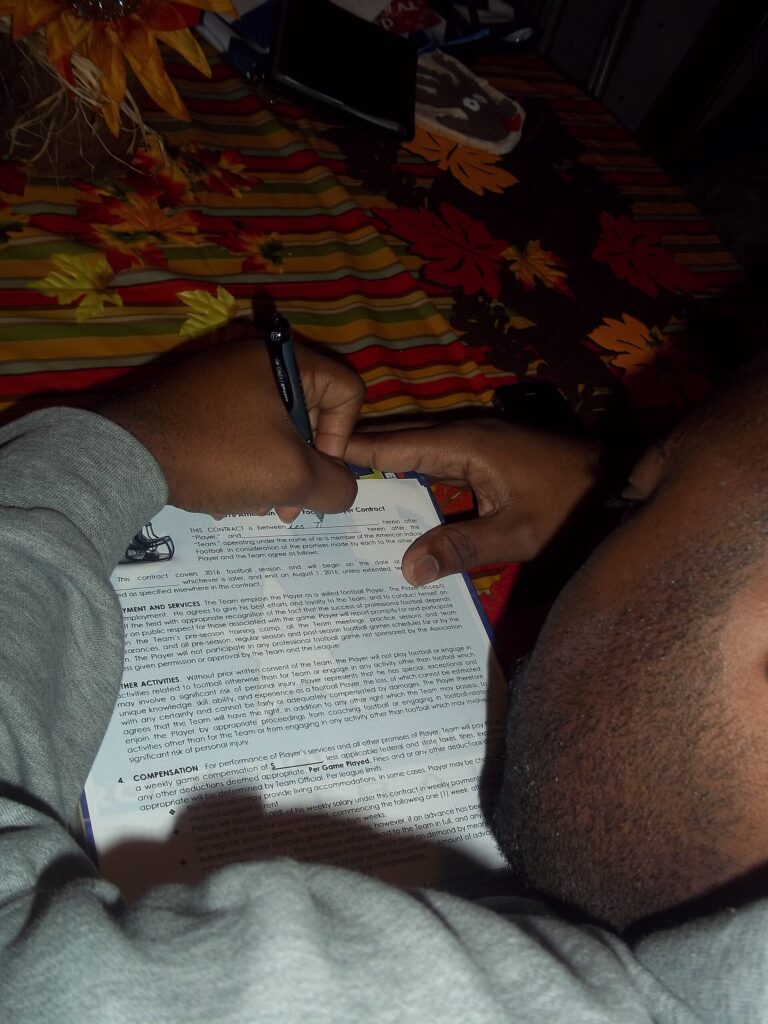
This gets reported as instability, which is a description rather than an explanation. The mechanism is narrower and more boring: contracts are short, usually a single season, and a squad built on one-year agreements has to be rebuilt every June whether or not anyone wanted to rebuild it.
What follows is why the one-year deal became normal, what it does to a season on the pitch, and what would have to change before a club could plan past next spring.
Where the churn shows up first
- The spine. Goalkeeper, centre-backs and the holding midfielder change together more often than any other group, because they are signed together after a coaching change.
- Pre-season. Spent installing basics rather than refining them, because a third of the group has never trained under the coach.
- Set pieces. The first routine to disappear and the last to return. It is the part of the game most dependent on repetition with the same bodies.
- Resale value. A player in the last year of a one-year deal is worth a fee to nobody. The club has no asset, only an employee.
- Autumn results. The cost usually appears between September and November, before the group has settled.
- What survives. Academy graduates and long-serving staff. Continuity, where it exists, is almost never bought.
Why the one-year deal became the default
Clubs here mostly operate on annual budgets that are approved annually. A club owned by a state enterprise or an industrial group receives a figure for the coming year, and that figure is confirmed close enough to the season that committing to a wage three years out is a decision nobody in the building has authority to make.
Sponsorship works the same way. Where a large share of income comes from a parent organisation or from an agreement renewed each year, the revenue side of the balance sheet has a twelve-month horizon. A finance director who signs a three-year wage against a one-year revenue is creating a liability, and he knows it.
Add to that a manager who may not be in post by December, and the one-year contract stops looking like short-termism. It looks like an accurate reflection of how far ahead anyone at the club can actually see.
Why Iranian club squad turnover runs so high
Iranian club squad turnover is the arithmetic consequence of that horizon rather than a separate phenomenon. If most of a squad is on a one-year deal, then most of a squad is available on a free transfer every summer, and every summer every club competes for the same suddenly available pool.
The loop is self-reinforcing. Because so many players reach the market at once, a club that loses three starters can replace them quickly, which lowers the perceived cost of losing them, which reduces the pressure to offer longer deals to keep them. Liquidity in a market removes the incentive to lock anything in.
It also compresses negotiation. A player with an expiring contract in April has leverage he will not have in August, and clubs know that the same player will be available to a rival within weeks. Renewal talks therefore happen late, under time pressure, with a queue of alternatives visible to both sides.
A currency problem the player solves by re-signing
The player’s side of this is rarely explained and is at least as important. A wage agreed today and paid in three years is worth whatever it is worth in three years, and in an economy where purchasing power moves quickly, a fixed multi-year salary transfers that risk entirely onto the player.
A one-year agreement lets him re-price annually. If costs rise, he negotiates against the new level rather than against a number set two seasons ago. Multi-year offers that do not include an indexation mechanism are therefore frequently worse for the player than an annual deal at the same headline figure, and experienced players treat them that way.
Clubs occasionally try to solve this with escalating structures or with a share of the wage tied to appearances. Both help. Neither addresses the underlying point, which is that the player is being asked to hold a risk the club is not willing to hold either.
Wage arrears turn a contract into an exit route
Late payment is the other engine of turnover, and it operates through the regulations rather than around them. Where salaries fall overdue for a defined period and the player has put the club on written notice, the global framework permits him to terminate with just cause and leave.
The effect on squad planning is severe. A club in arrears is not merely a club that pays late; it is a club whose entire squad has an option to leave that it can exercise unilaterally. Even players who choose to stay negotiate their next contract knowing the option exists.
Arrears also shape who signs in the first place. Experienced professionals with alternatives avoid clubs with a payment history, which pushes those clubs toward younger and more marginal signings, which produces worse results, which worsens the finances. Several clubs in the pyramid rebuild large parts of a squad each summer for no reason other than this cycle.
A coaching change resets the recruitment list
Managerial tenure in the top flight is measured in months more often than in seasons, and each change carries a recruitment consequence that is larger than the appointment itself.
A new coach inherits a squad assembled for someone else’s structure. If the previous coach played with a back three and wing-backs and the new one wants full-backs in a four, two or three players become surplus immediately, regardless of quality. Because their contracts expire in June anyway, the cheapest resolution is to let them go and sign replacements — which is exactly what happens.
The result is that a coaching change in November produces a squad change in July, and a club that changes coach twice in a season effectively recruits twice. Long-running national-team projects such as the tactical continuity built over successive cycles are the counter-example that proves the point: the ideas developed there depended on keeping the same group long enough to install them.
What a rebuilt spine costs on the pitch

Not all turnover is equal. Replacing a substitute winger costs almost nothing in coordination terms. Replacing a centre-back pairing costs a great deal, because defending is a shared task performed at speed with no time to communicate.
Three relationships take longest to rebuild. The first is between the two central defenders: the covering angles, who steps and who drops, and the shared decision about the height of the line. The second is between the goalkeeper and the defence, particularly on crosses and on balls played into the space behind. The third is between the holding midfielder and the centre-backs, which determines whether the space in front of the box is occupied.
All three are habit rather than instruction. They can be trained, and the training takes weeks of repetition against opposition rather than an afternoon of explanation. A club that rebuilds its spine in July is buying an autumn of small errors and paying for it in points.
Tactical implementation is the first casualty
A coach arriving at a squad that is half new spends pre-season on a different task from a coach arriving at a settled one. The settled coach refines: he adjusts pressing triggers, changes the timing of one movement, works on a variation of a set piece. The other installs from zero.
Installation is slow because the units that matter are collective. A pressing scheme requires four or five players to react to the same cue within a second of each other, and no individual can practise it alone. Build-up structures have the same property. What looks like a tactical idea is in practice a set of shared expectations, and shared expectations are built by repetition.
This is why domestic sides frequently look organised by February and disorganised in September, and why the analysis written about new tactical approaches in the domestic game tends to describe the second half of a season rather than the first. The ideas were there in August; the automatisms were not.
The asset that never gets created
The financial cost is easier to state than the sporting one. A player under contract for three years and sold in year two produces a fee. The same player on consecutive one-year deals produces nothing when he leaves, because there is nothing to transfer.
That single fact removes an entire revenue line from most clubs here. Selling players is the primary income of well-run clubs in comparable markets, and it is structurally unavailable to a club whose squad is permanently in its final contracted year. The leverage an expiring contract hands a player is not local: it is the same effect that the Bosman ruling made permanent in European football three decades ago. Departures abroad, including moves such as a transfer into a European league, generate far less for the selling club than the profile of the player suggests, because the contract situation is known to every buyer.
Players are aware of the same arithmetic from the other direction. A move abroad in the final months of a contract is cheaper for the buying club and therefore easier to arrange, which is one reason a departure like a step up to a major European club is often timed to a contract expiry rather than to a peak in form. What the player gains in mobility, the club loses in fee.
The academy is the only continuity most clubs own

Where continuity exists, it is almost always home-grown. An academy graduate signs a first professional contract that can run several years, and clubs that would never commit three seasons to a signing will happily do so for a nineteen-year-old whose wage is a fraction of the squad average.
This produces a pattern that looks like a youth policy and is really a budget policy. Clubs promote from within because young players are the only part of the squad they can plan around, not because of a developmental philosophy that survives a bad run of results.
It also concentrates institutional memory in a small group. When the only players who remember last season’s set-piece routines are the two academy graduates, the routines become theirs to teach, which is a large responsibility to place on the least experienced people in the building.
Contract length against what it buys, and what would have to change
| Contract length | Squad continuity | Resale value | Wage risk holder | Club negotiating position |
|---|---|---|---|---|
| One season | None beyond June | Zero | Club, annually | Weak from February |
| Two seasons | One protected summer | Real in year one | Shared | Strong for a year |
| Three seasons, fixed wage | Two protected summers | High in years one and two | Player | Strong, until arrears |
| Three seasons, indexed wage | Two protected summers | High | Club | Strong and durable |
| Rolling extension on appearances | Conditional | Moderate | Shared | Depends on the trigger |
The bottom two rows are the interesting ones, because they are available now and are used rarely. An indexed multi-year deal moves the inflation risk back to the club, which is precisely why clubs resist it, and precisely why it is the only structure that would reduce turnover without asking players to accept a worse outcome.
Longer contracts are a symptom to fix last, not first. Three conditions sit upstream of them, and none is within a single club’s control: revenue with a horizon longer than a year, enforcement of payment, and coaching stability. Where those exist, longer contracts follow without anyone mandating them, because they become the cheaper option for both sides.
Where they do not, a rule requiring longer contracts would simply produce more terminations. That is the reason competition rules in this area tend to regulate payment behaviour rather than contract duration.
Frequently Asked Questions
Are one-year contracts against the regulations?
No. The global framework sets a minimum of the period between two registration windows and a maximum of five years, with local law taking precedence where it is stricter. A single-season contract sits comfortably inside that.
Does high turnover always mean a worse team?
Not necessarily in quality, but reliably in coordination during the first months. A squad rebuilt in July can be individually stronger and collectively worse until the shared habits are rebuilt, which is why autumn form is a poor guide at these clubs.
Why do clubs not simply extend their best players early?
Because an extension requires committing budget that has not been approved, and because the player often prefers to re-price at the end of the season. Early extensions do happen, and they cluster at the clubs with the most predictable income.
What does turnover do to the academy?
It increases promotion in the short term and weakens development in the medium term. A young player thrown into a rebuilt spine learns under pressure without experienced players around him, which is the least efficient way to develop anybody.
Is the pattern the same outside the top flight?
It is sharper. Budgets below the first tier are smaller and less certain, so contracts are shorter and squads change more completely. A promoted club frequently arrives in the top flight with a squad that is unrecognisable from the one that won promotion.
Would longer contracts reduce wage costs?
Over several seasons, probably, because the annual re-negotiation of an entire squad is an inflationary event in itself. The saving is real but slow, and it requires the club to survive the years in which it is paying above the current market for players it signed earlier.
The clubs that break the pattern will not do it by announcing a policy on contract length. They will do it by producing a revenue line that still exists next March, and the longer contracts will follow on their own.