
A ground can sell out every seat on the manifest and still be told by its own safety certificate that it cannot open the upper tier that night. The number printed on a ticket has nothing to do with the number an inspector signs off, and clubs that treat the two as identical find out the difference at the worst possible moment: an hour before kickoff, with a queue already forming.
The certified capacity of a ground is not a count of seats. It is the smallest of several separate numbers, each produced by a different piece of the inspection, and the ground can only ever hold as many people as the tightest of those numbers allows. A stand with ten thousand seats and one narrow stairwell does not hold ten thousand people; it holds however many that stairwell can clear in the time the regulations allow.
This is a walk through the criteria that actually set a stadium safety certificate capacity: exit widths, segregation, lighting, medical cover and the control room, in the order an inspection usually works through them, and why a full-looking ground can be running under its paper capacity without anyone in the crowd noticing.
- What sets the number. Egress time, not seat count, is the binding constraint in almost every ground.
- Who signs it. A local safety advisory group, drawing on fire, police, medical and structural input.
- How often it is reviewed. Annually as a baseline, and again after any structural change or serious incident.
- What closes a section fastest. A blocked exit route or an unstaffed turnstile bank, not a crack in a wall.
- What a club controls directly. Segregation layout, stewarding numbers, and how tightly turnstiles are matched to sections.
What a safety certificate actually licenses
A safety certificate does not license a stadium in the abstract. It licenses a specific configuration of that stadium: a named layout of stands, a named set of exit routes, a named stewarding plan and a named maximum number of spectators for each section under that configuration. Change any one element and the certificate, strictly read, no longer covers what is being sold.
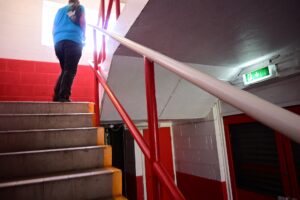
This is why two grounds with an identical seat count can carry very different certified capacities. One might have four broad stairwells feeding a wide concourse and an open perimeter beyond it; the other might have the same seats above two narrow stairwells feeding a concourse that itself narrows into a single gate. The seats are the same. The route out is not, and the route out is what the certificate is actually measuring.
The document itself typically lists a capacity per stand or block rather than a single stadium-wide figure, because the constraint is local. A club that only ever quotes the total misses the point of the certificate, which exists precisely because the total conceals which single block is the weak link.
Exit widths set the ceiling before anything else does
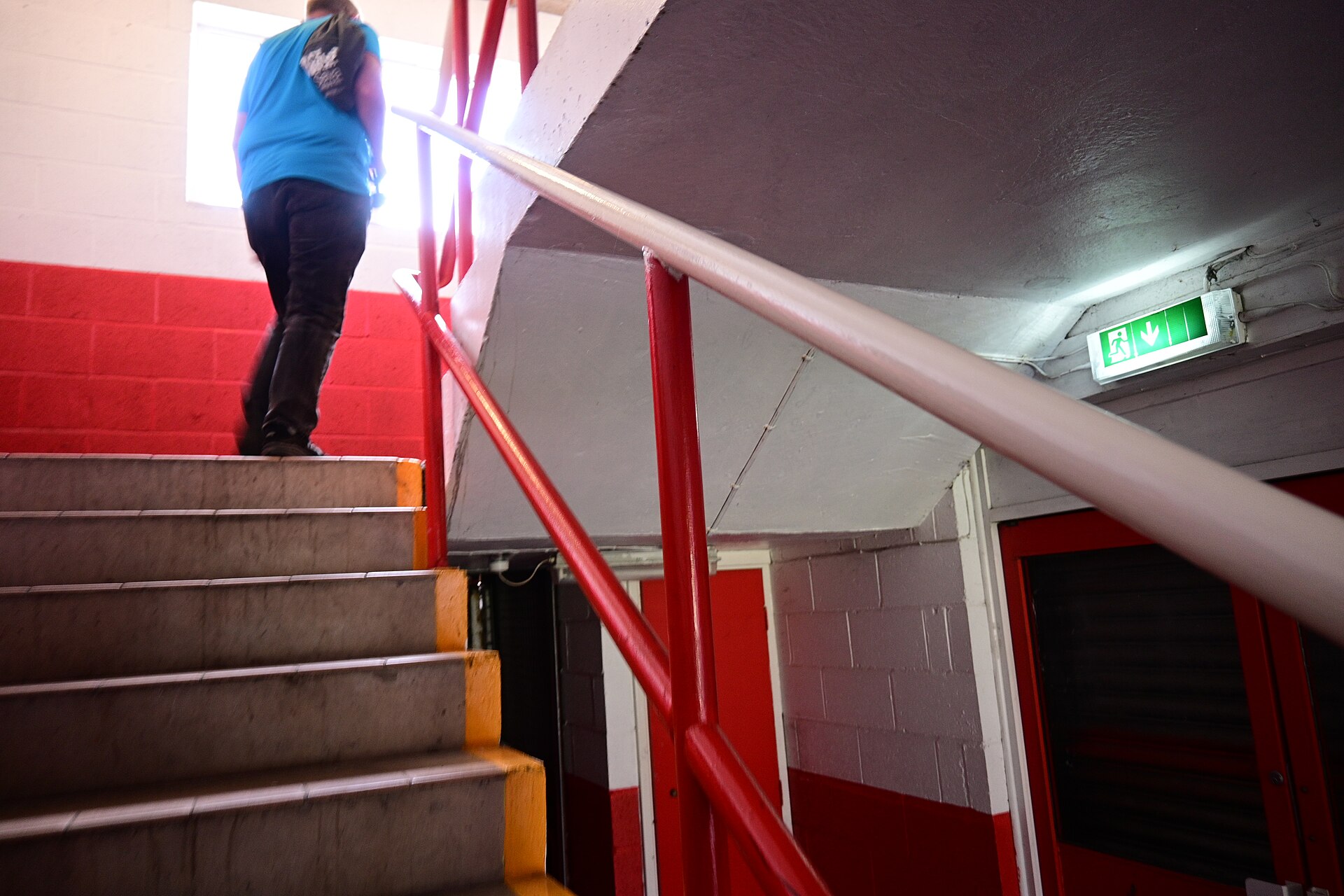
The calculation inspectors return to first is simple in principle: how many people can pass through a given width of exit route in the time allowed for clearing that section in an emergency. Regulations generally work from a clearance time in the range of a few minutes, and the exit width of every stairwell, gangway, gate and turnstile bank feeding a section is measured and totalled against that time.
A narrow point anywhere along the route becomes the number for the whole section behind it, no matter how wide the route is everywhere else. A stairwell that opens into a broad concourse and then funnels through a single narrow gate to the street is only as good, for capacity purposes, as that gate.
This is also why a renovation that adds seats without touching the exit routes behind them so often produces a certified capacity lower than the seat count suggests. The extra rows increase the number of people who need to leave through the same stairwells in the same time, and unless the exits were widened to match, the section is licensed for fewer than the seats installed.
Segregation lines eat capacity that turnstile counts don’t show
Segregation, the physical and stewarded separation of rival supporter groups, is not free in capacity terms. A fenced or stewarded buffer zone between two sections is space that cannot be sold, and the routes on either side of it have to be capable of clearing independently, without spectators crossing into the buffer to reach an exit that belongs to the other side.
High-demand fixtures where segregation is tightened, rather than relaxed, are the ones most likely to run under a ground’s normal certified number, because the buffer grows and the exit routes available to each side shrink relative to a low-tension fixture where a single shared concourse can be used more freely.
A ground’s normal certificate usually assumes a baseline segregation plan. Where a fixture requires an enhanced plan, the local safety advisory group can require a reduced capacity for that specific match, which is one of the more common reasons attendance is capped below the number printed on the certificate for the season as a whole.
Lighting and the emergency scenario nobody wants to run
Emergency lighting is assessed against a scenario that never happens on a normal matchday: the main supply fails at the point of maximum crowd movement, and the ground has to be cleared without it. Inspectors check that emergency lighting covers every exit route independently of the main supply, that it activates automatically rather than requiring a manual switch, and that it holds long enough to clear the section it serves.
A route that is perfectly adequate under normal floodlighting can fail this test if the emergency lighting along it is patchy, under-specified for its length, or dependent on a single circuit that the same fault could take out. Where that happens, the certificate treats the route as unusable for capacity purposes even though it works fine every single matchday the lights don’t fail.
This is a case where the number being tested for is deliberately the worst case, not the typical one, because a certificate that only accounted for typical conditions would tell a club nothing useful about the one night it actually matters.
Medical provision scales with attendance, not with the fixture
The medical and first-aid cover required for a ground is set against expected attendance, not against the perceived importance or physicality of the fixture, and it scales in steps rather than smoothly. Crossing an attendance threshold can require an additional ambulance on site, a larger first-aid room, or a set number of qualified responders per thousand spectators, and a club that has not arranged the higher tier of cover cannot simply sell tickets up to it.
This provision is checked as part of the same certification process as the physical structure, because from a safety planning standpoint the two are the same question: what does this ground need in order to handle this many people safely, structurally and medically, for the whole duration of the event including the period after the final whistle when a crowd is still leaving.
The control room is where the certificate becomes a live decision
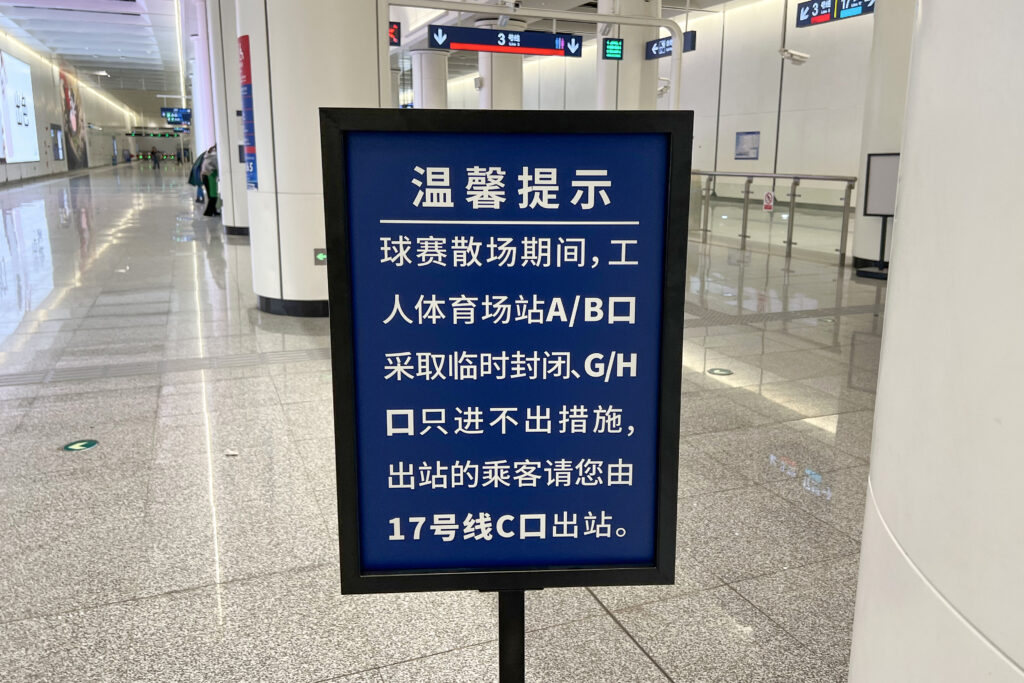
Every certified ground above a given size operates a control room with a direct view, by camera or by position, of every section, along with radio contact to stewards and a working relationship with the police commander on duty for the match. The certificate specifies minimum staffing and equipment for this room, because it is the point where a developing problem, a blocked stairwell, a crush building at one gate, a fault in the emergency lighting, is supposed to be caught before it becomes an incident.
An inspection tests this function directly, sometimes by requiring the club to demonstrate a response to a simulated problem rather than simply showing that the room exists and is staffed. A control room with the right headcount on paper but no rehearsed procedure for closing a turnstile bank mid-match is treated as a live gap, not a technicality.
Why stadium safety certificate capacity is not the same as seating capacity
The gap between stadium safety certificate capacity and the number of physical seats installed is the sum of every constraint above, and it is rarely a small number. A ground can lose several percent of its seat count to exit widths alone, more again to segregation on a high-tension fixture, and further headroom to whichever single constraint, lighting, medical cover, control room staffing, happens to be weakest that week.
Clubs sometimes quote the seat count publicly because it is the larger and more flattering number, but the certificate is what governs the turnstiles on the day, and a mismatch between the two is not a paperwork curiosity. Selling above the certified figure, even where seats physically exist, is the kind of breach that a safety advisory group can and does act on.
How an inspection actually goes
An inspection is not a single walk-through. It is a sequence of separate checks, usually spread across representatives of fire safety, structural engineering, police and the local authority, each looking at a different failure mode and each able to impose a condition independently of the others.
| Check | Who typically leads it | What a failure does to capacity |
|---|---|---|
| Exit width and clearance time | Fire safety officer | Caps the section behind the narrowest point |
| Structural condition of stands | Structural engineer | Can close a block entirely until repaired |
| Segregation plan | Police commander | Reduces sellable capacity on high-tension fixtures |
| Emergency lighting | Fire safety officer | Treats the affected route as unusable |
| Medical and first-aid cover | Local authority / ambulance service | Sets a hard ceiling on attendance until upgraded |
| Control room and stewarding | Local authority safety officer | Can condition the certificate on higher staffing |
The certificate that results is the intersection of every one of these findings, not an average of them, which is why a ground can pass five checks comfortably and still be capped by the sixth.
What changes a certified number mid-season
A certified capacity is not fixed for the life of the ground. It is reviewed on a routine schedule, typically annually, and it can be revisited outside that schedule after any structural alteration, any incident that raises a question about crowd movement, or any change to the policing or stewarding arrangement a club relies on.
A club that adds temporary seating for a single high-demand fixture, closes a section for renovation, or loses a stewarding contractor between matches can see its certified number move within a season, sometimes with very little public notice, because the certificate follows the physical and operational reality of the ground rather than a headline figure set once and left alone.
What a club does when the number comes back lower than expected
The practical response to a disappointing certified figure is almost always physical or procedural rather than a request to relax the rule. Widening a stairwell, adding a second exit gate, upgrading emergency lighting on a specific route or increasing the contracted first-aid presence are the interventions that actually move the number, because each one addresses the constraint that produced it.
What does not work, and what safety advisory groups are set up specifically to refuse, is treating the certified figure as negotiable through assurance alone. A club that promises to manage a crowd more carefully within an exit route that is physically too narrow is offering a plan that the geometry does not support, and inspectors weigh the geometry, not the promise.
Frequently Asked Questions
Does a bigger stadium always have a higher certified capacity?
Not necessarily. A larger stand with exit routes that were not upgraded to match its extra seats can be certified below a smaller stand with generous, well-lit routes and a wide segregation margin.
Why does capacity sometimes drop for a specific fixture?
Usually because that fixture requires an enhanced segregation plan, which reduces the exit routes available to each group of supporters and can lower the number the ground is allowed to hold that day.
Who has the final say on the certified number?
A local safety advisory group, combining fire, police, structural and medical input, issues the certificate, and any one of those disciplines can impose a condition that lowers the figure.
Can a club sell tickets above its certified capacity if seats are physically available?
No. The certificate, not the seat count, governs how many tickets can be sold, and selling above it is a breach regardless of whether the extra seats exist.
How often is a ground’s safety certificate reviewed?
At least annually as routine practice, with additional reviews triggered by structural changes, incidents, or significant changes to stewarding and policing arrangements.
The seat count tells a supporter how big the ground looks. The exit widths, the segregation plan and the control room staffing tell an inspector how many of those seats can actually be filled, and it is the second number that decides what goes on sale.