


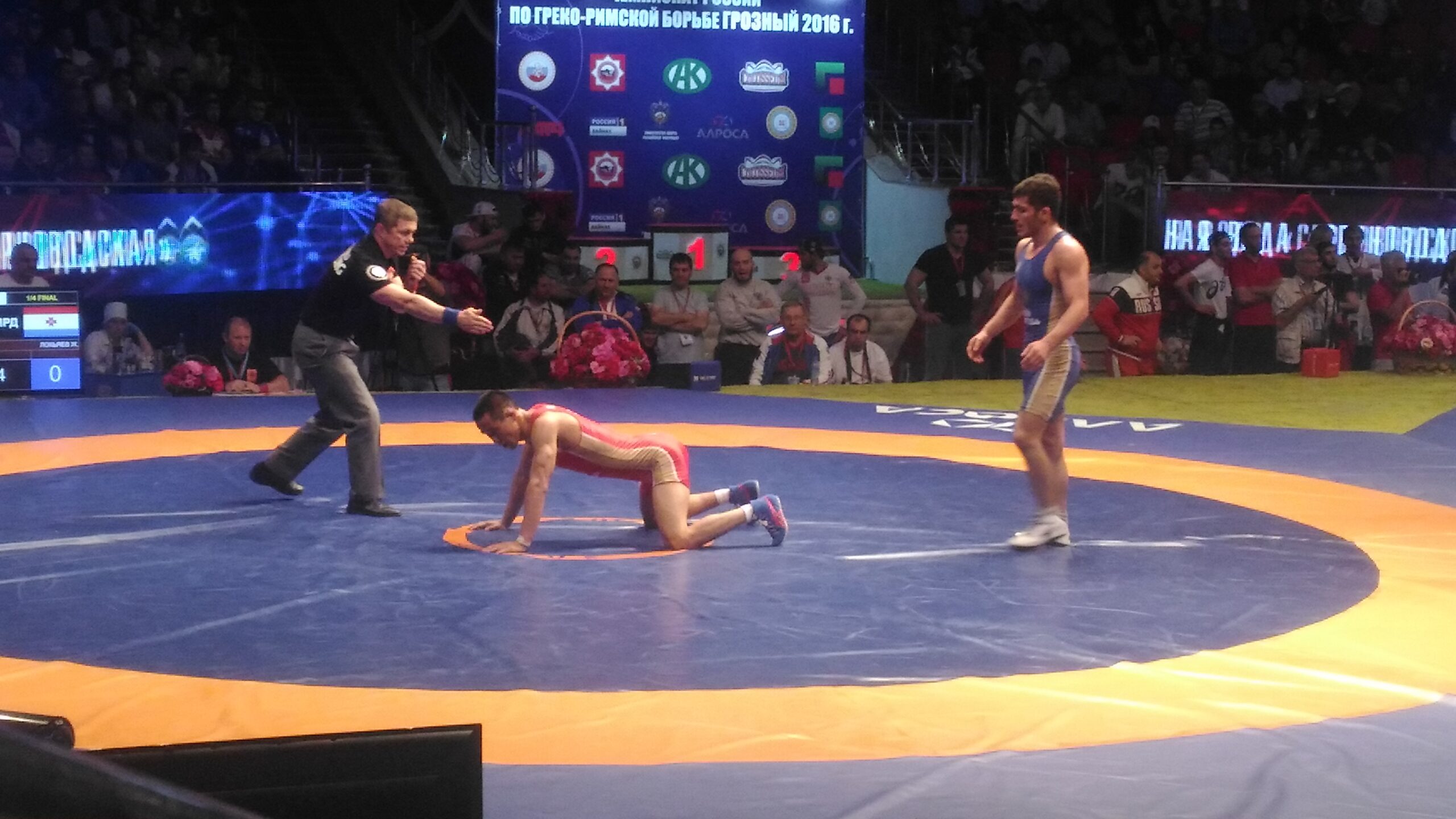
Take one prohibition out of a rulebook and you do not get a variant. You get a different sport with a different body type, a different scoring pattern and a different training week. Greco-Roman forbids any hold below the waist and any use of the legs to attack or defend, and everything else follows from that single line.
Coaches see the consequence in the numbers before they see it anywhere else. Two wrestlers of identical quality produce completely different statistical profiles in the two styles: different action counts, different point sources, different distributions of when in a bout the score moves.
What follows puts the two scoring systems beside each other and works out what the ban actually changes about which attempts are worth making.
The two styles on one page
- The prohibition. Greco-Roman allows no contact below the waist and no use of the legs in an action. Freestyle allows both.
- Where points come from. Freestyle: leg attacks from standing. Greco-Roman: throws from the tie-up and turns on the ground.
- Ground work. Ordered as a penalty in Greco-Roman after passivity. Reached by taking someone down in freestyle.
- Technical superiority. Eight points in Greco-Roman, ten in freestyle.
- Physical profile. Greco-Roman loads the upper back, shoulders and grip. Freestyle loads the hips, hamstrings and change of level.
- Crossing over. Possible at junior level, difficult later. The reflexes are the obstacle, not the technique.
What Greco-Roman scoring rewards that freestyle does not
Greco-Roman scoring is not a reduced version of the freestyle table. The values are largely the same, and the availability is entirely different, which is a more important distinction than it sounds.
A takedown is worth two points in both styles. In freestyle it can be reached with a low attack on a leg, which is a fast, low-risk, highly repeatable action. In Greco-Roman the only way to take an opponent down is through a body lock, an arm drag, a headlock or a throw, all of which require the opponent’s upper body to be committed, and all of which are considerably riskier to attempt.
The result is that Greco-Roman rewards the four and five-point actions disproportionately, not because they are worth more on paper, but because the cheap alternative does not exist. A wrestler who cannot generate points from a tie-up has no fallback, whereas a freestyle wrestler in the same position can still shoot a leg.
The one prohibition that produces every other difference
Removing the legs from the exchange changes the geometry of the contest. In freestyle, the distance between wrestlers is negotiable: one can stay long, out of tie-up range, and threaten with level changes. In Greco-Roman there is no threat at range, so the wrestlers must close, and the bout is fought in contact.
That produces the characteristic Greco-Roman posture: upright, chest to chest, hands fighting for inside position. The tie-up is not a preliminary to the action; it is the action, and a wrestler who wins the hand fight has usually already won the exchange.
It also removes the main defensive tool. A freestyle wrestler defends a leg attack with his legs, sprawling and using his hips. A Greco-Roman wrestler defending a body lock has only his own upper body and his position, which is why balance and hip awareness in a standing clinch are trained so heavily. Beginners’ guides to the differences between styles tend to stop at the rule; the geometry is the part that matters.
Where the points actually come from in each style
In freestyle, the modal scoring action is a two-point takedown initiated from standing with an attack on a leg, followed by whatever the wrestler can add on the mat. Scores climb in twos, several times per period, and a bout can reach double figures without a single spectacular action.
In Greco-Roman, scoring is lumpier. Long stretches produce nothing while the hand fight is contested, and then a sequence produces four, six or eight points at once: a throw, a landing in danger, and a turn or two on the ground before the wrestlers are returned to their feet.
That difference in distribution is why the two codes of Olympic wrestling feel so different to watch and why they need different broadcast conventions. A Greco-Roman bout at nil-nil after two minutes is not necessarily a dull bout; it is a bout in which nobody has yet won the grip that produces everything else.
Par terre: ordered in one style, earned in the other
Ground work exists in both styles and is arrived at completely differently. In freestyle, a wrestler reaches the mat by taking his opponent down, and the position is a consequence of an action he chose.
In Greco-Roman, par terre is also imposed. When a wrestler is penalised for passivity, he is placed on the mat in a defined position and his opponent is given the chance to work from the top. That converts an officiating judgement directly into a scoring opportunity, which is why passivity is a far heavier matter in Greco-Roman than in freestyle.
The top wrestler in that position has a limited window to produce something. If he cannot, the wrestlers return to their feet and the advantage is gone. The result is a specialised skill set built around a single ordered position, with a small number of turning techniques trained to an extremely high standard.
Passivity is handled differently, and it matters more
Freestyle answers passivity with a clock: the passive wrestler is given thirty seconds to score, and if he fails his opponent receives a point. The penalty is one point and an obligation.
Greco-Roman answers it with position. The passive wrestler concedes a point and is put down in par terre, where his opponent can attempt a turn worth two points, and another two after that. The effective cost of a passivity call in Greco-Roman is therefore not one point; it is one point plus whatever the opponent can generate from a position he did not have to earn.
This asymmetry drives Greco-Roman tactics from the first whistle. Wrestlers work visibly to demonstrate activity, contest the grip constantly, and treat the referee’s reading of the bout as a factor to be managed rather than an outcome to be accepted.
The gut wrench has no freestyle equivalent
The turning techniques used from par terre are the technical heart of Greco-Roman. The gut wrench, a body lock around the midsection rolled sideways, is the most common, and a specialist can execute it repeatedly from the same position, taking two points each time.
Freestyle has turns, and they matter, and they do not occupy the same position in the sport. A freestyle wrestler on top has usually just scored a takedown and has a defending opponent underneath who was not placed there. A Greco-Roman wrestler on top after a passivity call has a defined start, a known grip and a rehearsed sequence.
That reliability is why par terre defence is trained as hard as the offence. Denying the first grip is worth more than escaping later, and a wrestler who can be gut-wrenched at will has a structural weakness that no standing ability compensates for. The techniques are visible across the traditional styles too, including in the practice around regional jacket wrestling.
Technical superiority: eight against ten
Greco-Roman ends a bout at an eight-point margin; freestyle waits for ten. The two-point difference sounds trivial and is not, because of how points arrive in each style.
In Greco-Roman, eight points can be a single sequence: a five-point throw and a turn and a half. A wrestler who concedes one good throw and one turn can lose a bout in fifteen seconds having done nothing else wrong. In freestyle, ten points is nearly always four or five separate actions, which takes time and gives the trailing wrestler chances in between.
The strategic consequence is that a Greco-Roman lead is more fragile and more decisive at the same time. Leading by four is not comfortable, because one exchange can end the bout in either direction, and this shapes how a corner instructs a wrestler who is ahead in the second period.
What a wrestler’s statistical profile looks like in each
Count actions rather than points and the two styles separate immediately. A freestyle bout typically contains more scoring actions of lower average value, with most of them initiated from a standing position at range and finished within a couple of seconds.
A Greco-Roman bout typically contains fewer scoring actions of higher average value, with a larger share of the total coming from the ground and a meaningful share arriving as a consequence of a passivity call rather than an attack.
That is why a wrestler’s numbers are not portable between styles. A high takedown rate in freestyle says nothing about whether the same athlete can score in a tie-up, and a strong par terre turn rate in Greco-Roman does not predict anything about defending a leg attack. Comparing them on the same scale produces a confident and meaningless answer.
Body types, grip strength and why crossing over is hard
Physical demands diverge as much as tactical ones. Greco-Roman loads the upper back, the trapezius, the shoulders, the neck and the grip, and rewards a thick torso and a strong lock. Freestyle loads the hips, hamstrings and lower back, and rewards a fast level change and the ability to sprawl.
The training weeks reflect that. Greco-Roman programmes contain a great deal of throwing and lifting work with dummies and partners; freestyle programmes contain far more shot and sprawl repetition and more work on the mat from a scramble.
The genuine obstacle to switching is neither of those. It is reflex. A wrestler with years of freestyle behind him will drop a level under pressure, and in Greco-Roman that is a caution. A Greco-Roman wrestler moved to freestyle will not use his legs defensively because he has spent a decade being penalised for it. Retraining a reflex takes longer than building a technique, which is why crossovers usually happen young or not at all. The competitive record of both styles domestically shows very few athletes doing it late.
Scoring compared, action by action
| Element | Freestyle | Greco-Roman |
|---|---|---|
| Leg attacks | Permitted, and the main scoring route | Prohibited entirely |
| Typical takedown | Two points from a low attack | Two points from a body lock or drag |
| Route to the mat | Earned by a takedown | Earned, or ordered after passivity |
| Passivity penalty | One point after a thirty-second clock | One point plus par terre position |
| Grand amplitude from standing | Five points, uncommon | Five points, a realistic plan |
| Technical superiority | Ten-point margin | Eight-point margin |
| Score pattern | Frequent small increments | Long gaps, then large sequences |
What a coach changes first on a switch
Moving a wrestler between styles starts with posture, not with technique. The freestyle stance is lower and staggered; the Greco-Roman stance is taller and squarer, because there is nothing to defend below the waist and everything to contest above it.
The second change is the hand fight. A Greco-Roman wrestler spends the entire bout fighting for inside position on the arms and head, and that battle has no real freestyle equivalent at the same intensity. It is trained separately, in isolation, before any throw is added.
The third is the ground. A wrestler arriving from freestyle has to learn a defined par terre offence and defence from a fixed starting position, which is closer to a set piece than to open wrestling. Most coaches teach one turn and one defence properly before adding anything else, because a half-learned gut wrench in competition is simply two points for the opponent.
Frequently Asked Questions
Why are leg attacks banned in Greco-Roman?
It is the defining rule of the style rather than a safety measure. Removing everything below the waist forces the contest into the upper body, which is what produces the throws and the tie-up work the style is built around.
Which style is higher scoring?
Freestyle generally produces more scoring actions, because the two-point leg attack is repeatable and low risk. Greco-Roman produces fewer actions of higher average value, so a bout can be low scoring for four minutes and finish in double figures.
What is par terre and why does it matter more in Greco-Roman?
It is the ground position. In Greco-Roman it can be ordered as a penalty for passivity, handing the opponent a rehearsed scoring opportunity he did not have to earn, which makes a passivity call much more expensive than the single point suggests.
Why does Greco-Roman end at eight points and freestyle at ten?
Because points arrive in larger blocks. In Greco-Roman a throw plus a turn or two can reach eight in one sequence, so the lower threshold keeps the margin comparable in practice to ten points accumulated in twos.
Can a wrestler compete seriously in both styles?
Some do at junior level, where reflexes are still forming. Later it becomes rare, because the defensive habits conflict directly: dropping a level is correct in one style and penalised in the other, and habits of that kind are slow to rewrite.
The rule looks like a restriction and functions as a design decision. Take away the legs and you have not made wrestling smaller; you have moved the whole contest upward into a grip nobody can see from the stands.