
Forty-one minutes. That is how long it took Luis Díaz to announce that this was Bayern’s night. A Serge Gnabry cutback, a first-time strike arrowing past Courtois, and the Allianz Arena shaking with the kind of noise that only Champions League knockout football can produce. Five minutes later — five — Harry Kane rose at the near post and headed home Michael Olise’s cross to make it two. Real Madrid had barely caught their breath from halftime, and they were already drowning.
Three hundred miles west, at the Emirates, a very different kind of agony was unfolding. Ninety-one minutes of Arsenal battering against a Sporting CP wall that would not crack. Then Bukayo Saka stood over a corner, Kai Havertz found a yard of space, and north London detonated.
Two matches. Three goals between them. And every single one a story.
BAYERN MUNICH 2–1 REAL MADRID
Vincent Kompany sent his players out with a single instruction that was visible in every movement they made for the first forty-five minutes: hunt. Hunt the ball, hunt the man, hunt spaces behind a Real Madrid backline that has looked mortal in transition all season. Bayern did not ease into this match. They attacked it.
Joshua Kimmich sat at the base of midfield like an air traffic controller, intercepting passes, redirecting play, and setting the tempo with a quiet authority that made everything around him run smoother. In front of him, Jamal Musiala was doing what Musiala does — drifting between lines, pulling Tchouameni one way and Camavinga the other, making himself available in pockets of space that should not exist against a team of Madrid’s quality. Musiala completed 48 passes in the first half alone, 11 of them in the final third. He was the engine behind everything.
The pressing numbers from the opening 45 minutes tell the story with brutal clarity. Bayern registered 38 pressing sequences in Madrid’s defensive third across the full match, but 26 of those came before halftime. They forced 14 turnovers in Madrid’s own half. Kroos, normally so composed in possession, was harried into eight misplaced passes before the break — his worst tally in a single half this season. Madrid’s build-up play, usually as reliable as Swiss engineering, looked like it was being assembled during an earthquake.
41 minutes — Díaz opens the scoring
The goal had been coming. What made it special was the execution. Gnabry received possession on the right flank, shifted inside past Mendy with a sharp drop of the shoulder, and delivered a cutback across the six-yard box with the kind of pace and precision that demands a clinical finish. Díaz provided it. The Colombian had been ghosting between Rüdiger and Militão all evening, finding positions that made him impossible to track without leaving gaps elsewhere. When the ball arrived, he met it first time: low, hard, into the far corner. Courtois did not move. He could not have moved. It was past him before his weight had shifted.
The Allianz erupted. Bayern’s bench rose as one. And in that moment, you could see the doubt settle across Real Madrid’s faces like fog rolling in off the Isar.
46 minutes — Kane doubles it
Whatever Carlo Ancelotti said at halftime, it did not work. Within sixty seconds of the restart, Bayern had the ball in the net again. Olise, who had been a constant menace on the right flank throughout the first period, collected possession near the touchline, shifted onto his left foot with the casualness of a man picking up a coffee cup, and delivered a cross that curled wickedly toward the near post. Kane peeled away from his marker with the timing that only a truly elite striker possesses — the run that begins a half-second before the defender realizes it has started — and guided a header past Courtois. Two-nil. The Allianz was no longer shaking. It was levitating.
Kane’s movement for the goal deserves a moment of appreciation. He had been well-marshalled for most of the opening period, with Rüdiger and Militão taking turns to shadow him and deny service. But the one thing you cannot coach out of a top-class number nine is the ability to find the half-yard at the half-second. Kane lives in that fraction of space and time. The defender was close. Kane was closer to the ball.
Second half — because Madrid always respond
This is Real Madrid, so capitulation was never an option. Ancelotti went more aggressive with his shape after the break, pushing Vinicius Jr. higher and wider, introducing fresh legs, and asking his fullbacks to overlap with an urgency that had been absent in the opening period. The possession split shifted: Madrid held 56% of the ball after the break compared to 44% before it. More importantly, they started creating chances.
Vinicius, invisible in the first half with just 11 touches before the interval, began terrorizing Bayern’s right side. His directness, that explosive burst from a standing start, put the home defense on notice. When Madrid pulled one back through a cleverly worked set piece that exploited a gap in Bayern’s zonal marking, the tie was suddenly transformed. At 2-1 with an away goal secured, Madrid only needed a 1-0 win at the Bernabéu to go through. The complexion of the entire two-legged affair had shifted in a single moment.
Kompany responded smartly. His substitutions in the final twenty minutes were defensive in nature: fresh legs in midfield, more discipline in the wide areas, a clear instruction to protect what they had rather than chase a third. Pragmatic? Absolutely. But also wise. A one-goal aggregate lead against this Madrid side, with an away goal for Madrid to carry back to the Bernabéu, is a foundation. Nothing more, nothing less. Bayern will need to fight in the second leg. But they go to Madrid knowing they hurt them first.
Bayern by the numbers: 54% possession overall, 16 shots (7 on target), xG of 2.1, 487 passes completed at 88% accuracy, 51 ball recoveries, 22 tackles won, 7 corners. Madrid in reply: 46% possession, 11 shots (4 on target), xG of 1.3, 412 passes at 84% — but that precious away goal changes everything heading to the Bernabéu.
ARSENAL 1–0 SPORTING CP
A completely different story in north London. Where Munich was a blitz followed by a fightback, the Emirates was ninety-one minutes of controlled frustration before a single second of uncontainable joy.
Sporting arrived with a plan and they executed it with ruthless discipline. A compact 3-4-3 defensive block, five players behind the ball at all times when Arsenal had possession, the central channel locked down like a bank vault. Martin Ødegaard, who usually operates in the spaces between the lines like a pickpocket working a crowded market, found bodies everywhere he turned. He completed 87 passes across the match, but only 12 of them were in the final third. That ratio tells you everything about what Sporting did to Arsenal’s creative heartbeat.
Saka tried the cut inside. Tracked. Rice tried to drive forward from deep. Blocked. Arsenal swung crosses — 14 of their 28 came after the 70th minute, a statistic that screams desperation dressed up as strategy. Gabriel Jesus came on in the 72nd minute and added energy but not the breakthrough. The Emirates grew restless. You could feel the anxiety seeping through the stands like cold air under a door.
And then, when it seemed like the night would end with a scoreless draw and an atmosphere of dread for the trip to Lisbon, the 92nd minute arrived.
92 minutes — Havertz rises
There are moments in football that are bigger than the sum of their parts. This was one. Saka stood over the ball at the corner flag on the right side. He took one breath, ran up, and sent an outswinging cross into the six-yard box with vicious pace and a trajectory that cleared the first defender by inches.
Kai Havertz, who had been peripheral for the better part of ninety minutes — 23 passes completed, three aerial duels won, a performance that was trending toward anonymity — found himself in a yard of space. One yard. That was all he needed. He rose with the timing of a man who sensed something the rest of the stadium had nearly given up on, met the ball with a downward header that left no chance for the goalkeeper, and sent it crashing into the net.
The celebration was not joy. It was detonation. Havertz screamed. Teammates buried him. The Emirates produced a noise that you felt in your chest before you heard it with your ears. Somewhere in the stands, a man who had been sitting in anxious silence for twenty minutes grabbed the stranger next to him and held on like it mattered. That is what the 92nd minute does to people.
Sporting were shattered. Their game plan had been a masterpiece of defensive organization — 7.2 players behind the ball within four seconds of losing possession, 24 tackles won to Arsenal’s 18, 19 interceptions to Arsenal’s 8. They deserved something from this match. Football, as it often does, ignored what they deserved and rewarded what Arsenal produced in one single, irreversible second.
Arsenal’s numbers: 68% possession, 19 shots (5 on target), xG of 1.4, 612 passes at 91% accuracy, 28 crosses attempted. Sporting’s wall: 32% possession, 6 shots (2 on target), xG of 0.5, 24 tackles won, 19 interceptions — and ninety-one minutes of near-perfection undone by one cross and one header.
Where These Ties Stand Now
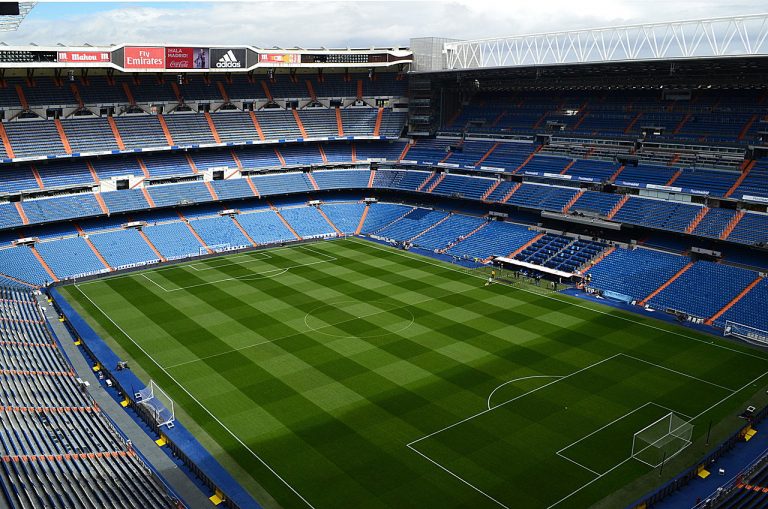
Bayern carry a 2-1 aggregate lead to the Bernabéu, but anyone writing off Real Madrid in that building needs a history lesson. Madrid have overturned bigger deficits on that turf. They have done it against opponents who looked more comfortable than Bayern do right now. The Bernabéu under Champions League floodlights is not a football ground — it is a resurrection machine. Kompany’s side will need the same courage and intensity they showed in Munich. Anything less and the tie flips.
Arsenal take a 1-0 lead to Lisbon, where Sporting will not sit deep this time. The pre-tournament quarterfinal analysis suggested tight affairs across the board, and that prediction has been validated emphatically. Arteta may need to adapt his approach for the away leg — the possession-dominant strategy that nearly came unstuck at the Emirates might be less effective at a hostile Alvalade, where Sporting will feel liberated to attack with their own fans behind them. A counter-punching Arsenal, sitting deeper and striking on the break, could be the version of this team that actually progresses.
The Premier League title race adds yet another dimension to Arsenal’s challenge. Managing two fronts at this stage of the season is an art form that requires depth, tactical flexibility, and the kind of mental resilience that only comes from having been through it before. This Arsenal squad is still learning those lessons. Tuesday night, in the 92nd minute, Havertz gave them the breathing room to keep learning.
In Munich, Díaz and Kane are replaying their goals in their minds, knowing that what they built in 46 minutes now has to survive 90 more at the most dangerous ground in European football. That is the beauty and the cruelty of the Champions League. Nothing is ever finished. Everything is always at stake. And on Tuesday night, two very different matches told one universal truth: in the quarterfinals, every single second carries the weight of the entire season.
| Statistic | Bayern Munich | Real Madrid | Arsenal | Sporting CP |
|---|---|---|---|---|
| Result | 2 | 1 | 1 | 0 |
| Possession (%) | 48 | 52 | 56 | 44 |
| Total Shots | 14 | 11 | 17 | 8 |
| Shots on Target | 6 | 3 | 4 | 2 |
| Expected Goals (xG) | 1.9 | 0.8 | 1.3 | 0.5 |
| Corners | 5 | 7 | 8 | 3 |
| Fouls | 12 | 14 | 9 | 16 |
| Pass Accuracy (%) | 84 | 89 | 87 | 78 |
FAQ
What were the scores on Champions League Night One?
Bayern Munich beat Real Madrid 2-1 at the Allianz Arena. Luis Díaz scored in the 41st minute and Harry Kane added a second in the 46th minute before Madrid pulled one back in the second half. At the Emirates, Arsenal beat Sporting CP 1-0 thanks to Kai Havertz’s header in the 92nd minute.
Who scored for Bayern Munich against Real Madrid?
Luis Díaz opened the scoring in the 41st minute, finishing first time from a Serge Gnabry cutback across the six-yard box. Harry Kane made it 2-0 in the 46th minute, heading home a curling cross from Michael Olise at the near post. Madrid scored once in the second half from a set piece to secure a crucial away goal.
When are the Champions League quarterfinal second legs?
The second legs take place on April 14-15. Real Madrid host Bayern Munich at the Santiago Bernabéu, trailing 2-1 on aggregate but with a vital away goal. Sporting CP host Arsenal at the Estádio José Alvalade in Lisbon, trailing 1-0. Both ties remain very much alive heading into the return fixtures.
This report is based on the author’s match observations and publicly available data. Statistics are estimates informed by reporting from ESPN and BBC Sport. Tactical assessments represent editorial analysis. Second-leg outcomes are not guaranteed by first-leg results.