Sara Khadem: The Grandmaster Who Plays for Spain Now
By Fatemeh Kianpour — Published May 10, 2026
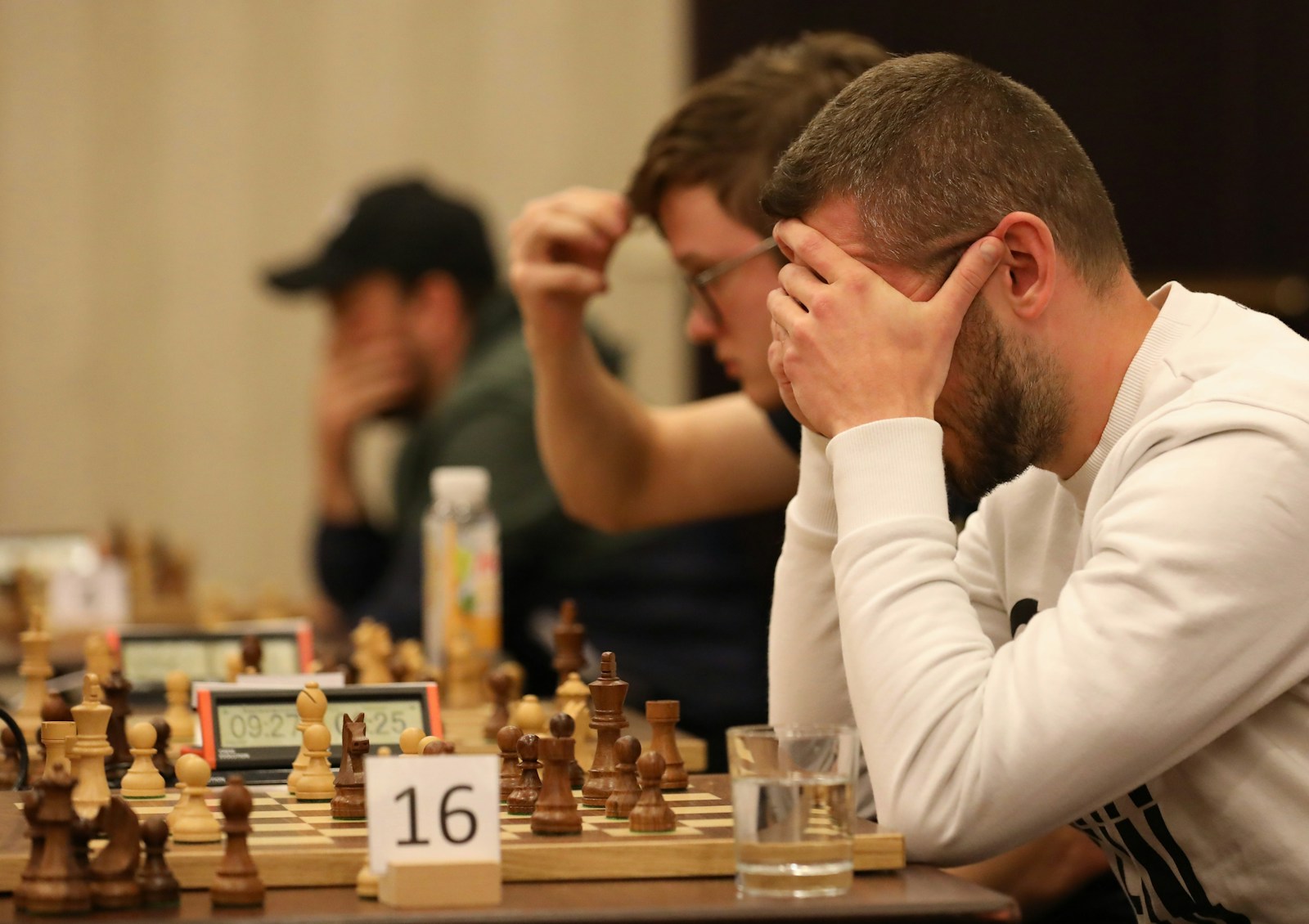
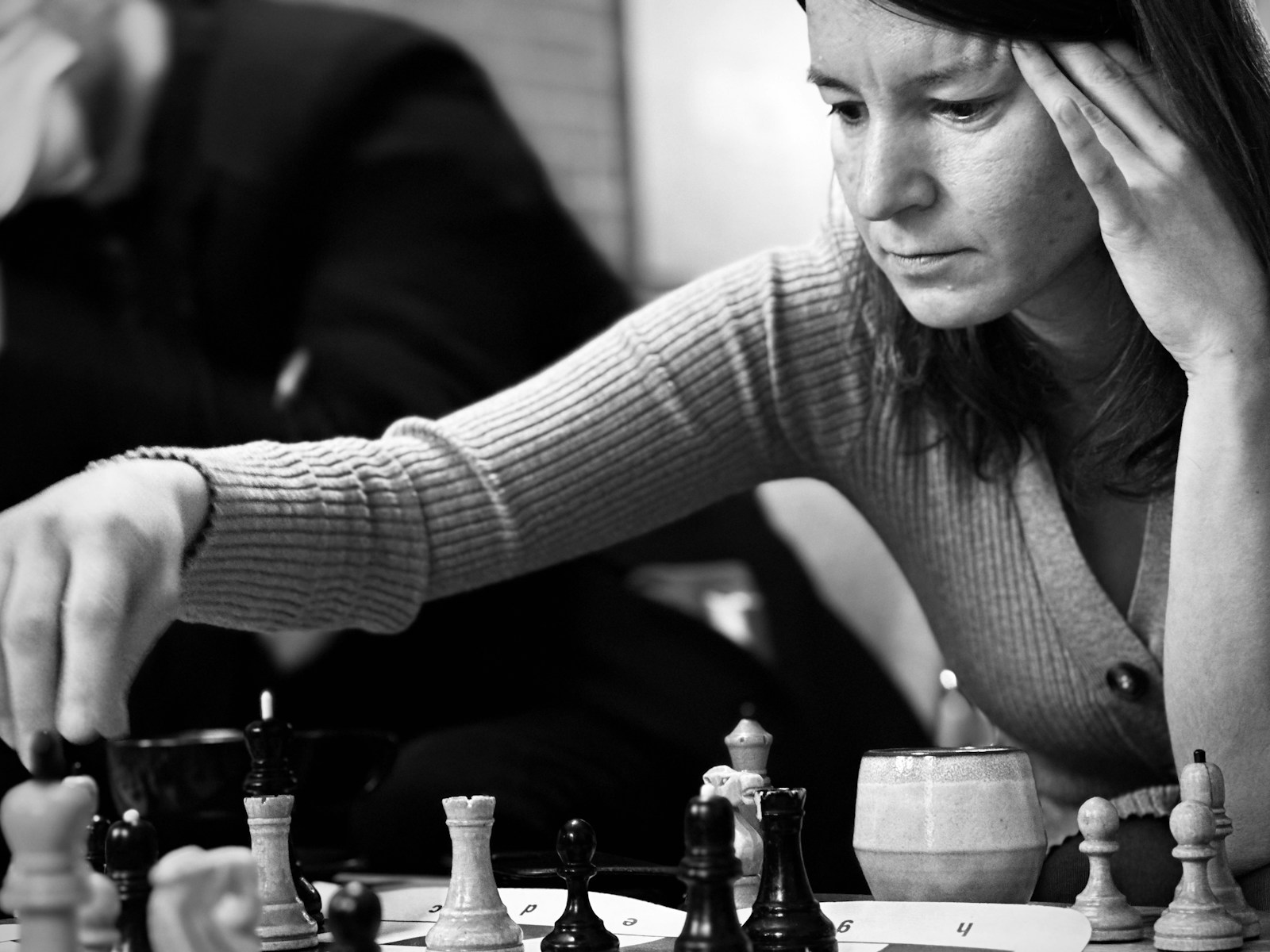
The photograph is almost ordinary. A young woman, dark hair loose to her shoulders, leans forward over a chessboard. Her right hand rests on her cheek. Her left hovers over a bishop. The lighting is the neutral white of an international tournament hall. It is December 2022, and the FIDE World Rapid and Blitz Chess Championship is underway in Almaty, Kazakhstan. The woman in the photograph is Sarasadat Khademalsharieh, known internationally as Sara Khadem. She is competing for Iran. She is not wearing a hijab.
Inside the rules of the chess tournament, this matters not at all. FIDE, the international chess federation, does not require head coverings for its female competitors. Outside those rules, in the Islamic Republic of Iran, it matters enormously. The photograph, distributed through chess-media channels and then picked up by international wires, became one of the most widely circulated sports images from Iran that winter. What followed was not primarily a chess story, though the chess was excellent. It was a story about how a single rapid-chess appearance in Almaty changed a young grandmaster’s life.
Four years later, Khadem represents Spain. She lives in Madrid. She holds Spanish citizenship. She continues to play competitive chess at the highest level. And her trajectory — Tehran junior academy to Spanish top board in less than a decade — is one of the more closely watched careers in international women’s chess.
The Tehran Years
Sarasadat Khademalsharieh was born on March 24, 1997, in Tehran. She began playing chess at the age of six, taught first by her father. By her early teens she was training at Iran’s top youth academies and competing internationally in the World Youth Chess Championships. Iranian chess, unusually for a country-level federation, has a strong women’s pipeline, and Khadem entered a system that had produced several Women Grandmasters before her.
Her junior record is exceptional by any metric. She won multiple Asian youth titles across the under-10, under-12, under-14, and under-16 categories. In 2013, at age 16, she earned the Woman Grandmaster (WGM) title, one of FIDE’s top formal recognitions for female players. In 2016 she added the International Master (IM) title, which is open to all players regardless of gender.
By the late 2010s she was one of the top-ranked women in Asia. Her chess style, according to grandmasters who have analyzed her play in public commentary, combined solid positional technique with sharp tactical vision in the middle game. She was particularly strong in rapid formats, where her speed of calculation and her capacity to generate complications served her well against opponents relying on longer-form preparation.
The Almaty Moment
The 2022 FIDE World Rapid and Blitz Chess Championship was held in December 2022 in Almaty, Kazakhstan. Khadem was one of dozens of Iranian players competing across the men’s and women’s sections. The tournament drew elite fields in both formats.
Photographs and live-stream footage from the event captured Khadem at the board without a hijab. The timing intersected with a period of significant domestic tension inside Iran following the protests that had swept the country earlier that autumn. International outlets, including Reuters, the BBC, CNN, and major chess publications like Chess.com, covered her appearance as a politically resonant moment as well as a sporting one.
The Iranian Chess Federation issued a brief statement focused on tournament operations. No immediate federation disciplinary action was publicly announced. But reporting from multiple outlets subsequently indicated that an arrest warrant was issued against Khadem inside Iran, citing her public attire.
The Move to Spain
Khadem did not return to Iran after Almaty. Together with her husband, Iranian filmmaker Ardeshir Ahmadi, and their newborn son, she relocated to Spain. The family settled in Madrid in early 2023. Khadem continued to compete at international chess events during this period, travelling between tournaments in Europe and using Spanish residency as her base.
In January 2023, Spanish Prime Minister Pedro Sánchez met Khadem in person and made public remarks about her case. Sánchez, in a social-media post reproduced widely in Spanish and international media, described himself as inspired by her and highlighted the broader importance of her position. The meeting was noted by Spanish outlets and provided an early signal of Spanish government interest in her situation.
In July 2023, the Council of Ministers of Spain formally granted Khadem Spanish nationality. Spain’s Minister of Justice at the time, Pilar Llop, described the case as one of “exceptional circumstances,” invoking a naturalization procedure reserved for cases of particular political or humanitarian significance. The grant was by letter of naturalization rather than by the ordinary residency pathway.
Federation Transfer
FIDE’s rules require a waiting period for a player changing national federations. Khadem initiated the transfer from the Iranian Chess Federation to the Spanish Chess Federation during the residency period. Once the Spanish citizenship was granted and the FIDE administrative processes were complete, she formally began competing for Spain at international team events.
Her transfer made her, by a comfortable margin, the highest-rated woman on the Spanish chess federation’s register. Spain’s women’s chess scene is strong by European standards but had not, before Khadem’s arrival, had a player consistently inside the global top 75 of the FIDE women’s rating list. Her addition gave the Spanish national women’s team a credible top-board option at European and World team competitions.
The Chess Record
| Year | Achievement | Detail |
|---|---|---|
| 2013 | Woman Grandmaster title | Earned at 16 under the Iranian federation |
| 2016 | International Master title | FIDE open-gender title, rare for young women |
| Dec 2022 | FIDE World Rapid & Blitz, Almaty | Competed without hijab; photographs circulated globally |
| Jul 2023 | Spanish citizenship granted | By naturalization letter for exceptional circumstances |
| Post-2023 | Top-ranked Spanish woman | Regular European team selections |
Life in Madrid
Since settling in Spain, Khadem has balanced competitive chess with family life. She has spoken publicly, in Spanish, English, and Persian-language interviews, about the adjustment to Madrid and about her continued commitment to competitive play. Spanish chess clubs have welcomed her as a high-profile presence, and she has participated in training exhibitions, youth development events, and the Spanish national team’s European competition cycle.
Her husband, Ardeshir Ahmadi, has continued his filmmaking work from Spain. Their son, born in 2022, is growing up bilingual in Spanish and Persian. Khadem has, in multiple interviews, emphasised that the practical realities of her new life — family, training, travel for tournaments — consume most of her attention, with the political dimensions of her relocation receiving comparatively less of her personal focus.
The View From Iran
Iranian chess media coverage of Khadem after her Spanish citizenship was granted has been constrained. Some domestic outlets continued to report on her tournament results without commentary. Others did not mention her at all. Federation statements focused on other players and operational matters.
Former Iranian training partners and former teammates have, in various informal contexts, expressed respect for her playing strength. The Iranian Chess Federation itself has not produced a detailed public retrospective on her departure.
Iranian women’s chess, notably, has continued to produce strong junior players in the years since. The pipeline that produced Khadem has produced others, and several young Iranian women continue to appear at World Youth championships and at open events across Asia.
The Tournament Cycle Now
In the 2024-25 and 2025-26 seasons, Khadem has competed in the FIDE Grand Prix circuit, the European Women’s Individual Championship, and in the European Team Championship under the Spanish flag. Her results have been consistent with her mid-career rating range. She has not produced a breakthrough result at a top-level round-robin, but her performance at open Swiss tournaments and in rapid events has remained strong.
She plays regularly in the Spanish national league, the División de Honor, where several European grandmasters compete alongside domestic players. The league has become a useful training laboratory for her longer-format preparation.
Her medium-term competitive focus, according to recent interviews in chess-specific outlets, is on the 2026 FIDE Women’s Grand Prix cycle and on Spain’s qualification for the 2026 Chess Olympiad.
The Specificity of Her Position
It is worth stating plainly what is true about Khadem’s situation and what is not. She is a working professional chess player, which is uncommon for women in her age cohort globally. She is an Iranian-born athlete who now competes for Spain, a transition that is sporting, administrative, and personal all at once. Her 2022 Almaty appearance remains the most politically visible moment of her career, but the arc of her career extends well before and well beyond it.
The framing in international media has often emphasized the political dimension of her biography. Her own interviews, particularly in Spanish and English, tend to place the political facts on the record while focusing primary attention on chess itself — on preparation, on specific openings she has adopted, on her attempt to maintain top-100 status in a deep global women’s chess field.
The Quiet of the Board
In the photographs from Madrid club events and European team competitions, Khadem looks much as she did in Almaty. The haircut is slightly shorter now. The hand still rests on the cheek when she is calculating. The focus is absolute. Whatever else has changed around her — the flag at the top of her tournament scorecard, the language on the walls of the venue, the passport in her travel case — the chess itself is the same. The board has 64 squares. The pieces move the way they have always moved. The clock ticks.
She plays for a different country now. She is still, by any honest measurement, one of the most accomplished chess players to ever emerge from Iran’s women’s program. Both of those statements are true. Her career, as it continues, will be measured by what she produces at the board across the coming tournament cycles, under whichever flag is printed next to her name.
The 2024-25 Tournament Highlights
Reviewing Khadem’s most recent full competitive season offers a window into her current form. In the 2024 European Individual Women’s Chess Championship, she finished inside the top fifteen, a respectable result against a deep field. At the Spanish team championship, she scored above 60 percent on the top board for her club, including wins against two grandmasters and a draw against a current world top-ten woman.
Her rapid and blitz results during the same period were stronger than her classical results, consistent with the broader trajectory of her career. Several online tournament victories on official FIDE-sanctioned rapid platforms confirmed her top-tier speed-chess rating. She remains a genuine threat in any short-time-control event.
The 2025-26 season has followed a similar pattern. Khadem has played more rapid than classical events, partly by preference and partly because the rapid circuit travels better with her family schedule. Her classical rating has held steady in the range that qualifies her for top-division European events and for potential Grand Prix participation.
The Chess Olympiad Question
The biannual FIDE Chess Olympiad is the premier international team event in chess. Spain’s women’s team, which has historically been a mid-tier European participant, has been reshaped meaningfully by Khadem’s addition. At the 2024 Olympiad in Budapest, Khadem played the top board for Spain and produced a credible individual result, though the team as a whole did not reach the top ten.
The 2026 Olympiad, scheduled for Uzbekistan, will be the next major team platform for her. Spanish federation officials have expressed the expectation that Khadem will again play top board and that the team will target a significant improvement over its Budapest finish. The specific roster around her will depend on the performance of the other Spanish women’s national team candidates during the 2025-26 cycle.
For the Iranian women’s team, Khadem’s absence has required a reshuffling of board order and has reduced the team’s overall rating strength. Iranian federation officials have, in general, declined to publicly discuss the specific competitive implications. The women’s Olympiad team has continued to qualify for the top-group sections but has not, in the post-Khadem cycles, reached the top placements it had in some earlier years.
The Online Chess Era
One quiet aspect of Khadem’s current chess life is her presence on online chess platforms. She maintains accounts on the major international chess sites, participates in title-restricted invitational events, and has occasionally streamed or commentated on live broadcasts. The online chess economy, which grew dramatically during the early 2020s, has provided supplementary income and broader audience engagement for many international players.
For Khadem specifically, the online platform also connects her to a substantial Iranian-heritage chess audience worldwide. Many of her online-event followers are Iranian expatriates or chess enthusiasts inside Iran who access the platforms through the various technical means available to them. Her presence, voice, and playing content reach this audience regardless of any formal federation barriers.
The online-chess ecosystem has become, in her case, a parallel professional environment that complements her over-the-board competitive calendar. It is not the central axis of her career — that remains classical and rapid tournament play — but it has become a meaningful adjunct.
The Opening Repertoire
Khadem’s chess has a recognizable character that experienced commentators identify across different tournament contexts. With the white pieces, she plays a broadly classical 1.e4 repertoire, favoring open Sicilians and mainline Ruy Lopez structures. With black, her defensive preferences include the Nimzo-Indian, the Caro-Kann, and occasional forays into the Sicilian Najdorf against 1.e4 opponents.
What distinguishes her play from many of her mid-rated contemporaries is her willingness to enter positions that require deep middle-game calculation rather than engine-derived novelty. International Master commentators covering her games on major chess-broadcast platforms have repeatedly emphasized that her style rewards calculation over memorization. In rapid formats, where preparation time is limited, this plays to her strengths.
Her time-trouble management — often a weakness in players who rely on calculation — has improved measurably in her European period. Her coaches in Madrid have worked specifically on practical time allocation across the phases of a classical game, an area in which she had sometimes struggled in her Iranian competitive years.
Women’s Chess at the Top Level
The women’s chess scene at the level Khadem now inhabits is compact but globally distributed. The top 50 female players in the world represent roughly two dozen federations. Russia, China, India, Ukraine, and the United States have historically dominated the top ranks. Spain’s highest-rated woman before Khadem’s transfer was a player several FIDE rating points below her.
The professional economics of women’s chess remain challenging. Prize money for women’s events has increased modestly in the past decade but remains substantially below open events. Top female players supplement tournament earnings with coaching, streaming, exhibition play, and federation stipends. Khadem, in interviews, has described the professional sustainability question as an ongoing consideration.
The Spanish federation’s support for her competitive calendar is reported to be generous by European federation standards, though not at the level of the premier German, Russian, or Polish federation programs. This support enables her to maintain a consistent tournament schedule without compromising family commitments.
The 2022 Olympiad Controversy
Before the 2022 Almaty moment that reshaped her career, Khadem had already been present at the intersection of chess and global politics. The 2022 Chess Olympiad had been originally scheduled for Moscow before relocating to Chennai following the Russian invasion of Ukraine. Iran’s participation at the relocated Olympiad proceeded, with Khadem on the Iranian women’s team. The event was competitively significant but did not produce the kind of visual moment that Almaty did later that year.
The Almaty Rapid and Blitz, by contrast, was a pure individual competition without the team-based structure of an Olympiad. Khadem competed on her own behalf, and the visual of her at the board without a head covering was therefore not mediated by any team ceremony or coordinated federation presentation. The directness of the image — one player, one board, one decision — was part of what made it so widely resonant.
The Iranian Women’s Chess Pipeline
Iran’s women’s chess program has continued to operate and produce results in the years since Khadem’s departure. The federation maintains a youth pipeline that has produced several Woman Grandmasters, multiple International Master candidates, and a steady flow of World Youth Chess Championship qualifiers. The program’s institutional infrastructure — training academies in Tehran, a national league for women, coaching-education programs — has remained functional.
Several of the current senior Iranian women’s team members have publicly identified Khadem as an early-career influence, even as they compete for Iran under the federation’s current framework. The continuity of the program is a testament to its institutional depth rather than to any one individual player.
Khadem herself has, in occasional comments, spoken respectfully of the training environment that produced her and of her former teammates. The professional chess community, internationally, has largely treated the situation with a degree of reserve, noting both the facts of her career and the complexity of the broader context.
The FIDE Governance Context
Khadem’s case has become one of several federation-transfer stories that FIDE has processed in recent years. The governance framework for federation changes has evolved meaningfully since the 2010s, with more detailed procedures now in place for handling transfers under exceptional political or humanitarian circumstances. Her case did not require unusual rule-making by FIDE, but it did require careful administrative handling.
FIDE’s current policy on hijab and head-covering rules at official events remains as it was in 2022: such coverings are not required, and individual players may elect to wear or not wear them based on personal preference. The organization has not changed its position in response to Khadem’s specific case or to any broader lobbying.
These governance details matter because they define the operating environment within which Khadem and other female players from restrictive-dress federations make their competitive decisions. The absence of a FIDE requirement for head covering is, in effect, the structural precondition that made her 2022 Almaty moment possible.
Sources
- Wikipedia — Sarasadat Khademalsharieh
- CNN — Sara Khadem granted Spanish nationality
- Chess.com — Khadem Spain’s number-1 woman after gaining citizenship
Related Reading
- Iranian athletes and international federations
- Coverage from across the SportsPersia international desk
Frequently Asked Questions
Who is Sara Khadem?
Sarasadat Khademalsharieh, known internationally as Sara Khadem, is an Iranian-born chess player and Woman Grandmaster, International Master, who now represents Spain. She was the highest-rated Iranian woman at the time of her move.
What happened at the 2022 FIDE World Rapid and Blitz Championship?
In December 2022, Khadem played at the FIDE World Rapid and Blitz Chess Championships in Almaty, Kazakhstan, without wearing a hijab. Photographs of her at the board circulated globally and drew significant political attention inside and outside Iran.
When did she receive Spanish citizenship?
Khadem was granted Spanish nationality in July 2023 by decision of Spain’s Council of Ministers, under a naturalization procedure reserved for exceptional circumstances.
What is her current chess standing?
She holds the FIDE titles of International Master (IM) and Woman Grandmaster (WGM) and has been listed as the top-ranked female player in Spain since her federation transfer.