

Jahan Pahlevan Takhti — The Moral Conscience of Iranian Sport, 58 Years On
By Arman Petrosian — Published 8 May 2026

Ibn Babawayh Cemetery sits on the southern edge of old Tehran, in the Rey district. On a cold morning in early January every year, thousands of Iranians walk through its gates to a specific grave in the southwest quadrant. They carry flowers, wrestling singlets, bouquets, photographs, and occasionally small wooden mils — the Persian clubs. The grave is modest. Its headstone reads, in Persian, simply “Pahlevan Gholamreza Takhti — Jahan Pahlevan.”
On 7 January 2026, the crowd was larger than in most years. The date marked the 58th anniversary of his death, and Iranian television cameras recorded scenes that some correspondents described as surprising even by the standards of Takhti anniversaries — families with small children, older men weeping openly, and a group of wrestlers from the 2025 world champion team, including Amir Hossein Zare, quietly laying a wreath before the rest of the crowd was allowed in. Zare remained at the graveside for about eleven minutes, spoke to no journalists, and left.
Fifty-eight years after his death, Takhti is not remembered as a historical athlete. He is remembered as a moral figure, roughly the way Muhammad Ali is remembered in the United States, but with a specifically Iranian and specifically pahlevan valence. His Olympic gold from 1956 matters. His death in 1968, even more so. But what holds him in Iranian public memory is the character he embodied between those two dates, and the way that character became inseparable from an Iranian idea of what a sports hero is supposed to be.
The Wrestler from Khani Abad
Takhti was born on 27 August 1930 in Khani Abad, a working-class neighbourhood in the south of Tehran. His father, Rajab, was a labourer who had come to the capital from Shaft in Gilan Province. The family was poor. Takhti’s elementary schooling was interrupted multiple times by the need to work, and by his mid-teens he was employed at a railway warehouse and a mechanical workshop before he found his way into a zoorkhaneh.
The zoorkhaneh he trained in first was in the Khani Abad neighbourhood itself, a modest room with a central pit and a Morshed who, according to Takhti’s own later recollections, recognised his talent for the kabbadeh and the mil almost immediately. Within two years the same Morshed was taking him to wrestling halls in central Tehran for freestyle practice. By 19 Takhti was on the national team. By 21 he was an Olympic silver medallist, at Helsinki 1952, in the 79-kilogram class.
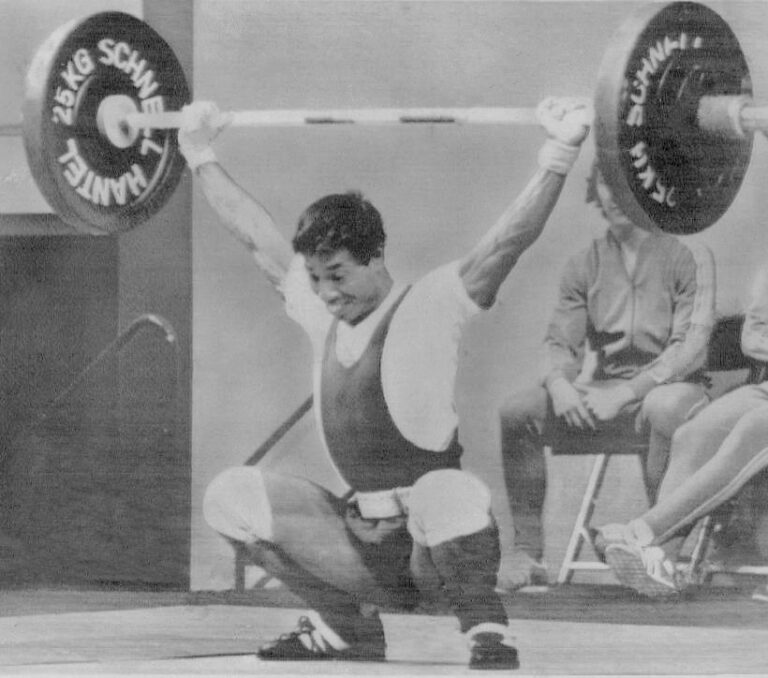
His technical profile was distinctive. Tall for the middleweight and light-heavyweight classes at 1.84 metres, he had long levers, a defensive foot-game, and a patient style that traded flurry scoring for controlled exchanges on the edge of the mat. He was famously hard to take down, and when he did take opponents down, he rarely risked the aggressive top-work that characterised the Soviet wrestlers of the era. He won most of his matches by technical superiority on aggregate points rather than by falls.
Melbourne 1956 — The Gold
The Melbourne 1956 Olympic Games are where Takhti entered the international wrestling pantheon. Competing at 87 kilograms in the freestyle programme, he moved through the bracket without a lost period. In the final he faced the Soviet wrestler Givi Kartvelishvili, a Georgian who had himself come through the bracket cleanly. The match was tense, physical, and decided on tactical advantage across two periods. The verdict went to Takhti. The gold was his.
What happened in the immediate aftermath of that final is what started to build the pahlevan reputation internationally. Kartvelishvili injured his knee in the early exchanges and visibly limped for the rest of the bout. Takhti, according to contemporaneous accounts and Kartvelishvili’s own later interviews, deliberately avoided attacking the injured leg. He wrestled a full-length match at pace, won on technique and positioning, and refused the obvious tactical advantage. It is the kind of story that accrues to a legend after the fact, except that in this case it was reported at the time by American and Soviet wrestling correspondents in Melbourne, and confirmed later by Kartvelishvili himself, who remained a close friend of Takhti until Takhti’s death.
Takhti added World Championship gold medals in 1959 and 1961, and a silver at the 1961 Worlds as well. He took silver at Rome 1960 and finished out of the medals at Tokyo 1964, where he had moved up to 97 kilograms for a final Olympic run. Three Olympic medals — two silvers and a gold — spanning twelve years remain a rare and specific achievement in wrestling history.
Buin Zahra — September 1962
On 1 September 1962, an earthquake measuring 7.1 on the Richter scale struck the Buin Zahra region of Qazvin Province, about 120 kilometres west of Tehran. The earthquake killed more than 12,000 people in a cluster of villages that collapsed almost instantly. The Iranian government response was slow. Aid from the capital was insufficient. The international response had not yet mobilised.
In that interval, Takhti made the decision that more than any Olympic medal placed him in Iranian public memory. He walked down Laleh-Zar street, one of the main commercial avenues of Tehran, with a collection box and a simple request. Accounts vary on the exact first day, but by the third day he was walking multiple avenues, accompanied by a small group of fellow wrestlers and pahlevans. Tehran’s commercial class, the bazaaris, responded with generosity. Photographs from the period show shopkeepers running into the street to press banknotes into his hands. Ordinary pedestrians did the same.
The amounts raised, in 1962 rials, are difficult to translate meaningfully into modern currency, but contemporary estimates place Takhti’s personal collection effort at something close to what would today be hundreds of thousands of dollars, contributed within roughly two weeks. Those funds went directly to the Red Lion and Sun Society (the Iranian equivalent of the Red Crescent at the time) and were earmarked for Buin Zahra reconstruction. More importantly, the gesture shamed the state into a more substantive response and catalysed a broader civic mobilisation.
It was not the first time an Iranian athlete had engaged in public charity. It was the first time an Olympic-medallist athlete had done so with his own body, on his own streets, as a personal rather than institutional act. The story passed into folklore almost immediately. To this day, Iranian schoolchildren learn the Takhti-and-Buin-Zahra narrative as an early formative story about what a good citizen is supposed to look like.
The Politics of a Wrestler
Takhti’s political identity is impossible to separate from the rest of his biography, and it is the dimension of his life that most directly set the stage for his death. He was a nationalist, sympathetic to Prime Minister Mohammad Mossadegh and the National Front opposition, and he remained so through the years following Mossadegh’s removal in the 1953 coup. He was a member of the Second National Front during the 1960s, participated in political activity that the Shah’s regime watched closely, and openly attended Mossadegh’s funeral in March 1966 at the village of Ahmadabad, despite repeated warnings from SAVAK agents.
This was politically dangerous behaviour in 1960s Iran. SAVAK, founded in 1957 with American and Israeli intelligence support, was the Shah’s primary instrument of domestic surveillance and political suppression. Its operatives watched dissident figures continuously, and its threats were rarely empty. Takhti’s celebrity afforded him some protection, but also made him a particular target, because his public moral authority reached a broader Iranian audience than any political speech could have reached.
In the last years of his life, Takhti was increasingly isolated from the official sports establishment. The Iranian Wrestling Federation, which had once celebrated him, began to distance itself. His access to international competition was restricted. His name appeared less often in state media. The political climate was tightening, and Takhti’s refusal to be institutionally tamed had consequences.
The Atlantic Hotel — 7 January 1968
On the evening of 6 January 1968, Takhti checked into the Atlantic Hotel in central Tehran. The reasons for his choosing a hotel rather than his own home have never been clarified. He was reportedly going through a difficult personal period and had spoken of needing to be alone. His wife, Shahla Tavakoli, was pregnant with their son, Babak, who would be born four months later. Takhti had met Shahla at the 1964 Tokyo Olympics, where she had worked as a translator.
On the morning of 7 January 1968, hotel staff found him dead in his room. The official government announcement came quickly: suicide by barbiturate overdose. The death was declared, funeral arrangements were made, and the Shah’s government attempted to manage the public response.
Public response did not cooperate with management. The funeral, held at Ibn Babawayh Cemetery on 8 January, drew an estimated crowd of several hundred thousand Tehranis, one of the largest funeral processions in Iranian history to that point. The mourning was spontaneous and unpoliced, and the government was unable to contain the public reaction. Within days, the suicide narrative was being openly disputed. Towfigh Magazine, the satirical weekly, published a cartoon on 14 January 1968 showing Takhti with angel wings flying above the mourners, with the caption “Don’t cry for me, cry for yourselves.” The magazine was shut down by the Shah’s censors for several months afterward.
What Happened in the Atlantic Hotel Room
The question of whether Takhti took his own life or was killed has not been settled in the fifty-eight years since, and it likely cannot be settled now. The official government account, repeated in state documents from 1968 through the early 1970s, described a suicide consistent with depression and marital tension. The alternative account, held by Takhti’s family, by many of his wrestling contemporaries, and by large sections of the Iranian public, is that he was murdered by SAVAK because his growing political stature made him a threat to the regime.
The post-revolutionary Iranian government, after 1979, formally adopted the murder account and named a series of public institutions after Takhti on that basis. Stadiums, streets, a Tehran metro station, and a major annual wrestling tournament all bear his name. His widow Shahla Tavakoli and his son Babak have, in rare public interviews, maintained that they believe he was murdered. Contemporary Western scholarship on the case has tended to treat the question as genuinely open, noting that the documentary evidence available in both directions is fragmentary.
What is less ambiguous is the broader political function of his death. Whether suicide or murder, Takhti’s death in January 1968 became a crystallising moment for Iranian dissent against the Shah. Historians of the Iranian revolution have argued that the public mobilisation around Takhti’s funeral was a rehearsal for the mass mobilisations that brought down the Pahlavi regime a decade later. His death made visible, for the first time on that scale, the depth of public feeling against a government that could not protect its own moral heroes.
Fifty-Eight Years of Memory
In the fifty-eight years since, Takhti has occupied a specific position in Iranian public memory that no other athlete has occupied. The annual commemorations on 7 January draw large crowds. The Takhti Cup international wrestling tournament, first held in 1963 during his lifetime, continues to run and is a fixture on the United World Wrestling calendar. The Takhti Sports Complex in Tehran houses the Iranian National Wrestling Hall of Fame. Iranian school curricula include his biography. Streets and squares in virtually every Iranian city carry his name.
Among wrestlers specifically, his influence has been generational. Every major Iranian freestyle wrestler of the last four decades has been measured, at some point in their career, against the Takhti standard. The measurement is not primarily athletic. It is moral. The question Iranian wrestling culture asks of its world champions is whether they carry themselves like pahlevans, whether they represent their country with dignity, whether they serve something beyond their own trophy case. Takhti is the reference case. Hassan Yazdani, Rasoul Khadem, Amir Hossein Zare — all of them have, at various points, been publicly compared to Takhti, and all of them have publicly refused the comparison as premature. That refusal is itself part of the tradition. Takhti himself, when asked late in his life whether he considered himself a pahlevan, answered that he was still learning.
The Takhti Cup and the Annual Pilgrimage
The Takhti Cup, first organised in 1963 during Takhti’s lifetime, is the longest-running international freestyle wrestling tournament in Iran and one of the oldest on the UWW calendar. Named for Takhti while he was still active as a competitor, the event was meant as a tribute from the Iranian Wrestling Federation to its most internationally recognised athlete. It continues to run annually, typically in late February or early March, and functions as the opening international event of the Iranian wrestling calendar each year.
Winning the Takhti Cup carries a specific symbolic weight beyond its competitive value. For Iranian wrestlers, it is the first chance each year to wear the national singlet in a televised setting, and for the coaching staff it is the initial read on the team’s condition heading into the spring and summer competitions. International wrestlers who travel to Tehran for the event typically arrive with a sense that they are participating in something that sits at the intersection of competitive sport and cultural ritual. The opening ceremony includes a moment of silence at Takhti’s graveside, broadcast live on Iranian state television, and the tournament’s competition bracket has, in recent years, been dedicated in memory of named senior figures from the Iranian wrestling tradition.
The annual 7 January commemoration at Ibn Babawayh Cemetery is a second, parallel ritual. Unlike the Takhti Cup, which is competitive and organised by the federation, the graveside commemoration is informal and popular, organised by neighbourhood associations, wrestling clubs, and individual families. Its scale has grown in recent years as Iranian state media has covered it more prominently and as younger Iranians, several generations removed from Takhti’s active career, have begun to participate in what is, for them, a cultural heritage event rather than a personal memorial. The 58th anniversary in 2026 drew estimates of several tens of thousands of attendees over the course of the day.
The Specific Iranian Idea of a Sports Hero
To a foreign audience, it can be difficult to translate the precise cultural weight of Takhti’s memory. Western sport culture has its heroic figures, but most of them are primarily remembered as athletes and only secondarily as moral examples. Takhti’s case inverts that order. His athletic achievement is genuinely significant — three Olympic medals, two World Championship golds, a long domestic reign — but it is not the centre of gravity of his memory. The centre is Buin Zahra. It is Kartvelishvili’s uninjured knee. It is the choice to attend Mossadegh’s funeral in the face of SAVAK threats. It is the willingness to lose political protection rather than compromise personal conviction.
Iranian sport has, in the fifty-eight years since, produced athletes of extraordinary accomplishment. Hossein Rezazadeh won two Olympic golds in weightlifting. Hassan Yazdani has established himself among the greatest freestyle wrestlers of his generation. Zare has now joined the three-time world champion club. But the title of Jahan Pahlevan remains reserved for Takhti alone. It is not a trophy that can be won through performance. It has to be earned through a life, and the life has to end before the judgement can be made. Takhti’s life ended in an Atlantic Hotel room on 7 January 1968, and in the judgement of his country, he earned it.
Takhti’s Major International Medals
| Year | Event | Weight | Medal |
|---|---|---|---|
| 1951 | Worlds — Helsinki | 79 kg | Silver |
| 1952 | Helsinki Olympics | 79 kg | Silver |
| 1956 | Melbourne Olympics | 87 kg | Gold |
| 1959 | Worlds — Tehran | 87 kg | Gold |
| 1961 | Worlds — Yokohama | 87 kg | Gold |
| 1960 | Rome Olympics | 87 kg | Silver |
Frequently Asked Questions
Which Olympics did Takhti win?
Melbourne 1956, in the men’s freestyle 87-kilogram class, with a final victory over Soviet wrestler Givi Kartvelishvili. He also earned Olympic silvers at Helsinki 1952 and Rome 1960.
What did he do after the Buin Zahra earthquake?
After the September 1962 earthquake killed more than 12,000 people, Takhti walked the main commercial avenues of Tehran personally collecting donations for the victims over roughly two weeks, raising a significant sum that shamed the state into a more substantive relief response.
How did Takhti die?
He was found dead in Tehran’s Atlantic Hotel on 7 January 1968. The Shah’s government declared it a suicide. His family, members of the political opposition, and much of Iranian public opinion have long maintained he was killed by SAVAK, the regime’s intelligence agency, because of his political activism.
What does “Jahan Pahlevan” mean?
Literally “World Pahlevan” — the informal title awarded to an athlete who combines world-level achievement with exemplary moral character. Takhti is the only Iranian wrestler to whom the title is universally granted.
Sources
- Wikipedia — Gholamreza Takhti
- Tehran Times — Iranians honor 58th anniversary of Takhti’s death
- PBS Frontline Tehran Bureau — Profile of Takhti
Related coverage on Sports Persia
Arman Petrosian covers combat sports, wrestling, and strength athletics for Sports Persia. He writes from Tehran and Yerevan.