
Pahlevani and Zoorkhaneh — The World’s Oldest Athletic System Still Meets at Dawn
By Arman Petrosian — Published 2 May 2026

The zoorkhaneh opens at five in the morning. The men arrive one by one in the half-dark of the Tehran bazaar, remove their shoes at the door, bow once in the direction of the pit, and descend the three stone steps into the octagonal sunken arena at the centre of the room. The Morshed, the master of ceremonies, is already seated on his raised platform at the west wall, wiping the skin of his goblet drum with a cloth. Above him hang photographs of previous Morsheds going back to the late Qajar period, the oldest of them faded to the colour of dry tea.
When the last athlete has entered the pit, the Morshed strikes his drum once. The sound is specific — deep, wooden, travelling through the pit’s octagonal acoustic the way it has travelled in Iranian houses of strength for something like a thousand years. The men bow. The Morshed begins a couplet from the Shahnameh, Ferdowsi’s tenth-century epic of Persian kings and heroes. The athletes circle the pit once, slowly, on bare feet. The session has begun.
In 2010, UNESCO inscribed Pahlevani and Zoorkhaneh rituals on the Representative List of the Intangible Cultural Heritage of Humanity, recognising what Iranian sports historians have argued for decades: that this is the oldest continuously practiced athletic and martial system in the world. Not the oldest sport. The oldest continuously practiced athletic system. Other traditions are older in their origins; none have survived in the institutional, musical, and ritual form that brought the men into this Tehran pit at five in the morning.
What the Word Means
The vocabulary matters because the names carry the grammar of the tradition. Zoorkhaneh is Persian for “house of strength” — zoor meaning force or power, khaneh meaning house. The architectural reality of a zoorkhaneh is a low-ceilinged room, often partially below ground level, with a central octagonal pit called the gowd where the exercises are performed. The pit is sunken by roughly one metre, with tiered seating around its perimeter for observers and older athletes.
Varzesh-e Pahlavani means “sport of champions” or, more precisely, “sport of the pahlevan.” Varzesh-e Bastani means “ancient sport.” Both names are used interchangeably for the discipline. The pahlevan concept is the animating one. A pahlevan, in Persian moral language, is not merely a strong man. He is a morally upright strong man — chivalrous, humble, generous to the poor, protective of the weak, loyal to friends, respectful to elders, and modest about his own accomplishments. The athletic system is explicitly designed to produce this character, and the physical training is subordinated to the ethical training.
This is not a marketing reading of the tradition. It is stated openly in the Morshed’s opening invocations, in the ritual ordering of the exercises, and in the names the athletes use for each other inside the pit. Every pahlevan is called by the honorific pahlevan rather than by his given name during the session. The Morshed calls out “Pahlevan Ali,” “Pahlevan Reza,” “Pahlevan Hassan,” regardless of what the man is called outside.
The Seven Arts of the Pit
The exercises performed in a zoorkhaneh session are traditionally organised into seven distinct arts. They are performed in a specific order, each with its own rhythm and musical accompaniment from the Morshed’s drum and bell.
The first is the sang, a pair of wooden or metal shields, each weighing between 20 and 40 kilograms, pressed alternately from a supine position while the athlete lies on his back in the centre of the pit. The sang is the warm-up exercise and the one most visibly resembling modern barbell pressing, though its biomechanics are different because the resistance is on two independent implements that can travel on slightly different paths.
The second is shena, a variation of the push-up performed on a curved wooden board. The shena is more demanding than a standard push-up because of the range of motion and the balanced pause at the top. A capable pahlevan performs 200 to 300 repetitions in a single set at moderate pace, dictated by the Morshed’s rhythm.
The third is meel or mil, the Persian clubs. These are weighted wooden implements with a pear-like shape, ranging from 5 kilograms for beginners to 25 kilograms for the senior Morshed’s demonstrations. The mil is swung overhead in large circular patterns, alternating arms, sometimes in synchronisation with other athletes, sometimes tossed and caught mid-rotation. The exercise develops shoulder mobility, rotator cuff endurance and rotational core strength in a way that Western strength training has, arguably, never quite replicated. Indian clubs and the Kehrer clubs of Central Europe are descended from, or parallel to, the Persian mil.
The fourth is kabbadeh or kaman, the bow-shaped iron weight with a chain of rings attached. The kabbadeh resembles an archer’s bow in form but weighs between 20 and 45 kilograms. The athlete holds it overhead and alternately rotates it from side to side, timed to the Morshed’s drum. The chain of rings produces a specific metallic rattle that is one of the signature sounds of the zoorkhaneh session.
The fifth is charkh, a spinning exercise in which the athlete rotates on the spot with arms extended, sometimes holding a mil in each hand, for extended periods without losing balance. A senior pahlevan performs charkh for two to three minutes at a time in a session demonstration, a feat of vestibular conditioning that Western sport science has studied with interest.
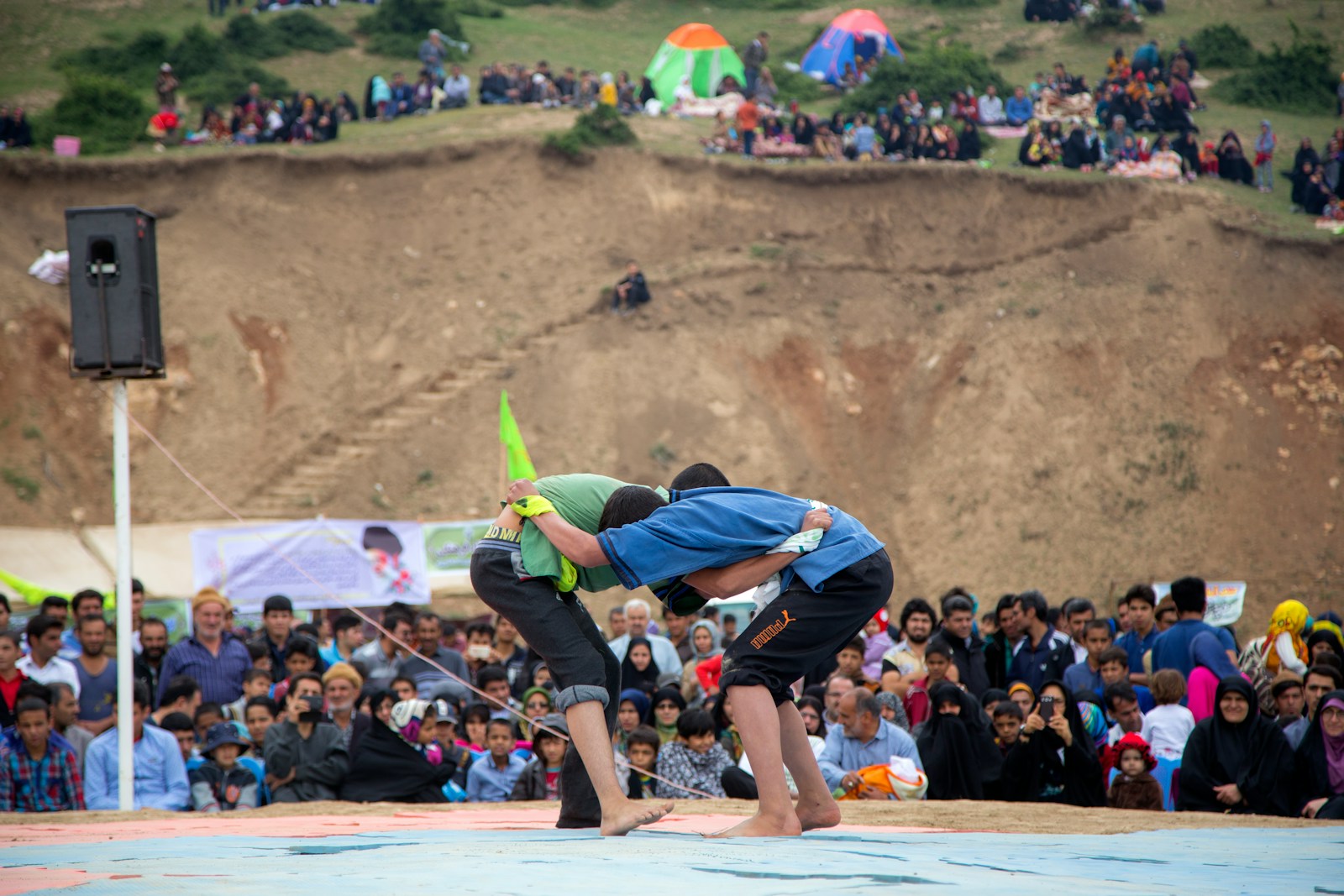
The sixth and seventh are narmesh and pa zadan — dynamic stretching and rhythmic stepping — and koshti-e pahlevani, the traditional wrestling that historically closed the session. The wrestling component is the direct ancestor of modern Iranian freestyle wrestling and carries the same philosophy of controlled domination without unnecessary violence.
The Morshed
The Morshed is the most important figure in a zoorkhaneh. He is not, technically, a coach — he does not demonstrate exercises or correct form. He is not a priest, though his function is quasi-liturgical. He is, roughly, a musical director and cultural mnemonist. From his platform, called the sardam, he dictates the pace of the session through his goblet drum — the zarb — and a small bronze bell. He calls the exercises by name and number. He recites verses from the Shahnameh, from Saadi, from Hafez, from Rumi, and from Shi’ite devotional poetry honouring Imam Ali and Imam Hussein. Between verses he praises individual pahlevans by name, calling out their lineages or their charitable acts.
The Morshed’s repertoire is not written down. It is memorised over a lifetime of apprenticeship, and the best Morsheds carry thousands of verses in their heads, drawn from twelve centuries of Persian literature. The role is, in that sense, a living archive of Persian culture. When a Morshed dies, his specific repertoire dies with him unless it has been passed to an apprentice. The UNESCO inscription in 2010 has accelerated formal efforts to record and preserve Morshed repertoires, but the oral tradition remains the primary medium.
Iran’s most celebrated Morsheds — figures like Morshed Ostad Mohammad Mehdi Kaboli, who performed for decades in Tehran’s Pahlavan Pour zoorkhaneh — are cultural figures of considerable standing, invited to perform at state occasions, recorded for radio broadcasts, and honoured at the Iranian National Wrestling Hall of Fame. The Morshed’s drum that hangs in the hall’s founding-era exhibit was used by the Morshed who presided over Gholamreza Takhti’s earliest training sessions in the late 1940s.
Pre-Islamic Roots, Islamic Continuity
The origins of pahlevani predate Islam. Iranian sport historians trace the lineage to the warrior training traditions of the Sassanid empire (third to seventh centuries CE), and probably to earlier Parthian practices. Some elements — the wrestling, the club work, the respect for the warrior-hero figure — appear in the Shahnameh itself, which Ferdowsi completed around 1010 CE and which collected much older oral traditions. The hero Rostam of the Shahnameh is explicitly described as a practitioner of wrestling and strength arts, and Rostam’s lineage is referenced in modern zoorkhaneh invocations to this day.
After the Arab conquest and the gradual Islamisation of Iran, the pahlevani tradition incorporated Islamic elements, particularly Shi’ite ones, without losing its pre-Islamic structure. The Morshed’s repertoire now includes verses in praise of Imam Ali ibn Abi Talib, who is revered as the exemplar pahlevan — courageous, just, generous, skilled in combat. Imam Hussein, martyred at Karbala in 680 CE, is invoked in the devotional portions of the session. The result is a syncretic tradition in which pre-Islamic Persian, Zoroastrian, and Sufi elements sit alongside Shi’ite Islamic ones.
The Sufi dimension is particularly interesting. Many of the Morshed’s recited verses come from Sufi poets — Rumi, Hafez, Attar — and the ethical philosophy of the pahlevan system has clear Sufi resonances: the subordination of the ego to the collective, the cultivation of humility through physical discipline, the spiritual master-student relationship. Scholars of Iranian religious history have argued that the zoorkhaneh functioned, for much of the medieval and early modern period, as a distributed network of Sufi-influenced civic associations, with each zoorkhaneh effectively serving as a community centre for its neighbourhood.
The Century of Decline and the UNESCO Revival
Pahlevani tradition went through a period of decline in the mid-twentieth century, as modern Olympic sports gained institutional support and the zoorkhanehs of Tehran, Isfahan, Shiraz and Tabriz competed for youth attention with football, basketball, and modern weightlifting. By the 1970s, the number of active zoorkhanehs in Iran had fallen from an estimated several thousand at the turn of the century to roughly 500. By the early 2000s it had stabilised at around 400 nationwide, with 50 of them in Tehran.
The UNESCO inscription in 2010 marked a turning point. International recognition brought domestic funding, academic attention, and a new cohort of younger Iranians who chose to train at the zoorkhaneh specifically as a cultural commitment rather than by default. The Iranian Ministry of Sport has, since 2012, included pahlevani in its cultural heritage preservation budget, and the Ministry of Culture has supported a programme of Morshed apprenticeships to ensure generational continuity.
By 2026 the number of active zoorkhanehs in Iran stands at roughly 500 again, with active internationalisation efforts in Turkey, Iraq, Afghanistan, Tajikistan, and several European countries with Iranian diaspora communities. The International Zurkhaneh Sports Federation, established in 2004 and recognised by the Asian Olympic Council, has hosted international competitions since 2007, though the competitive format is an invention of the modern era rather than a traditional element of the discipline.
The National Wrestling Hall of Fame
The Iranian National Wrestling Hall of Fame, located in the Takhti Sports Complex in Tehran, serves as the institutional memory of both pahlevani and modern freestyle wrestling. The hall’s exhibits move chronologically from the pre-Islamic period to the present, with Gholamreza Takhti’s Olympic medals and wrestling shoes occupying the central gallery. The relationship between pahlevani and modern Iranian wrestling is made explicit there: the hall’s founding statement describes modern freestyle wrestling as “the international form of the koshti-e pahlevani tradition,” and the hall’s curator maintains a working library of Morshed repertoires dating to the early twentieth century.
The hall’s current curator, Ostad Bahram Hashemi, is himself a trained Morshed and practicing pahlevan, and he holds weekly apprenticeship sessions in the hall’s small interior zoorkhaneh. Iranian Olympic wrestlers, including several members of the 2025 world champion team, trained in that interior zoorkhaneh as part of their cultural education. Amir Hossein Zare, the 125-kilogram world champion, has performed the kabbadeh there, at the invitation of Ostad Hashemi, on two separate occasions.
What the Tradition Offers Modern Sport Science
Beyond the cultural and historical dimensions, pahlevani has begun to attract serious attention from Western sport scientists and strength coaches. The mil’s biomechanical profile — a rotational load at a long lever, cycled through overhead patterns — offers training stimuli that modern barbell work does not replicate. Rotator cuff health, scapular mobility, and rotational core strength are three areas in which club work has documented benefits, and several Olympic weightlifting teams outside Iran have begun to incorporate modified club training into their preparation.
The shena board, similarly, has been studied as a superior push-up variant for upper-body endurance, and the charkh spinning exercise has attracted attention from vestibular training researchers studying the balance requirements of combat sports and gymnastics. None of this is new to Iranian strength coaches, who have always incorporated zoorkhaneh elements into the national team preparation. What is new is that sport science outside Iran is finally catching up to what the Morshed’s drum has been saying for a thousand years.
The Diaspora Zoorkhanehs
Outside Iran, zoorkhanehs have been established in cities with significant Iranian diaspora populations. Los Angeles, home to the largest Iranian community outside Iran, has three functioning zoorkhanehs, one in West Los Angeles and two in the San Fernando Valley. London has a zoorkhaneh attached to the Islamic Centre of England, and a second in the Ealing neighbourhood that serves a mixed Iranian and Afghan community. Toronto, Frankfurt, Stockholm, and Sydney all host active zoorkhanehs supported by local Iranian cultural associations.
The diaspora zoorkhanehs face specific challenges. The Morshed role requires a level of cultural and literary training that is hard to replicate outside Iran, and several diaspora houses rely on audio recordings of Iranian Morsheds rather than live performance. The equipment, particularly the mil, the kabbadeh and the sang, has to be imported from Iran or commissioned from specialist workshops, and supply chain issues have periodically disrupted training. The younger diaspora generation, several steps removed from direct Iranian cultural fluency, sometimes approaches the tradition through sport-performance framing rather than the ritual-cultural framing that dominates in Iran.
Nonetheless, the diaspora zoorkhanehs have served as important transmission points for the tradition to Iranian communities abroad, and the UNESCO inscription has given them an institutional standing that helps with local fundraising and cultural visibility. Several diaspora zoorkhanehs participate in cultural heritage months in their host countries, and the Los Angeles house in particular has become a regular fixture on tour buses following the Persian cultural circuit in Southern California.
The Session Closes at Sunrise
Back in the Tehran zoorkhaneh at five in the morning, the session winds down after roughly 90 minutes. The men have completed sang, shena, mil, kabbadeh, charkh, and a brief wrestling exchange. The Morshed has recited twenty-odd couplets, praised each of them by their pahlevan name at least once, and concluded with the traditional closing invocation that calls blessings on Imam Ali and on all the Morsheds and pahlevans who have stood in that pit before.
The athletes bow to the Morshed, bow to each other, climb out of the pit, and disperse into the Tehran morning. Most of them will go to their day jobs — shopkeepers, teachers, civil servants, a couple of them are senior government officials. None of them wrestled professionally. None of them will compete internationally. They came because their fathers came, and their fathers’ fathers came, and because a thousand years of Iranian cultural memory sits folded into the rhythm of the drum and the circular swing of the mil. At sunrise the zoorkhaneh closes for the day. At five the next morning, it will open again.
Key Elements of a Zoorkhaneh Session
| Implement | Typical Weight | Exercise | Primary Benefit |
|---|---|---|---|
| Sang | 20–40 kg each | Overhead press (supine) | Upper-body strength |
| Mil | 5–25 kg each | Rotational overhead swing | Shoulder mobility, rotational strength |
| Kabbadeh | 20–45 kg | Overhead rotation with rings | Shoulder stability, core endurance |
| Shena board | Bodyweight | Push-up with deep range | Upper-body endurance |
| Charkh | — | Extended spinning | Vestibular conditioning, balance |
Frequently Asked Questions
When was Pahlevani inscribed by UNESCO?
In 2010, on the Representative List of the Intangible Cultural Heritage of Humanity — recognised as the world’s oldest continuously practiced athletic system.
What does the word zoorkhaneh mean?
Literally “house of strength,” referring to the traditional gymnasium with its octagonal sunken training pit called the gowd.
Who is the Morshed?
The master of ceremonies who leads the session from an elevated platform, beating a goblet drum and reciting verses from the Shahnameh and devotional poetry to set the rhythm of each exercise.
What are the main training implements?
Mil (wooden clubs), sang (metal shields), kabbadeh (iron bow with rings), and the shena board for push-ups, performed in a specific ritual order across a 90-minute session.
Sources
- UNESCO Intangible Cultural Heritage — Pahlevani and Zoorkhanei rituals
- Wikipedia — Pahlevani and zoorkhaneh rituals
- Tehran Times — Pahlevan tradition and Takhti commemoration
Related coverage on Sports Persia
Arman Petrosian covers combat sports, wrestling, and strength athletics for Sports Persia. He writes from Tehran and Yerevan.