Persia to Los Angeles: A Long Walk Through Iran’s 125 Years at the Olympic Games
By Saman Azizi — Published May 3, 2026

There is a black-and-white photograph, reprinted in fencing histories and Olympic archives, of a tall man with a heavy mustache, a pressed white jacket, and a narrow épée at rest across his shoulder. He stands in a Parisian courtyard in the summer of 1900. The caption identifies him as Prince Freydoun Malkom of Persia. He is the first athlete to represent what we now call Iran at any Olympic Games. And for the next forty-eight years, he is the only one.
That is where any serious history of Iran at the Olympics has to begin — with a single fencer, a single event, and a country whose national sporting apparatus did not yet exist. From that singular dot, a curve starts to rise. Slowly at first. Then, after the Second World War, decisively. By the time the Iranian flag flies over the Paris 2024 closing ceremony, it represents a program that has won more than 75 Olympic medals, dominated Asian wrestling for the better part of a century, and become one of the handful of countries in the Middle East with a continuous, generation-deep Olympic tradition.
This is that walk, one Games at a time, one breakthrough at a time — and a preview of the road toward Los Angeles 2028.
Paris 1900: A Prince, an Épée, and a Country That Did Not Yet Compete
Freydoun Malkom was born in 1874, the son of Malkom Khan, one of the most influential Persian diplomats and reformers of the nineteenth century. He lived mostly in Europe, educated in the languages and athletic pursuits of European nobility. When the second modern Olympic Games opened in Paris in May 1900 as a sprawling, disorganized sideshow to the World’s Fair, Malkom entered the épée event. He did not medal. He did not advance far. But his entry is the reason the Iranian Olympic Committee, founded decades later, counts 1900 as its starting point.
No other Persian athletes competed at the Games until after the Second World War. The country had more urgent business — the constitutional revolution of 1906, the upheavals of the First World War, the Pahlavi consolidation of the 1920s and 1930s. Sport, in the Western sense, was not yet a state priority.
London 1948: Iran Arrives
The National Olympic Committee of Iran was formed in 1947, and the country received International Olympic Committee recognition the same year. For London 1948 — the first postwar Games — Iran sent its first real delegation: 36 men across wrestling, weightlifting, boxing, athletics, cycling, football, fencing, and swimming. This was the debut of Iran as an Olympic nation rather than a footnote.
The country did not leave London without a medal. Jafar Salmasi, a compact featherweight weightlifter, finished third in his class. Bronze. It was the first Olympic medal in Iran’s history, and it came in the sport that would, over the next seventy years, produce more Iranian Olympic medals than any other discipline except wrestling.
The cohort also included wrestlers who would anchor Iran’s international identity for a generation. Gholamreza Takhti, not yet the household name he would become, watched from closer to the bleachers at 17 years old. He would enter the Olympic frame at Helsinki 1952.
Helsinki 1952 and the Arrival of Takhti
Helsinki is where Iran announces itself on the mat. Takhti wins silver at middleweight freestyle. Three other wrestlers reach the podium. Weightlifting adds a silver via Mahmoud Namjou. The haul jumps from the single London bronze to seven medals, including the country’s first ever medal in the Greco-Roman style.
Helsinki 1952 is also where the cultural template begins to set. Iranian wrestling, particularly freestyle, becomes the spine of the Olympic program. Federation resources, public attention, and talent identification all bend toward it. When young athletes pick a sport in small-town Iran in the 1950s and 1960s, the default choice is wrestling, because wrestling wins medals, and the medals matter nationally.
Melbourne 1956: Gold, Finally
At Melbourne, Takhti wins gold. Middleweight freestyle. He becomes the first Iranian to stand atop an Olympic podium. A photograph of him in the wrestling singlet, medal around his neck, fills newspapers in Tehran for months. He would go on to win silver at Rome 1960, but Melbourne is the one that changes the trajectory of Iranian sport.
The story of Takhti is inseparable from Iran’s self-image as a wrestling nation. His funeral in 1968, after his controversial and still-debated death, drew crowds of hundreds of thousands in Tehran. Schools, streets, and stadiums bear his name. Every subsequent Iranian wrestler, in some sense, still competes inside the shadow he cast.
Montreal 1976 Through Seoul 1988
The 1970s and 1980s were complicated for the Iranian Olympic program. The 1979 Islamic Revolution reshaped the country’s institutions overnight, and the subsequent war with Iraq — from 1980 to 1988 — drained resources that might otherwise have funded sport. Iran did not send delegations to Moscow 1980 (following the general regional response to the Soviet invasion of Afghanistan) or Los Angeles 1984 (following a broader political stance).
Seoul 1988 marked the return. The delegation was modest. The results were, too — no medals. But the re-entry mattered. It signaled that even in a reshaped political order, Iranian athletes would continue to compete internationally under the national flag.
The 1990s Revival
Barcelona 1992 and Atlanta 1996 saw a steady climb. Wrestlers began to medal again. Weightlifting, now coached by a generation of veterans who had themselves competed in the 1970s, began producing its own breakthroughs. Hossein Rezazadeh, who would later define the super-heavyweight class globally, was a teenager in Atlanta’s summer watching from afar.
At Sydney 2000, Rezazadeh took gold. He defended it in Athens 2004. During that span, he was often referred to in international weightlifting media as the strongest man in the world — a title few athletes carry without hyperbole. His gold medals, and the world records he set along the way, gave weightlifting a profile inside Iran comparable to wrestling for the first time.
Beijing 2008 Through Tokyo 2020
The twenty-first century is where Iran’s Olympic story widens from wrestling and weightlifting alone. Taekwondo arrived as a medal-producing discipline. Hadi Saei won gold in 2004 and again in 2008. Kimia Alizadeh, at Rio 2016, became the first Iranian woman to win an Olympic medal — a taekwondo bronze that moved the country’s historical narrative forward in a way no previous result had.
Basketball qualified for Beijing 2008 — its first Olympics in 36 years — and returned again in Tokyo 2020. Volleyball qualified for Rio 2016. Athletics began producing serious continental champions, led by Hassan Taftian in the sprints and Ehsan Hadadi in discus throw (silver at London 2012).
The medal table across these four Games shows Iran settling into a comfortable range: roughly four to seven medals per Summer Games, with gold consistently in wrestling and weightlifting, and broader medal diversity slowly appearing.
The Historical Ledger
| Games | Iranian delegation | Headline result | Total medals |
|---|---|---|---|
| Paris 1900 | 1 athlete (Freydoun Malkom) | First Olympic appearance as Persia | 0 |
| London 1948 | 36 athletes | Salmasi wins first Iranian medal (weightlifting bronze) | 1 |
| Melbourne 1956 | 40+ athletes | Takhti wins first Iranian gold (freestyle wrestling) | 3 |
| Athens 2004 | 37 athletes | Rezazadeh defends super-heavyweight gold | 6 |
| Rio 2016 | 64 athletes | Alizadeh — first female Iranian medalist | 8 |
Paris 2024: A Mixed Return
Paris 2024 saw a mid-range Iranian performance. Wrestling delivered, as expected. Weightlifting had fewer gold-medal performances than anticipated. Taekwondo’s internal dynamics were complicated by the dual presence of Kimia Alizadeh, now representing Bulgaria, and Nahid Kiani, still representing Iran, in the same weight class and medal rounds. Shooting, archery, and rowing added depth to the delegation without necessarily adding medals.
The 2024 Games reinforced a lesson the federation has been slowly absorbing for a decade: the medal base Iran built on wrestling and weightlifting is narrowing as those sports globalize and other nations invest in them. Iran’s future medal growth, if it is going to happen, will increasingly need to come from taekwondo, athletics, shooting, and the ball sports.
Women, Slowly, at the Games
The first Iranian woman to compete at an Olympic Games was Lida Fariman, a shooter at Atlanta 1996. She was also the Iranian flag bearer at the opening ceremony. For the next decade, Iranian female participation remained modest. The expansion came gradually: rowers, archers, shooters, taekwondo athletes. Kimia Alizadeh’s Rio 2016 bronze was the first medal. Nahid Kiani’s Paris 2024 silver was the first by a female athlete still competing under the Iranian flag.
At the Winter Games, Marjan Kalhor became the first Iranian woman to compete at a Winter Olympics, skiing for Iran at Vancouver 2010. She has since been followed by a small but steady pipeline of winter-sports athletes, particularly in alpine skiing and cross-country.
Los Angeles 2028: What to Watch
Iran’s federations are already deep into qualification cycles for LA 2028. Wrestling and weightlifting remain the medal baseline — expect continuity, with rising stars Amir Hossein Zare, Kamran Ghasempour, and Rahman Amouzad leading a new freestyle generation.
Taekwondo is a genuine medal hope, led by Kiani and a deep women’s bench. Volleyball, under Roberto Piazza, is trying to engineer a return to the Olympic field after missing Tokyo 2020 and Paris 2024. Basketball is chasing its third Olympic berth through the 2027 FIBA World Cup qualifiers. Athletics will lean on a handful of continental champions, including Hassan Taftian at age 35 — an unlikely but still plausible fourth Olympic sprinter.
The federation’s internal targets, per sources quoted in Tehran Times this spring, are in the range of five to eight medals, with at least two gold. That would match a typical modern Iranian Games.
The Longer Arc
One fencer in 1900. A single bronze in 1948. A gold in 1956. An Olympic-record super-heavyweight in 2000. A first female medalist in 2016. A Winter Olympian in 2010. A volleyball team in the qualification brackets in 2026.
These are the landmarks of a small, persistent Olympic country. Iran’s story is not the story of the United States or China, nations that have built industrial-scale sporting machinery. It is something quieter and, in its own way, more interesting — a story of how a handful of sports, dominated by a handful of generational athletes, became a national self-image, and how that self-image now has to adapt to a wider, more competitive world.
The black-and-white photograph of Freydoun Malkom hangs, in a reproduction, on the wall of the National Olympic Committee in Tehran. He looks out past the camera the way he might have once looked past an opponent’s blade. One hundred and twenty-five years later, the country he represented is still at the Games.
Winter Sports: A Parallel Track
The summer story receives the majority of Iranian Olympic coverage, but the winter programme has its own continuous history. Iran has competed at most Winter Olympics since Sapporo 1972, typically sending small delegations in alpine skiing, cross-country skiing, and occasional entries in other disciplines. The country has never won a Winter Olympic medal. The delegations have usually numbered between two and five athletes.
The significance of the winter programme is not measured in medals. It is measured in continuity — the fact that Iran has maintained a winter Olympic presence across the 1979 revolution, the 1980-88 war years, economic sanctions, and multiple political transitions. Marjan Kalhor’s 2010 appearance in Vancouver — as Iran’s first woman at a Winter Olympics and as flag bearer at the opening ceremony — stands as the most visible individual moment of the winter history.
Going into Milano-Cortina 2026 (already completed) and Salt Lake City 2034, Iran’s winter programme continues to operate with modest resources but genuine institutional persistence. The alpine skiing programme based at Dizin and Shemshak remains the core of the country’s winter competitive presence, and recent reforms in junior pipelines suggest the programme will remain a fixture of the Iranian Olympic identity for the foreseeable future.
The Youth Olympic Games
Iran has also maintained participation in the Youth Olympic Games, introduced in 2010 as a development-focused IOC event for athletes aged 15-18. Iranian athletes have medalled at Youth Olympic Games across wrestling, weightlifting, archery, and shooting. These results have served as pipeline indicators for later senior-level success, and several of the country’s current senior national-team members first appeared on the international stage as YOG competitors.
The YOG framework has also provided useful exposure for Iranian female athletes, particularly in disciplines where senior-level international attire and scheduling considerations can be constraining. Several of the female athletes who competed at Tokyo 2020 and Paris 2024 made their international debuts at the 2014 or 2018 Youth Olympic Games.
The Wrestling Monopoly and Its Evolution
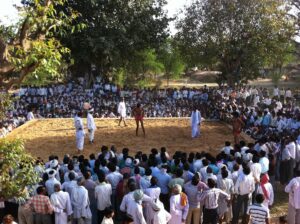
It is impossible to tell the story of Iranian Olympism without returning again and again to wrestling. The sport has accounted for more than half of Iran’s Olympic medals across all Games combined. Generations of coaches, clubs, and regional programs have been built around it. In small towns across Khorasan, Mazandaran, and Kermanshah, the local wrestling club is often the single most visible sporting institution.
The modern Iranian wrestling program, however, has faced more sophisticated international competition than at any prior point in its history. Russia, the United States, Azerbaijan, Georgia, and Japan have each invested heavily in elite-level freestyle and Greco-Roman programs. The 65-kilogram freestyle category, long considered an Iranian specialty, has become one of the most competitive weight classes in the world. Matches that Iran once won comfortably now come down to single takedowns in the final thirty seconds.
Coach Pejman Dorostkar’s generation of freestyle coaches has adapted the country’s technical tradition for this new environment, blending the classical upright wrestling style with an increased emphasis on leg attacks and conditioning. The results at Paris 2024 were mixed — one gold, several near-misses — but the trajectory toward LA 2028 remains credible.
The Weightlifting Dynasty
Weightlifting has been Iran’s second pillar since Salmasi’s London bronze. The super-heavyweight category, dominated by Hossein Rezazadeh from 2000 through the mid-2000s, passed through a transitional period in the 2010s before returning to Iranian hands in the late 2010s and 2020s.
Behdad Salimi, Sohrab Moradi, and Mostafa Rajai have each carried elements of the lifting tradition forward. The federation’s training infrastructure — based primarily at the national training centre in Tehran — remains one of the strongest in Asia. Iranian coaches have been recruited by multiple other federations, including in Central Asia, as consultants and permanent hires.
The international weightlifting landscape has been reshaped in recent years by rigorous anti-doping reforms, category restructuring, and the sport’s complicated political position within the Olympic movement. Iran’s program has navigated these changes without losing its medal-producing identity, though the 2024 Paris results were softer than historically expected.
Boycotts, Sanctions, and the Political Frame
The Iranian Olympic program operates within an unusually dense political frame. The absence from Moscow 1980 and Los Angeles 1984 established a precedent that sporting participation and political positioning are not always separable. In the years since, Iranian athletes have periodically withdrawn from specific competitions to avoid matchups with Israeli opponents — a policy that has attracted extensive international criticism and, in some cases, sanctions from international federations.
The 2019 case of judoka Saeid Mollaei, who left the Iranian program after being pressured to withdraw from a World Championship match to avoid an Israeli opponent, was a particularly visible example. Mollaei subsequently competed for Mongolia at Tokyo 2020 and won silver — a result that drew substantial media attention.
The international federations of judo, wrestling, and fencing have each, at different times, imposed disciplinary measures on Iran related to these withdrawal policies. Iranian athletes have sometimes publicly disagreed with the policies while remaining within the national program. The tension has shaped the country’s Olympic trajectory in ways that cannot be measured simply in medals.
Sources
Related Reading
- Iran’s current international sporting posture
- Tactical pieces from the SportsPersia desk
Frequently Asked Questions
Who was the first Iranian Olympian?
Prince Freydoun Malkom, a fencer who competed in the épée event at the 1900 Paris Olympics, representing Persia. He remains the country’s first recorded Olympic competitor.
When did Iran first send a full Olympic team?
At the 1948 London Games, Iran fielded its first full delegation — 36 men — after the National Olympic Committee was recognized by the IOC in 1947. Jafar Salmasi won the country’s first medal, a featherweight weightlifting bronze.
Which sports have produced Iran’s most Olympic medals?
Wrestling and weightlifting, by a wide margin. Together they account for the overwhelming majority of the country’s Olympic medal haul, with taekwondo and athletics filling out the remainder.
What is Iran’s outlook for Los Angeles 2028?
Iran is targeting continuity in wrestling and weightlifting while aiming for breakthroughs in basketball, volleyball, taekwondo, and athletics. A qualification campaign is already underway across multiple federations.