

Hassan Taftian at 32: The Patient Life of Iran’s Sprint King
By Saman Azizi — Published May 6, 2026
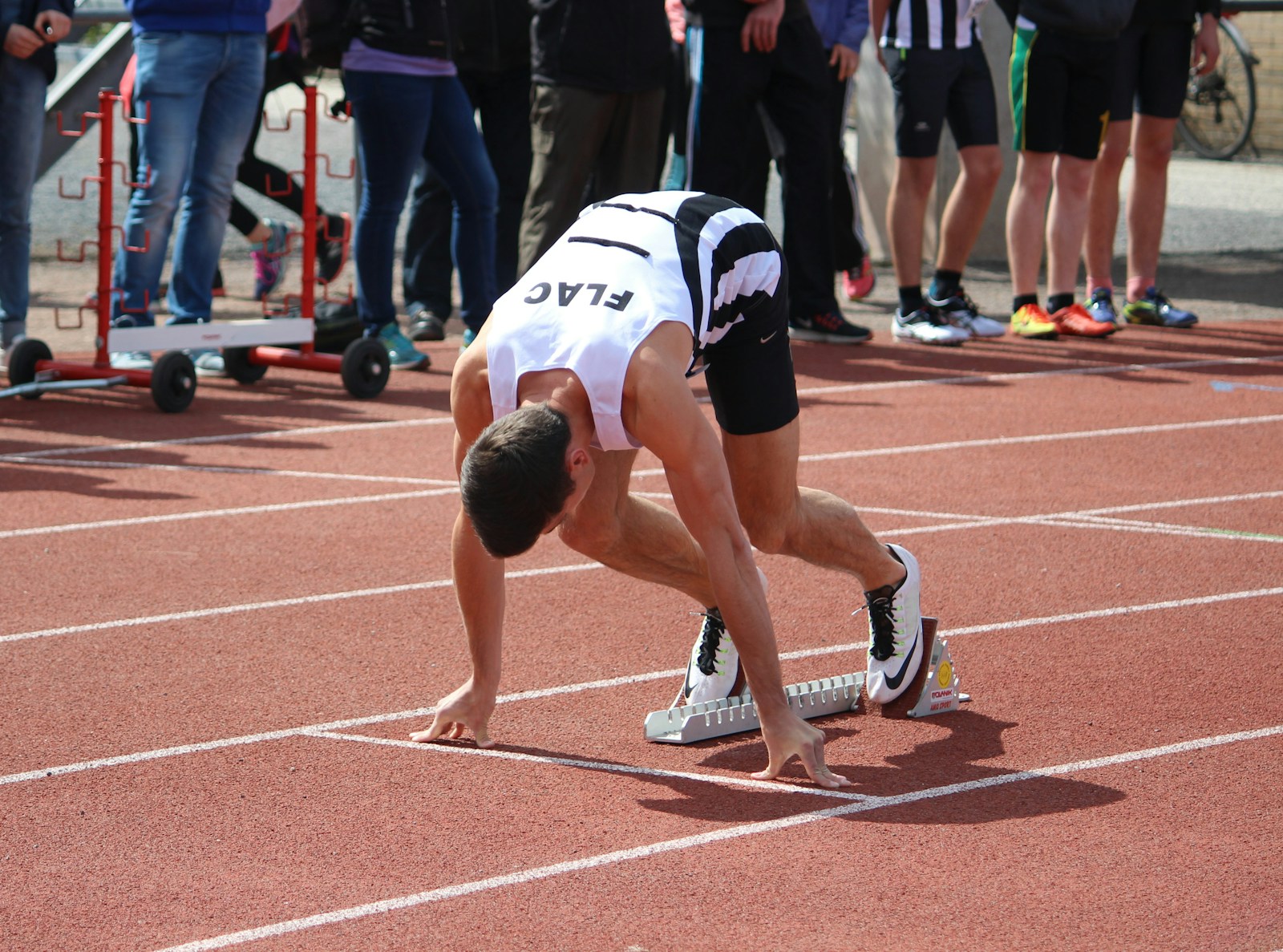
The starter’s commands in Gumi, South Korea, came in a clipped, formal English that carried cleanly across the empty-ish stands of the Gumi Civic Stadium. Hassan Taftian, in lane four of the 2025 Asian Athletics Championships 100 metres final, lowered himself into the blocks with the unhurried deliberation of a man who has done this more than a thousand times. He is 32. He has been the fastest man in Iran for more than a decade. He has competed at three Olympic Games, and the fourth — the last plausible one of his career, in Los Angeles in 2028 — is the reason he is still in a starting block at all.
He finished eighth that evening. The winner crossed the line a meaningful tenth ahead of him. By modern sprint standards, it was a respectable but unremarkable result. But Taftian, walking back to his kit bag afterward in Gumi’s mild autumn air, did not have the body language of a man finishing eighth. He had the body language of a man who had survived another final and who, more importantly, still had the legs to run more of them.
That patience — the acceptance that he is no longer a favorite but is still a contender — is the tone of his career now. It has not always been so measured. Understanding how Taftian arrived at this point requires walking back through a career that has quietly become the most accomplished in the history of Iranian athletics.
Torbat-e Heydarieh to Tehran
Hassan Taftian was born on May 4, 1993, in Torbat-e Heydarieh, a mid-sized city in the northeast of Iran, closer to the Afghan border than to Tehran. It is not a traditional athletics hub. The city is better known for saffron production, dried fruits, and a Sunni-majority cultural history that distinguishes it from much of surrounding Khorasan. Iranian track coaches who met Taftian as a teenager describe a slight, quick child who could already outrun every kid in his school by the time he was twelve.
He left for Tehran in his late teens to join the national athletics pipeline. Coaches there identified him as a pure sprint talent early — his acceleration out of the blocks was already unusual for an Asian sprinter of his era. Iranian athletics, historically far more invested in throwing events and middle distance than in sprints, had not produced a genuine 10-second 100-metre runner before Taftian. He was, in that specific sense, a kind of category error: a sprinter in a country that did not yet know how to coach one to world-class level.
Rio 2016: The Debut
At Rio 2016, Taftian was twenty-three. He qualified for the men’s 100 metres and reached the semifinals — an achievement that placed him among the fastest fifteen sprinters at the Games. He did not reach the final. He did not medal. But he was the first Iranian ever to compete in the semifinals of an Olympic 100 metres, and that fact alone drew coverage across Tehran’s sports media.
The following year, 2017, became the breakthrough that confirmed he was not a single-Games story. At the Asian Athletics Championships in Bhubaneswar, India, he won the 100 metres in 10.25 seconds, becoming the first Iranian to claim that title. World Athletics, in its coverage, highlighted his upset over the Qatari Femi Ogunode, who had owned Asian sprinting for the better part of a decade.
The 10.03 Breakthrough
On August 24, 2019, in a mid-tier European meet, Taftian ran 10.03 seconds. It is the Iranian national record. It is also, in context, a globally respectable time: inside the top hundred performers for that season worldwide, and faster than the qualifying standard for most major international championships.
He has not matched 10.03 since. Sprint experts who have reviewed his race tape in the years since identify a consistent issue — the last fifteen meters of his 100-metre races rarely match the acceleration profile of his peak 2019 form. He has acknowledged this publicly. It is a common arc for sprinters in their late twenties, and there is nothing unusual about it. What is unusual is that a sprinter in his early thirties, from a country without deep sprint infrastructure, is still running finals at all.
Tokyo 2020 and Paris 2024
At Tokyo 2020 — held, famously, in 2021 — Taftian again reached the 100 metres semifinals. Paris 2024 was harder. The depth of global sprinting had increased, particularly out of Jamaica, the United States, and a rising cohort of Nigerian and Kenyan sprinters. Taftian did not reach the semifinals in Paris. He ran cleanly in the heats, missed the cut by a few hundredths, and left the Stade de France for what many assumed would be his Olympic farewell.
He disagreed. Within a month of Paris, he was telling Tehran-based reporters that LA 2028 was his target. He would be 35 by the time the LA opening ceremony took place. Sprinters do not typically peak, or even remain internationally relevant, at 35. But Taftian’s training philosophy — conservative on volume, heavy on recovery, and structurally similar to the later-career programs of Kim Collins and Justin Gatlin — suggests he may be the exception.
The Indoor Chapter
An often-overlooked part of Taftian’s ledger is his Asian Indoor career. He has won the 60 metres at the Asian Indoor Athletics Championships twice — becoming one of the few Iranian sprinters to hold multiple continental titles across indoor and outdoor disciplines. His indoor racing has also been the laboratory where he tested starts, stride patterns, and recovery protocols before applying them to outdoor seasons.
Iranian coaches who travel with him on the indoor circuit describe him as methodical to the point of mild obsession. He logs every start time. He records weight-room loads to the half-kilogram. He brings his own sleep pillow on every flight. It is a professionalism that, his coaches say, has extended his career by at least two years.
The Record Ledger
| Achievement | Year | Venue | Time / Finish |
|---|---|---|---|
| Olympic debut | 2016 | Rio de Janeiro | 100m semifinalist |
| Asian Athletics Championship gold | 2017 | Bhubaneswar, India | 10.25 |
| National record 100m | 2019 | European circuit | 10.03 |
| Tokyo Olympics | 2021 | Tokyo | 100m semifinalist |
| 2025 Asian Athletics Championships | 2025 | Gumi | 8th in 100m final |
The Financial Reality
Track and field, unlike football, does not come with guaranteed athlete salaries in Iran. Taftian’s income over his career has been a patchwork: federation stipends, appearance fees from European meets, sponsorship arrangements with Iranian apparel brands, and occasional prize money from Asian competitions. He has never been wealthy by global athletics standards. He has been comfortable, by Iranian terms, and has spoken openly about the discipline required to make a sprinter’s budget work in a country without a commercial track circuit.
The federation, to its credit, has funded his training camps and his annual travel to European meets. Iranian sports media has covered him consistently. It is not a support system that rivals what American or Jamaican sprinters enjoy, but it is, by Middle Eastern standards, relatively generous.
The Coaching Shift
Since 2023, Taftian has worked with a mixed coaching team: an Iranian head coach for day-to-day programming and a European technical consultant, brought in on a quarterly basis, for start mechanics and race modeling. The setup is unusual for Iran but not unprecedented. Several of the country’s more successful Olympic athletes in the past decade have blended domestic and foreign coaching, and the federation has quietly come to see it as a pragmatic path.
Taftian’s most recent shift, reported in Tehran-based media this spring, is a greater emphasis on 60 metres work. The indoor distance has become the organizing principle of his 2026 season. He will chase an Asian Indoor title in the winter of 2026-27, use that as a building block for the outdoor 2027 campaign, and enter the LA 2028 qualification window with full hamstring and Achilles volume.
What He Means to Iranian Athletics
It is tempting to frame Taftian as a transitional figure — a sprinter whose career happens to span the beginning of Iran’s modernization of athletics. That framing is not wrong. But it undersells his actual impact. Young Iranian sprinters now exist. There is a cohort of teenagers running 10.4 and 10.5 second 100 metres in provincial competitions who cite Taftian as the reason they chose sprinting rather than football or volleyball. The federation has a development pipeline specifically for the sprints, a pipeline that did not exist in any functional sense before 2015.
Taftian built much of that pipeline by being the reason it existed. Without a 10.03 runner to look up to, the case for continued federation investment in sprinting would have been much harder to make.
The Question That Remains
Can Hassan Taftian reach a fourth Olympic Games? The math is unforgiving. The LA 2028 qualifying window will demand a 100-metre time somewhere in the range of 10.15 seconds, possibly faster. Taftian has run 10.2-low times in 2024 and 2025 but nothing at 10.15 or below since 2019.
He is not favored. But he is also not done. The combination of his indoor base, his continuing federation support, and the fact that the 100-metre field in Asia has thinned slightly since 2024 means that the door is ajar, not closed.
Whatever happens, he is already the most accomplished sprinter Iran has ever produced. The next two years will tell whether he can add one more chapter to a career that has already reshaped what Iranian athletics thinks is possible.
The Coaching Philosophy
Taftian’s current training philosophy, developed across his last two Olympic cycles, reflects a growing conservatism. Weekly volume has been reduced. Top-speed sessions are scheduled less frequently. Recovery days are prioritized over marginal additional work. The overall training load looks more like what an experienced marathoner might follow — patient, cumulative, and respectful of the body’s aging response — than what a 22-year-old sprinter in his first Olympic cycle might pursue.
This philosophy has been borrowed, in large part, from the late-career programs of sprinters like Kim Collins of Saint Kitts and Nevis, who ran a 9.93 100 metres at age 40, and Justin Gatlin of the United States, who remained competitive at world-championship level deep into his thirties. Taftian’s Iranian and European coaches have studied these case examples in detail. The working assumption is that with careful management, an elite sprinter can hold his peak or near-peak velocity through his mid-thirties, though the margins become increasingly narrow each year.
Whether Taftian can replicate these outlier examples is the open question of his career. The underlying math is uncompromising. Most 32-year-old sprinters are not competitive at world championship finals. A minority are. Taftian is betting that he will be among that minority for three more seasons.
The Competitive Mid-Season of 2026
Taftian’s scheduled 2026 outdoor season, as communicated through federation and management channels, includes appearances at mid-tier European meets in May and June, followed by the Asian Games trials in July, and culminates in the 2026 Asian Games — to be held in Nagoya, Japan — in late September. An Asian Games 100 metres medal would be the fourth of his career at that specific competition. It would also serve as a direct morale validation for the LA 2028 push.
The Asian Games medal race will likely be contested with Chinese sprinters Su Bingtian (at age 37, still a factor) and emerging Japanese sprinters including Yoshihide Kiryu, plus newer challengers from Thailand and Vietnam. The field depth at Asian Games level has risen measurably in recent cycles. Taftian’s ability to reach the final will itself be a competitive milestone.
Following Nagoya, the indoor 2026-27 season opens in December, beginning with small European circuit meets and building toward the Asian Indoor Athletics Championships in February. By the time the outdoor 2027 season begins, Taftian will be 34. The LA qualification window will be open. The countdown will effectively have begun in earnest.
The Training Camp Year
Taftian’s typical annual training calendar has, for most of his career, been built around two long blocks in Europe. The first, in Portugal or southern France, occupies the late winter and early spring — heavy speed work, block starts, and maximum velocity sessions on long-straightaway tracks. The second, in Italy or the Netherlands, occurs in mid-summer to sharpen race-model execution before the major continental meets.
The financial and logistical realities of these camps have shifted considerably. Currency devaluation in Iran has made European training substantially more expensive for Iranian athletes funded through a combination of federation support and personal resources. Taftian has, in several interviews, described the annual calculus as a genuine constraint: how many weeks in Europe can be funded, how much equipment can be imported, how many private flights for pre-competition travel can be absorbed.
For 2026, the federation has committed to partial funding for two European training blocks. The rest is on Taftian personally. It is the kind of arrangement that has become typical for Iran’s internationally competitive individual athletes.
The Generation Behind Him
One measurable sign of Taftian’s impact on Iranian athletics is the pipeline of sprinters now coming up behind him. Reza Ghasemi, born in 2002, has run 10.22 in competition and is considered by federation technical staff to be the most likely future national record-holder. Arash Khademi, 21, has focused on the 200 metres but has sub-10.3 capability at 100 as well. A broader cohort of under-23 runners operates in the 10.4 to 10.5 range — not internationally elite, but consistent enough to sustain a development pyramid.
None of this existed in any meaningful form before Taftian. Iranian sprinting in the 1990s and 2000s was characterized by isolated individual talents without a structural pipeline. The federation’s current sprint-development program — which includes formalized junior coaching, regional training centres, and an annual talent-identification combine — was built during the years Taftian was in his prime.
Whether any of the current under-23 sprinters reaches Taftian’s level is an open question. Sprinting is an unforgiving sport, and a 10.4-second junior does not automatically become a 10.0-second senior. But the infrastructure that would make such a progression plausible now exists in a way it did not a decade ago.
The Indoor Strategy and the LA Math
The 2026-27 indoor season is, by Taftian’s own description, the laboratory for his LA 2028 campaign. The 60 metres is a pure acceleration event — it measures the first six seconds of a sprinter’s race, which is precisely the part of the 100 metres that ages last in most careers. Older sprinters often hold their top-end speed and drive phase better than their late-race velocity. By emphasizing 60 metres work, Taftian is building on the portion of his race that his body still executes at elite levels.
The Asian Indoor Athletics Championships in early 2026 will be a major midseason target. A third continental indoor title would be an unprecedented achievement for an Iranian sprinter and would send a signal to the outdoor 2026 competitors that his form has not deteriorated.
Beyond the indoor title, the outdoor 2026 season will need to produce 100 metres times in the 10.1-second range if Taftian is to credibly challenge for LA 2028 qualification standards. This is the honest, uncomfortable number that his training team has internalized. The margins are tight. They are also not impossible. Sprinters in their mid-thirties have run these times before. Not often, and not reliably, but they have done it.
The Quiet Public Life
For all his competitive accomplishments, Taftian maintains a relatively low public profile. He uses social media sparingly. He gives interviews when asked but does not seek them. He has avoided the celebrity-athlete tabloid coverage that some of his Iranian football counterparts attract. In Tehran he lives quietly, reportedly in an apartment in the central part of the city. His commercial endorsements are modest by the standards of top international sprinters.
This reserved posture has probably helped extend his career. He has not burned through his competitive focus with media obligations. He has not built his identity around anything other than running fast. When he speaks publicly, he speaks primarily about the technical details of his sport. It is an approach that has more in common with long-distance runners than with sprinters, whose public personas often lean theatrical.
Sources
- Wikipedia — Hassan Taftian
- World Athletics — Taftian wins Asian 100m title
- Olympics.com — Hassan Taftian profile
Related Reading
- Iran’s current international sporting posture
- More analysis pieces from the SportsPersia desk
Frequently Asked Questions
What is Hassan Taftian’s 100m personal best?
10.03 seconds, set on August 24, 2019. It remains the Iranian national record and one of the fastest times ever recorded by a Middle Eastern sprinter.
How many Olympic Games has he competed in?
Three — Rio 2016, Tokyo 2020, and Paris 2024. He is the first Iranian sprinter to reach three Olympic Games.
What Asian titles has he won?
Two Asian Indoor 60m titles and the 2017 Asian Athletics Championship 100m gold in Bhubaneswar — the first ever by an Iranian sprinter at that event.
Is Taftian targeting Los Angeles 2028?
Yes. He has publicly stated that LA 2028 is his current focus and has structured his 2026 competition calendar around holding his top-end speed into his mid-thirties.