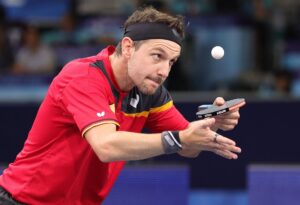
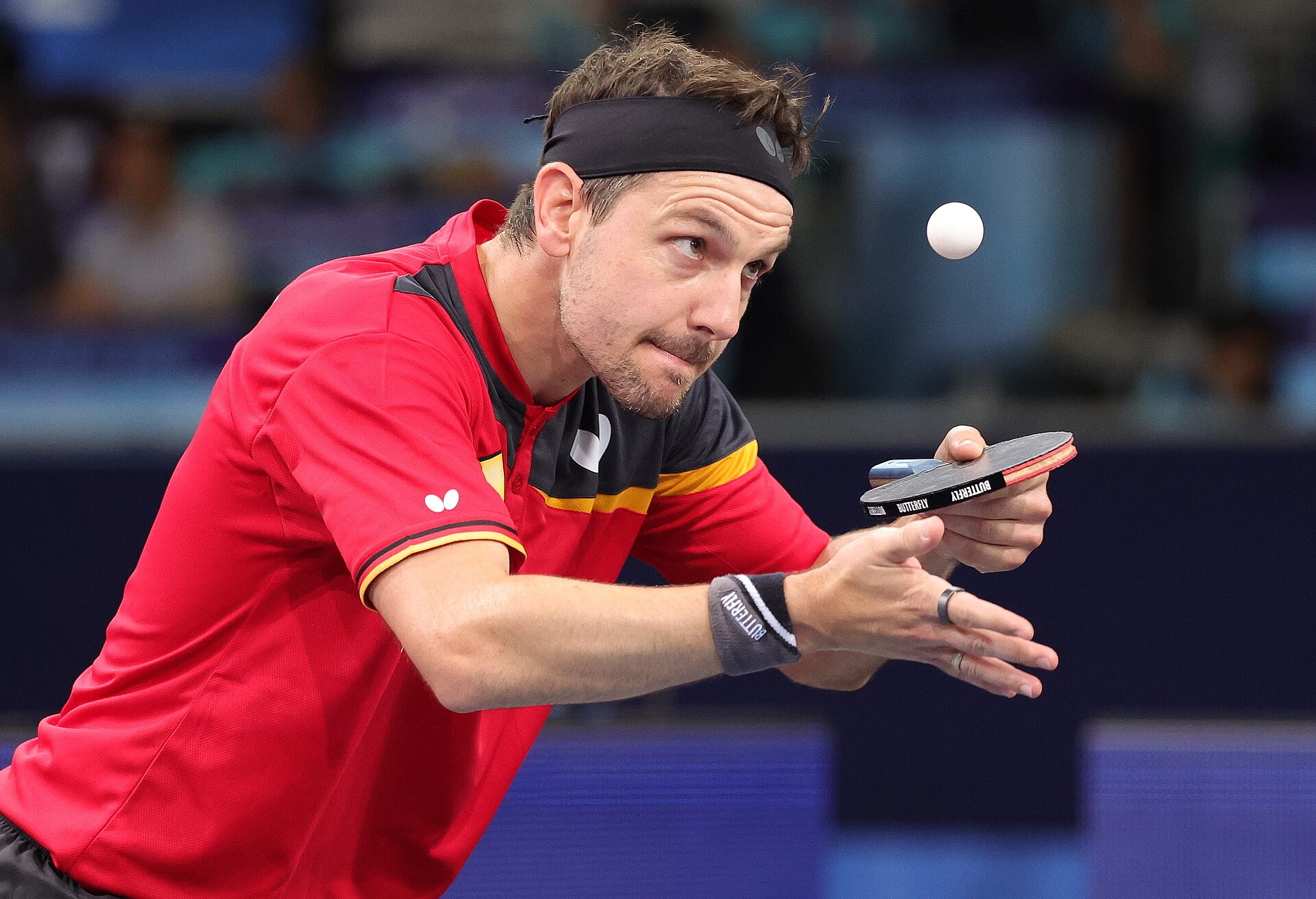
Two coaches in the same hall watch the same eleven-year-old and reach opposite conclusions. One sees a fast pair of hands close to the table and wants short pips on the backhand by the end of the season. The other sees a player who will be tall in four years and wants topspin from both wings and nothing else.
Both are describing a real pathway, and the decision is not reversible in any cheap way. A junior who spends three years blocking and hitting close to the table has built a set of reflexes that a looping style will spend two more years dismantling, and the same is true in the other direction.
What follows measures the two on the same scale: what the equipment does, what each style can and cannot do against a stronger opponent, what it costs a club to develop, and how well each one survives contact with international competition.
The two styles side by side
- Where the player stands. Short pips: at the table, inside the end line. Two-winged loop: a step or two back, with room to rotate.
- The primary shot. Short pips: a flat, early hit or block taken on the rise. Loop: a brushing topspin from either wing.
- What decides the point. Short pips: time taken away from the opponent. Loop: spin and placement, over several exchanges.
- Equipment cost. Short pips is cheaper to run and the rubber lasts longer. Tensor rubbers on both wings are the largest recurring cost in a junior programme.
- Junior demands. Short pips needs a coach who understands the rubber. Looping needs footwork volume, a physical base and better training partners.
- The honest summary. One reaches a competitive level faster. The other has the higher ceiling and takes longer to reach it.
What the argument is actually about
The disagreement is not really about rubber. It is about what a national programme is trying to produce and over what timescale, and the equipment is the visible end of that decision.
A club judged on provincial results next season has an incentive toward the style that wins earliest. A federation judged on who is competitive at senior international level in eight years has the opposite incentive. Both are rational and they point at different eleven-year-olds.
The cost of getting it wrong falls entirely on the player. A junior developed for early results and then asked at sixteen to rebuild as a looper loses the two years in which the physical base for looping is normally built, and the players who survive that transition are the ones who started it earliest.
Table tennis playing styles, defined by where the player stands
The useful way to classify table tennis playing styles is not by the shot but by distance from the end line, because everything else follows from it.
A player standing at the table has less time and gives less time. The ball is taken on the rise, often before the bounce has finished developing, and the point is won by removing the opponent’s preparation window rather than by producing a shot he cannot handle. That position rewards short strokes, a stable wrist and anticipation, and it punishes anyone who needs a full backswing.
A player standing a metre back has time to rotate the trunk, load the legs and brush the ball, and the point is won by the quality of the spin and by moving the opponent across the table. That position rewards footwork, physical capacity and consistency over a longer rally, and it punishes a player who cannot recover position between shots.
Short pips: what the rubber does to the ball
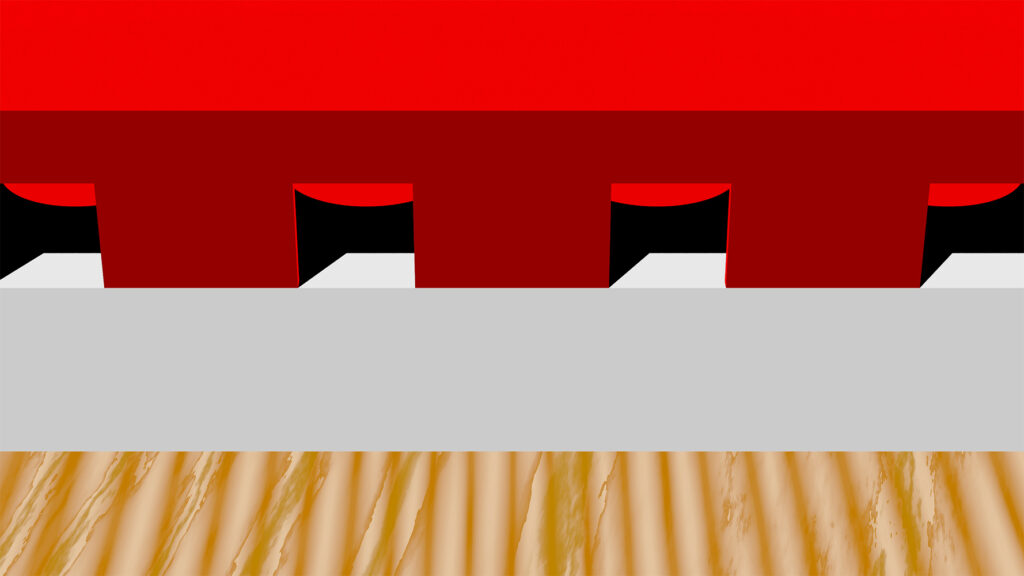
Short pips is pimpled rubber with the pimples facing outward and no sponge-and-smooth-surface combination to grip the ball. The contact is shorter and flatter, and the two practical consequences are the whole argument for the style.
The first is reduced spin sensitivity. Incoming topspin grips a smooth inverted rubber and kicks the ball upward, which is why a beginner blocking a heavy loop with inverted rubber sends it off the end. Short pips grip much less, so an incoming loop can be blocked or punched back with a small, stable movement and the ball comes off flatter.
The second is that the player also generates less spin. A short-pips hit travels fast and straight with very little rotation on it, which is difficult to read for an opponent used to spin, and which offers that opponent an easy ball to attack if the placement is poor. The style therefore lives on placement and timing rather than on margin.
The two-winged loop: spin as the default setting
The looping style uses inverted rubber on both sides and treats topspin as the resting state of every rally. Almost every ball is brushed rather than hit, the arc over the net is generated by rotation rather than by height, and the margin for error comes from the spin dipping the ball onto the table.
The technical demand is coordination between the legs, the trunk and the arm in that order. The power is produced by the ground and the rotation, not by the forearm, which is why a junior with a technically correct loop and no strength still produces a heavy ball while a strong junior swinging with the arm does not.
The backhand is the part that changed most in the last two decades. A modern player is expected to open a rally with topspin from the backhand over the table as well as from the forehand at distance, and the short backhand flick has moved from a specialist trick to a required skill. That expectation is what makes the style expensive to teach: it is two full techniques rather than one plus a block.
Equipment, and where the money actually goes
The blade is the cheapest long-term item and the one families spend the most time choosing. A serviceable wooden blade lasts years and its influence is real but modest; the rubber is where performance and cost both sit.
Modern inverted rubbers are the recurring expense. A performance rubber on both wings, replaced when the top sheet loses grip, is a per-season cost that recurs indefinitely, and a junior training seriously will wear one out well within a season. Short pips is cheaper to buy and considerably slower to wear, which is a genuine consideration in a club funded by fees.
Two constraints are worth knowing before spending. Competition rubber has to be on the approved list maintained by the international federation, and the two sides of the bat have to be visibly different colours so an opponent can see which surface was used. Both are checked at serious events, and a junior who has trained on unapproved rubber discovers the problem at the worst moment.
Three rule changes that moved the ground under both
The equipment argument is often conducted as if the conditions were fixed. They are not, and three changes since the turn of the century altered the balance between the styles.
The ball became larger and then changed material. A bigger ball with a plastic construction carries less spin and less speed than the smaller celluloid ball it replaced, which reduced the advantage of extreme spin generation and slightly favoured physical power and placement.
The scoring changed from twenty-one-point games to eleven, with service changing every two points instead of every five. Short games reward a fast start and a style that can impose itself immediately, and they reduce the value of grinding an opponent down over a long game. And the prohibition on volatile speed-boosting treatments removed a layer of speed from inverted rubbers specifically, which narrowed the gap between the two styles rather than widening it.
The tactical ceiling of each
Against an opponent of similar level, both styles win. The difference appears against a stronger one, and it appears in a specific way.
The short-pips player’s advantage is time, and time can be taken back. A stronger opponent serves shorter and heavier, keeps the ball away from the hitting zone, and forces the pips player to open the rally himself, which is the one thing the style does not do well. Once the player has to generate rather than redirect, the flat, low-spin ball becomes an invitation.
The looper’s limitation is different and slower to arrive. It is physical and positional: a looping rally at senior international pace demands recovery between shots that a player without the footwork base cannot sustain, and the style fails through fatigue and lost position rather than through being read.
The important asymmetry is that the second limitation can be trained away and the first largely cannot. Footwork and conditioning improve with work. A style built on denying an opponent time has no answer when the opponent refuses to give a ball worth taking early.
What each style asks of a junior programme
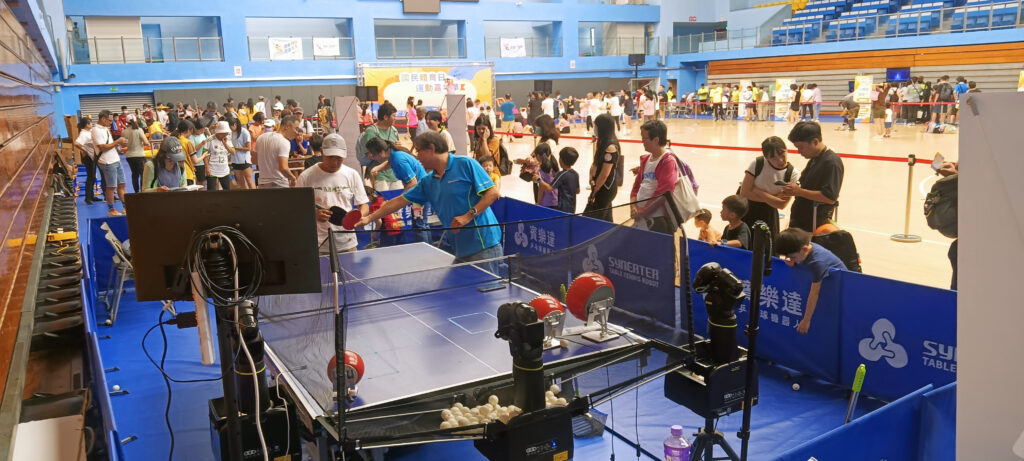
The demands diverge more in the training hall than on the table. A short-pips junior needs a coach who genuinely understands the rubber, because the technique is not a modified inverted technique and coaching it as one produces a player who does neither properly. Coaches with that specific knowledge are scarce, and a club without one should not choose the style.
A looping junior needs three things a small club often lacks: training partners who can feed a consistent heavy ball, floor space behind the table, and enough hours to build footwork through multi-ball repetition. The last is the binding constraint in most halls, since a shared facility rarely offers the volume the style requires.
Both need a physical programme, and the looper needs it earlier. Legs, hips and rotational capacity underwrite the whole style, and a junior who arrives at fifteen with a good loop and no physical base has a technique he cannot repeat for five games. General work on structured coaching programmes tends to underestimate how early that base has to start in racket sports.
Transfer to international competition
The record at international level is fairly consistent across decades and worth stating plainly: the two-winged loop is the dominant style at the top of the sport, and pimpled-rubber specialists exist as a minority who trouble opponents precisely because they are unfamiliar.
That unfamiliarity is a real asset and a fragile one. A pips player meeting an opponent who has never practised against the rubber has an advantage in the first meeting that shrinks in the second and largely disappears by the third, because the adjustments are known and coachable.
The corollary for a national programme is uncomfortable. A short-pips player can produce results at regional level and against unprepared opposition, and those results are real. What they do not reliably predict is performance in a competition where the same opponents recur, which is exactly the structure of senior international qualification.
Head to head, on the same measures
| Measure | Short pips at the table | Two-winged loop |
|---|---|---|
| Time to a competitive level | Shorter | Longer |
| Recurring equipment cost | Lower, rubber lasts | Higher, rubbers replaced often |
| Space required | Minimal behind the table | Two to three metres |
| Coaching required | Specialist knowledge of the rubber | Widely available |
| Physical demand | Moderate, mostly reaction | High, legs and rotation |
| Ceiling against prepared opposition | Limited once the serve is adjusted | Limited mainly by conditioning |
| Presence at senior international level | Minority, valued for surprise | The standard |
Choosing for the player rather than for the philosophy
A defensible decision looks at four things about the specific child, and none of them is the coach’s preference. Reaction speed and hand stability at the table point one way. Projected height, leg strength and willingness to do repetitive footwork point the other.
The second consideration is the hall. A club with one table, no space behind it, six hours a week and no partner who can feed a heavy loop cannot develop a looper honestly, and pretending otherwise produces a junior with a half-built technique and no results. Choosing the style the facility can actually support is not a compromise; it is the only version of the decision that is real.
The third is reversibility, and it argues for one default. A junior taught inverted rubber on both wings can adopt pips later in a season or two. A junior taught pips from the start is rebuilding from the ground when the change is required. Where the information is genuinely uncertain, the reversible option is worth the slower results, and that is the reasoning behind most modern development syllabuses. Access to hall time remains the practical barrier, as accounts of school sport provision repeatedly show.
Frequently Asked Questions
Is short pips a beginner’s rubber?
No, and treating it that way produces bad players. It is a specialist surface with its own technique, and it needs a coach who knows it. Used as a shortcut around learning to handle spin, it hides a weakness that reappears at the first serious level.
Why is the two-winged loop dominant internationally?
Because it scales. Its limits are conditioning and footwork, both of which improve with training, whereas a style that depends on taking time away from an opponent has no answer when the opponent serves short and heavy and refuses to offer a ball worth attacking early.
How much does rubber actually matter compared with the blade?
Rubber decides how the ball leaves the bat and is replaced regularly. The blade influences feel and speed and lasts for years. For a junior, the money is better spent on rubber that is current and on the approved list than on an expensive blade.
At what age should the style be decided?
Later than most clubs decide it. The reversible route is inverted rubber on both wings while the technical base is built, with a specialist surface introduced only when there is a clear reason and a coach who can teach it properly.
Can a player use short pips on one side and inverted on the other?
That combination is common and legal, provided both rubbers are approved and the two sides are different colours. It is also the version of the decision that keeps the most doors open, since the player still develops a full topspin technique on one wing.
The rubber is a consequence of a decision about distance, hours and the coach available, and clubs that make it in that order rarely regret it. Clubs that pick a philosophy first end up fitting a child to it.