
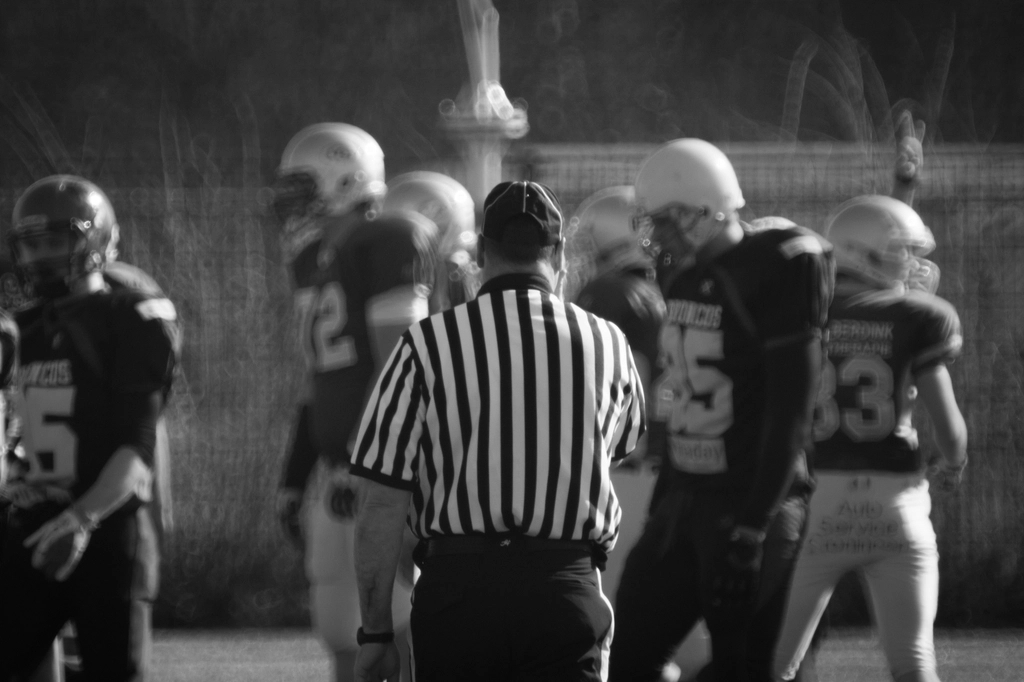
Two hours before kick-off in a provincial ground, a man in a tracksuit walks the pitch alone, checking the goal nets and the paint on the penalty area. He is not a groundsman. He is the match official, and the walk is part of a report he will file whether or not anything happens in the ninety minutes.
Refereeing looks like a job you get because someone thinks you are good at it. It is closer to a licensing regime with an annual renewal. There is a course, a written examination, a physical test with a pass mark, a medical, and a stream of written assessments that accumulate into a ranking. The appointment sheet published each week is the visible end of that machinery.
Below is how an official moves up it, how he is judged once he is on it, and why the appointment for a given fixture rotates instead of settling on whoever is best.
Grades, tests and reports: the three things that decide an appointment
- Grade. The category an official holds. It sets the ceiling of what he can be appointed to, and it is reviewed annually.
- Tests. Physical, written and medical, repeated every season. A failure removes eligibility until the retest, regardless of reputation.
- Reports. Written assessments from observers at matches, weighted by fixture difficulty. These accumulate into a merit ranking within the grade.
- Constraints. Neutrality, rest days, travel and recent history with the two clubs. These decide which of several eligible officials actually gets the match.
- What is not on the list. Seniority on its own, and public opinion about a previous performance.
Who appoints, who assesses, and why the two are kept apart
Three functions sit in different rooms on purpose. A refereeing committee under the federation owns the pathway: courses, examinations, grading and discipline. An appointments group allocates officials to fixtures. An observer corps attends matches and files reports on performance.
The separation exists because combining any two of them creates an obvious problem. If the people who appoint also assess, an official who wants matches learns quickly whose opinion to please. If the people who grade also appoint, promotion becomes a matter of who has been given the easier fixtures.
The separation is never perfect, because the same small pool of former officials tends to staff all three. What it does achieve is a paper trail: an appointment that looks strange has to survive a written report from someone who was not part of making it. Governance debates in the domestic game keep returning to that paper trail, in refereeing as in the wider argument about integrity monitoring in competitive sport.
What Iranian football referees training covers, course by course
Entry begins at a provincial refereeing committee, not at the federation. The introductory course is short, typically run over several weekends, and covers the seventeen laws, the mechanics of positioning, signalling and cooperation with assistants, and a first pass at match control. It ends with a written examination and a practical assessment on youth or amateur matches.
Iranian football referees training then advances in stages rather than in one qualification. Each stage adds three things: a narrower law syllabus focused on the cases that decide matches, a harder physical standard, and a requirement for a minimum number of assessed matches at the level below. A candidate cannot skip the match count by passing the exam brilliantly.
The written examination is unglamorous and much harder than outsiders expect. It is not a memory test on the text of the laws; it is a set of scenarios where two laws interact and the candidate has to state the restart, the sanction and the reasoning. Officials in other codes sit an equivalent paper — the structure of a rules examination in volleyball is recognisably the same exercise with a different rulebook.
Video sessions have become the core of the modern course. Candidates watch clips cut to the moment before a decision, commit to an answer, and then defend it against the room. The purpose is calibration: getting a group of officials to reach the same conclusion from the same footage is more valuable than getting any individual to be brilliant.
The fitness test is a gate, and it is failed every year

The physical standard is not a formality attached to the licence. It is a pass or fail conducted on a track under observation, and officials who fail are not appointed until they retest.
The test has two parts, and they measure different things. The first is repeated sprint ability: a series of short maximal sprints with a fixed recovery between them, each of which must be completed inside a time limit. The second is an interval test, alternating a run over a set distance with a short walking recovery, repeated for a large number of laps. The sprint half fails the unfit; the interval half fails the untrained.
The times required vary by category, with the top domestic and international groups held to the tightest standards. That gradient matters more than the absolute numbers, because it means a promotion is also a physical commitment. An official moving up a grade is accepting a harder retest every season for as long as he holds it.
A separate medical examination runs alongside it. Cardiac screening is standard, and it is one of the few areas where refereeing has moved faster than playing squads at the same level.
The categories, and what each one unlocks
Domestic grading runs in tiers, described in most systems as third, second and first category, with an elite group above them from which top-flight appointments are drawn. Names differ between federations; the logic does not. Each tier defines a maximum level of competition an official may be appointed to, and appointments below that level remain available.
Promotion between tiers is decided at the end of a season on the accumulated assessment record, subject to having passed the tests and completed a minimum number of matches. Relegation works the same way and is more common than supporters assume. A poor season does not end a career, but it removes a grade and the fixtures that came with it.
Above the domestic ladder sits the international list. Each association nominates a limited number of officials to it annually, and the quota is small enough that the list is a ranking of a ranking. Confederation competition then applies its own categories on top, so an official can be domestically elite and still be appointed to early-round continental fixtures for several years.
The assessment report is the real currency
An observer sits in the stand with a structured form. He records the match difficulty, the key decisions and their correctness, positioning and movement, use of advantage, management of players and staff, cooperation with the assistants and the fourth official, and the overall control of the match. The result is a numerical score inside a defined band, plus written commentary.
The difficulty weighting is the part that makes the system defensible. A quiet mid-table fixture with three fouls of note cannot produce the same score as a derby with two penalty claims and a red card, because the second match offered more opportunities to be wrong. An official who only ever handles quiet fixtures cannot climb quickly, which is itself an argument for rotating hard matches around a group.
Key match incidents are reviewed separately. Where a decision is judged clearly incorrect on video, it enters the record regardless of the general performance, and a run of them will hold an official at his grade for a season even if his match control is excellent.
Why the same official does not keep getting the same clubs
Rotation is a deliberate policy with four distinct reasons behind it, and only one of them concerns bias.
The first is neutrality in appearance. An official who has taken charge of a club three times in a season is a story waiting to be written, whatever he does in the fourth match. Removing the pattern removes the story.
The second is familiarity in fact. Officials and squads learn each other. A captain who has worked out where a particular referee’s tolerance sits will operate at the edge of it, and the referee’s own expectations of a known squad start to run ahead of what is happening in front of him.
The third is development. If the strongest official takes every difficult fixture, nobody else accumulates the assessed experience needed to be promoted, and the group thins from below. Distributing hard matches is a squad-building exercise for the refereeing pool.
The fourth is exposure management. A fixture such as a title-deciding match late in a season carries scrutiny that will follow whoever takes it for months. Spreading that load across a group is a workforce decision as much as a sporting one.
Rest days, distance and the constraints on any appointment
Once eligibility and neutrality have narrowed the field, the practical constraints finish the job. An official is normally not appointed to consecutive matches without a defined rest period, because the physical demand of a first-tier fixture is comparable to that of a midfielder and the recovery is the same.
Travel is the second filter. Domestic distances here are substantial, and an appointment that requires two days of travel around a working week is a different proposition from one an hour away. Most officials hold other employment, and the appointment sheet has to survive contact with their jobs.
Provincial origin is the third. An official from the same province as one of the clubs is normally avoided at the top level, which in a league with several clubs concentrated in the capital removes a large part of the available pool for those fixtures before anything else is considered.
Put together, an appointment that looks arbitrary from outside is usually the only remaining option after five filters have been applied in order.
The assistant referee runs a separate career
An assistant referee is not a referee who has not been promoted. It is a distinct specialisation with its own course, its own tests and its own progression, and moving between the two roles at senior level is uncommon.
The physical test differs accordingly. Assistants sit a change-of-direction test alongside the sprint and interval work, because the movement pattern of the role is sideways acceleration and deceleration rather than sustained running. Offside judgement is assessed on video with clips frozen at the moment of the pass.
The specialisation has become sharper since video review arrived. An assistant is now coached to delay a marginal flag so that a goalscoring situation can play out and be reviewed, which inverts the instinct the role trained for two decades. That change is taught in the course, not learned on the job.
Video review added a second certification

Working in a video review room is a separate qualification. An official who is fully certified on the pitch cannot operate the system without completing a dedicated course, a block of offline training on recorded matches, simulator sessions and a set of live matches under supervision.
The skill is genuinely different. On the pitch the task is to decide; in the review room the task is to determine whether the on-field decision is clearly and obviously wrong, which is a threshold judgement rather than a fresh one. Officials who are excellent on the pitch are not automatically good at that, and the training exists to find out which.
Simulation has become the standard tool for building the hours, and the wider adoption of simulated training environments in domestic sport has made repeated decision drills cheaper to run than they were when every session required a match.
A category-by-category reference
| Level | Typical appointments | Annual requirements | Assessment coverage |
|---|---|---|---|
| Entry / provincial | Youth, amateur and provincial leagues | Course, written exam, basic fitness test | Occasional, by the provincial committee |
| Third category | Lower divisions and regional competition | Retest, refresher course, minimum match count | Regular, several reports a season |
| Second category | Second tier and top-flight fourth official | Harder fitness standard, video assessment | Most matches observed |
| First category / elite | Top flight, cup finals | Tightest fitness times, full medical, seminars | Every match observed and reviewed |
| International list | Continental club and national team fixtures | Association nomination, confederation seminars | Confederation assessors in addition to domestic |
The pattern to read from that table is that scrutiny rises faster than status. An elite official is not primarily someone with more authority; he is someone whose every match is written up.
Frequently Asked Questions
How long does it take to reach the top flight?
The binding constraint is assessed match count, not ability, so the answer is measured in seasons rather than courses. An official has to accumulate a record at each level before he can be considered for the next, and each step has its own minimum.
Can a referee be removed from a fixture after the appointment is published?
Yes. Injury, a failed fitness retest, a late change of venue that creates a neutrality problem, or a club objection upheld by the appointing body can all trigger a change. Late changes are usually logistical rather than disciplinary.
Are referees full-time professionals?
In most domestic structures they are paid per appointment and hold other employment, with full professional contracts limited to small elite groups where a league can fund them. That funding question shapes availability, travel and how much midweek training is realistic.
What happens after a serious error?
It is recorded in the key match incident review, discussed in the next seminar, and it affects the merit ranking. Short-term consequences are usually a period without appointments at that level rather than a formal sanction, unless conduct rather than judgement is at issue.
Does the training cover dealing with crowds and pressure?
Increasingly, yes. Match control, communication with captains and coaching staff, and managing a hostile environment are assessed categories on the observer’s form, so they are taught rather than left to temperament.
Why do assistants sometimes keep the flag down on an obvious offside?
Because in matches with video review the instruction is to delay the flag when a goalscoring opportunity is developing, so that the phase can be completed and reviewed. The decision has not been missed; it has been deferred by design.
The reason a referee’s name on Thursday’s appointment sheet is rarely a surprise to anyone inside the system is that by then it has survived a grade, a test, a stack of reports and four scheduling filters. Everything the supporter sees on Friday evening is the last five per cent of that process.