
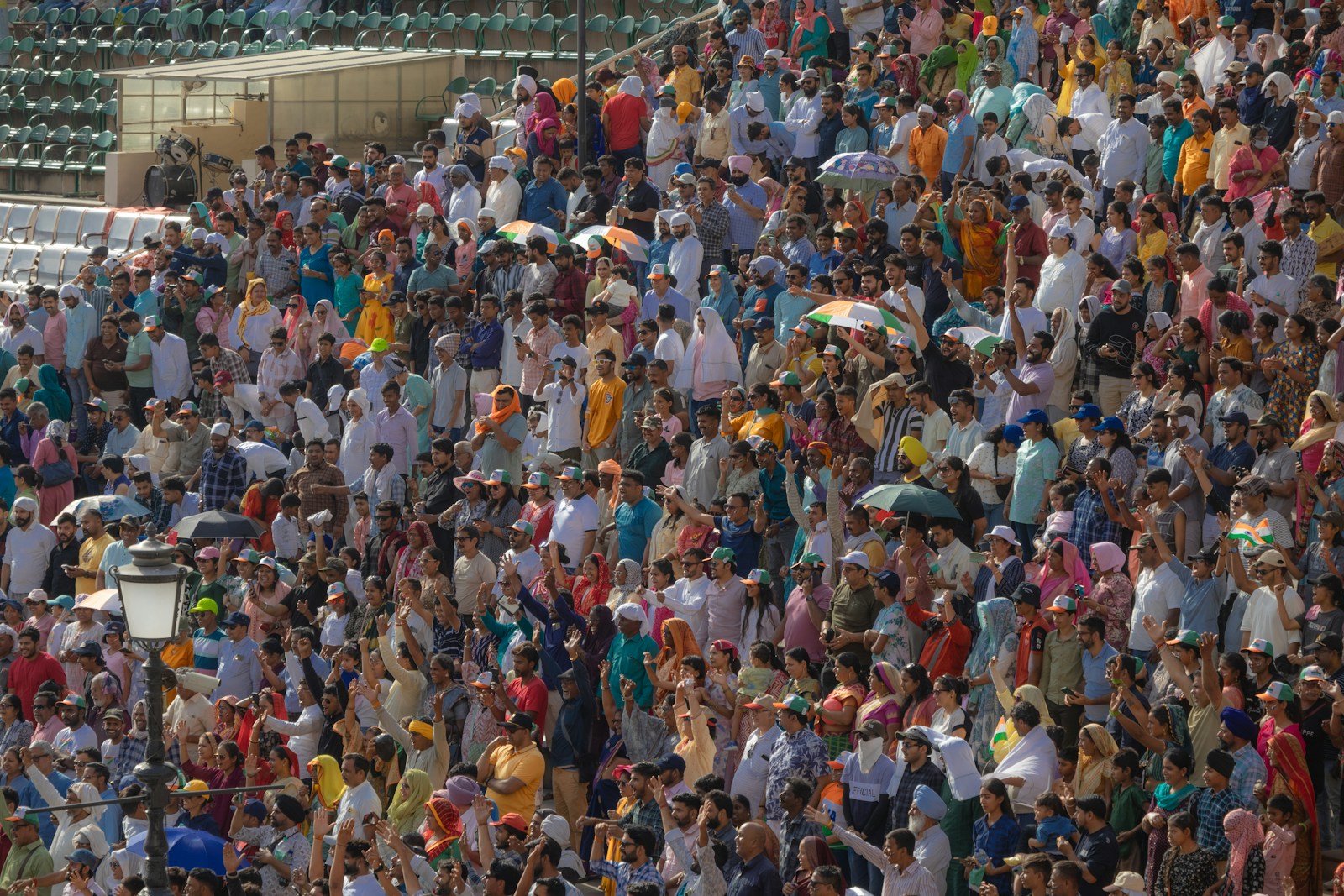
The first thing you notice about derby day in Tehran is the smell. From six hours before kickoff, long before a single ticket is scanned, the air around the Azadi sports complex turns heavy with kebab smoke, petrol from idling Peykans and Samands, and the faintly sweet chemical tang of the red and blue flares that get smuggled past security no matter how many times the federation promises they won’t. The second thing you notice is the silence in the metro carriages. Red scarves sit across from blue ones. Nobody speaks. Everybody waits.
This is the Tehran derby — Persepolis against Esteghlal, or as the older generation still calls the blue half, Taj. By the count most Persian football historians accept, the two clubs had played 106 competitive first-class matches between them as of the 2025/26 Matchweek 12 fixture on 5 December 2025. That match, the 106th, ended goalless at IRALCO Stadium in Arak in front of roughly ten thousand spectators, a number almost comically small for a fixture that once drew crowds that pushed stadium infrastructure to its physical limits.
The Tehran derby is routinely ranked among the most intense club rivalries on the continent, and has appeared on World Soccer’s lists of global must-see fixtures. What the lists don’t always capture is that Persepolis and Esteghlal are not just two football clubs. They are, in a way few other derbies in the world still really are, a story of class, of monarchy and revolution, of what a divided city does with its Friday afternoons.
How a Wrestling Club Became Persepolis and a Palace Favourite Became Taj
Persepolis was founded in 1963 as an attempt to give working-class Tehran a football club of its own. Its roots were in Ali Abdo’s wrestling and boxing gym. Its crest borrowed from Cyrus the Great’s ancient capital. From the beginning, its supporter base skewed toward bazaaris, factory workers and the southern, less wealthy districts of the city.
Taj — meaning “crown” — had been founded in 1945 under royal patronage. Its badge carried a literal crown. Its colours were imperial blue. Its players were celebrated at the Shah’s court. After the 1979 revolution, keeping a crown on the front of a football shirt was politically untenable, and Taj was renamed Esteghlal — “independence.” The crown came off the badge. The royalist associations did not.
Older Tehranis will still tell you, half-joking and half-not, that you can guess a stranger’s politics by the scarf they were raised in. It is an oversimplification, and in today’s Tehran the lines blur: plenty of reformist families follow Persepolis, plenty of bazaar merchants follow Esteghlal. But the shorthand persists because it is rooted in something real. The derby carries a class memory that the rest of Iranian football simply does not.
The First Meeting and the Early Decades
The two sides met in a competitive league fixture for the first time in 1969, though friendlies between Persepolis and Taj had been played as early as 1968. The league met-for-real first ended with a Taj victory, and the template was set. Tight games, few goals, and the kind of post-match newspaper columns that read like family feuds.
Through the 1970s, Taj dominated. Through the 1980s and early 1990s, against the backdrop of the Iran–Iraq War and a league that was often paused or played in empty stadiums, the balance shifted. By the time the Azadi League became the Persian Gulf Pro League in 2006 and Iranian football re-professionalised, the rivalry had settled into something more even, with title-winning runs traded between the two clubs almost decade by decade.
Azadi: The Theatre
Azadi Stadium opened in 1971 under its original name, Aryamehr, and was renamed after the revolution. The name means “freedom.” For a generation of Iranian football supporters, it means something closer to pilgrimage. Built for the 1974 Asian Games, expanded and then scaled back, its current official capacity sits around 78,000 after post-2002 renovations, though for the biggest fixtures that number is routinely stretched.
The stadium’s record attendance — an estimated 128,000 fans reportedly crammed into a venue then rated at 100,000 — came not from a derby, as is sometimes claimed, but from the Iran vs Australia World Cup qualifier on 22 November 1997, the match that sent Iran to the 1998 France tournament. Supporters climbed floodlight bases to watch. Some accounts place the real figure higher. No derby match since has matched that number, and after the 2002 reduction in capacity, none ever will.
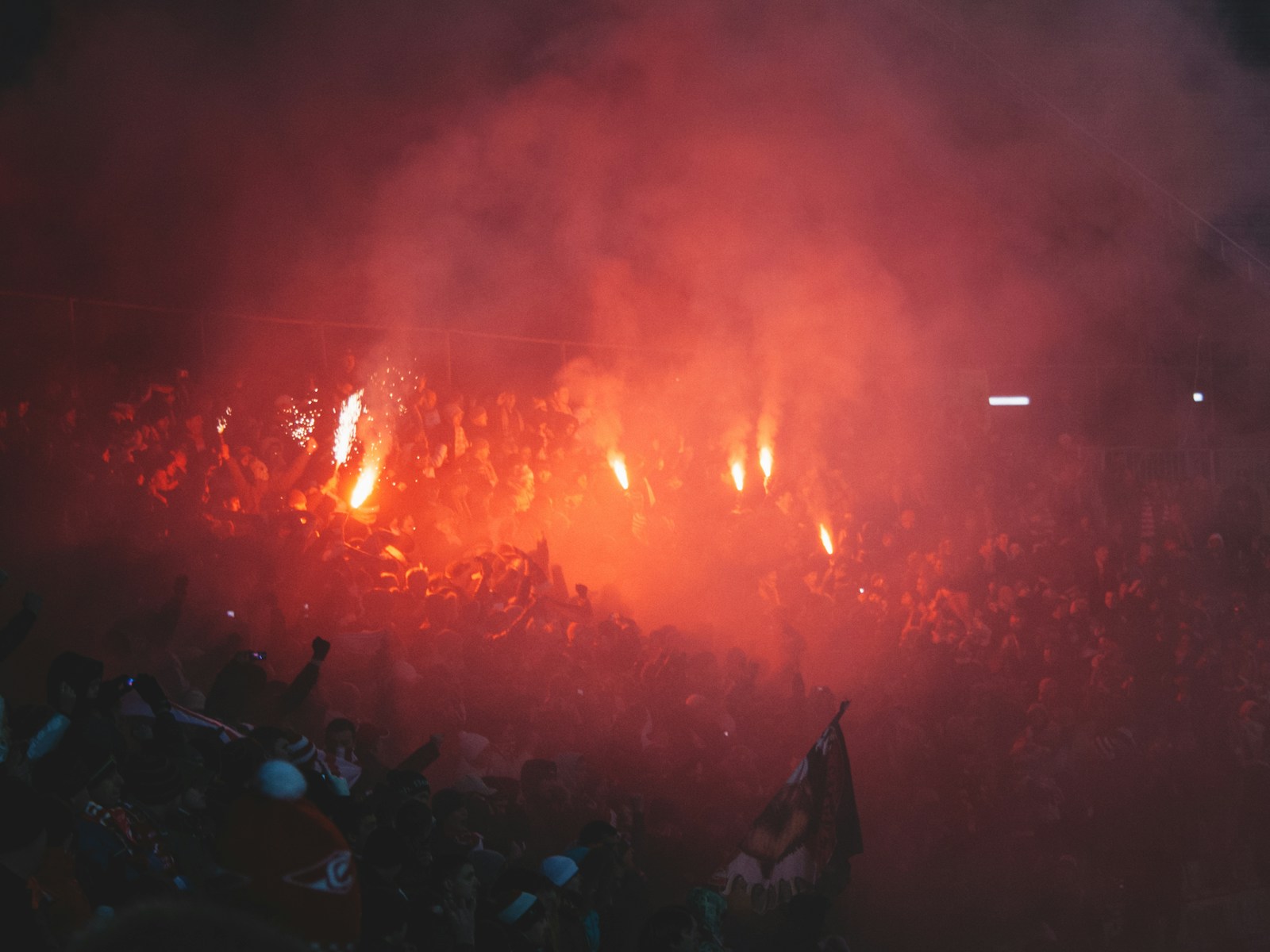
What Azadi does offer the derby is atmosphere at a scale few other venues can generate. The two halves of the stadium split cleanly into red and blue. Pre-match chants echo off the concrete for ninety minutes before kickoff. The lower tier bounces. Television cameras have trouble with the flare smoke. For a long time, the most controversial aspect of the Azadi matchday was the blanket ban on female spectators, finally partially lifted in the 2020s under FIFA pressure, with mixed compliance ever since.
The Ultras, the Chants, the Culture
Iranian ultras culture is younger than its European counterparts, shaped by the late 1990s more than the 1970s, but it is no less developed in its symbols. Persepolis’ most visible supporter group goes by names that shift over time, often associated with the South Stand. Esteghlal’s ultras gather in the Blue Sector and maintain their own distinct repertoire of chants and tifo designs. Both groups share a complicated relationship with Iranian authorities: occasionally celebrated by state media when the national team benefits, occasionally suppressed when chants stray into political territory.
Certain derby-day rituals transcend the rivalry. The pre-match national anthem has, over the years, sometimes been sung, sometimes been booed, sometimes been replaced with supporter chants that sit right at the line of what the security forces will tolerate. The post-match trip home, on a metro system that briefly operates in its own kind of temporary truce, is its own quiet ritual.
The Classic Matches Every Iranian Fan Can Recite
Ask any Tehran taxi driver over the age of forty and they will have their list. The 2–1 Persepolis win in 1996, famously dramatic. The Eamon Zayed hat-trick for Persepolis in April 2011 — three goals in the final fifteen minutes to turn a 2–0 deficit into a 3–2 win that still ranks among the single most remarkable individual derby performances the fixture has produced. Persepolis 2–1 Esteghlal in February 2025, a late winner that set up Persepolis’ push for a league title they ultimately didn’t quite close out. Dozens of others in between.
The matches that linger in memory tend not to be the high-scoring ones. Derby goals are treasured partly because they are rare. For long stretches of the fixture’s history, 1–0 has been the modal scoreline, 0–0 the second most common. The December 2025 goalless draw fits squarely into the pattern. It was, if you squint, a very traditional derby: lots of tension, lots of yellow cards, very few clear-cut chances, one point each, both coaching staffs walking away claiming they had done more than enough.
The 2025/26 Context: A Derby Displaced
| Metric | Persepolis | Esteghlal | Note |
|---|---|---|---|
| League position (MW12) | 2nd | 1st | Esteghlal +1 point with a game in hand |
| Matchweek 12 derby score | 0 | 0 | Played in Arak, not Tehran |
| Venue | IRALCO Stadium, Arak | Azadi unavailable; capacity ~15,000 | |
| Attendance | ~10,000 | Lowest derby attendance in years | |
| All-time competitive meetings | 106 | Since first league meeting in 1969 | |
That the 106th derby was played in Arak rather than Azadi told its own story. A mix of infrastructure issues and federation decisions has pushed high-profile fixtures out of the capital on several occasions in recent seasons. For a match with the historical weight of Persepolis vs Esteghlal to be staged at a venue with one-fifth of Azadi’s capacity is the kind of thing that would be unthinkable in most leagues. In Iran, where political and logistical pressures routinely reshape the fixture calendar, it has become almost routine.
Attendance was, predictably, a fraction of what it would have been at Azadi. Both sets of supporters travelled in reduced numbers. Ticket prices remained modest by international standards but high by domestic ones. The match itself, as reported by Tehran Times, was “lackluster,” with both teams showing the mental fatigue of a season played under unusual scheduling pressure.
The Players Who Carry Derby Weight
Every era of the derby produces its own cast. In the current cycle, Persepolis’ attack is built around a mix of domestic talent and foreign imports who have adapted to the rhythm of Iranian football. Esteghlal’s spine carries more international experience, with a handful of players with Asian Champions League pedigree. The derby scorers are rarely the headline signings; more often, they are the long-serving squad players who understand what the match requires.
For the Tehran derby, individual brilliance matters less than nerve. The players who thrive are the ones who can convert a half-chance in the seventy-eighth minute while tens of thousands of voices insist they will not. The players who disappear are often the flamboyant, the technically gifted, the ones expected to score precisely because they are expected to score. Form tables are irrelevant. Reputations are rebuilt and dismantled in ninety minutes.
What the Next Derby Will Change
Derby number 107 is scheduled for the spring portion of the 2025/26 season. If Azadi is available, it will be played there; if not, another venue. Esteghlal’s one-point lead at the top gives the fixture potential title-race consequence for the first time in several seasons. Persepolis have the game in hand and, historically, the stronger second-half record.
The stakes matter, but the derby does not really need them. Every derby is a title in its own right. Every derby cancels the week before and the week after. A Persepolis fan who watched their team lose every other match of the season will consider the season redeemed if the derby is won. An Esteghlal fan will say the same thing in reverse. It is a fixture that operates by its own accounting.
The Rivalry as Export
The Tehran derby has always been one of Iranian football’s most successful cultural exports. Clips travel. Atmosphere travels. The fixture has been featured in documentaries, academic papers, and enough foreign-language retrospectives that a certain mythology has built up around it — sometimes accurately, sometimes less so. The 128,000 figure keeps getting misattributed to derby matches. The class narrative gets flattened into tidy sociology. The genuinely complicated reality of an Iranian football supporter in 2026, torn between passion for a club, frustration with a federation, and a set of political pressures no fan in Manchester or Madrid has to navigate, rarely makes it intact into English-language coverage.
That’s part of why the derby is worth writing about from inside. It is not the Superclásico. It is not the Old Firm. It is not El Clásico. It is the Tehran derby, and on its best days, when Azadi is full and the flares are lit and a ball finally goes in after eighty minutes of stalemate, it is the equal of any of them.
The Economics of the Derby, Then and Now
For most of its history, the Tehran derby has been an economically modest fixture by the standards of continental rivalries. Broadcasting rights for the Persian Gulf Pro League are negotiated centrally, with the federation taking a controlling share. Matchday revenue at Azadi is split along federation-mandated lines that favour league-wide redistribution over club-level accumulation. Sponsorship, hamstrung by international banking restrictions and uneven advertising appetite from Iranian corporations, has historically produced a fraction of what comparable fixtures generate in the Gulf or in Turkey.
The 2020s have shifted the picture somewhat. Persepolis and Esteghlal both now have domestic sponsorship deals in the seven-figure US-dollar-equivalent range. Streaming rights to the derby — legally and illegally — produce meaningful traffic for regional platforms. Replica shirt sales, once negligible, now move in volumes that would have been unthinkable in 2010. The derby remains, by European comparison, a low-revenue fixture. But within Iranian football’s isolated economy, it is comfortably the richest single day on the calendar.
Player wages reflect this. The top earner at either Tehran club makes, in a good year, somewhere in the mid-six-figure US-dollar range annually — a figure that, by Iranian standards, is stratospheric and, by European standards, barely exceeds the League One minimum. This creates an obvious ceiling on the talent both clubs can retain. Iranian stars who break through in the Tehran derby almost inevitably leave for Europe or the Gulf within two seasons. The clubs’ scouting and academy pipelines must, therefore, run at a higher tempo than their European counterparts. Turnover is the norm. Continuity is the exception.
The Foreign Coaches Who Changed the Derby
Both clubs have turned to foreign coaches at pivotal moments. Branko Ivankovic’s second spell at Persepolis, bridging the late 2010s into the early 2020s, produced some of the club’s most sustained derby success in decades. Before him, Ali Daei’s tenure as a player-manager adjacent figure shaped the club’s identity through sheer personal weight. At Esteghlal, the Portuguese connection has been strongest, with a series of coaches from the Lisbon and Porto footballing schools arriving, usually for one or two seasons, before departing under the familiar pressures of Iranian football politics.
Foreign coaching has a specific impact on the derby. Coaches without domestic emotional attachment tend to prepare for the fixture with a detachment their Iranian counterparts cannot match. They focus on set pieces, on pre-match logistics, on psychological management of senior players. They are less prone to allow the match to become a personal or political moment. Derby matches under foreign management tend, statistically, to be tighter, lower-scoring, and more heavily influenced by dead-ball moments than derbies under domestic coaches.
Whether this is a positive or negative depends on which supporter you ask. Romantics will argue that the derby loses something when it becomes over-prepared. Pragmatists will note that over-preparation has produced Persepolis’ best derby results of the last fifteen years.
The Women Who Waited Four Decades
The story of female spectators at the Tehran derby is, in its own right, a significant piece of Iranian sporting history. After the 1979 revolution, women were effectively barred from attending men’s football matches. For four decades, the most high-profile fixture in Iranian football was watched live only by men. Women who attempted to attend in disguise, or who protested the ban publicly, faced arrest.
FIFA pressure, accelerated by the global attention following the 2019 death of Sahar Khodayari, finally produced partial change. Selected Iranian women were permitted to attend the World Cup qualifier against Cambodia in October 2019. Subsequent inclusions expanded to domestic matches, including derby fixtures, though compliance has been uneven and reversals have occurred. As of the 2025/26 season, women can attend most Azadi fixtures in a designated section, including derby matches when security assessments clear the event.
The sociological weight of this change is still being absorbed by Iranian football culture. Match photography from the past three seasons shows small but visible women’s sections, many supporters wearing custom scarves, some carrying banners. Derby-day footage has begun to feature female supporters in a way that, for anyone who watched Iranian football in the 2000s, remains remarkable every time.
Frequently Asked Questions
How often do Persepolis and Esteghlal meet in a season?
Twice in the Persian Gulf Pro League (home and away), with occasional additional meetings in the Hazfi Cup or Iranian Super Cup. A typical season produces two or three competitive derbies, with the spring league fixture usually the most consequential.
Who holds the all-time derby scoring record?
Records are disputed depending on which competitions are counted, but Farshad Pious and Safar Iranpak are among the most cited multi-goal derby scorers on the Persepolis side, while Esteghlal’s historical scorers include Nasser Hejazi (as both goalkeeper and captain) and Javad Nekounam from the modern era. Eamon Zayed’s 2011 hat-trick remains the single most famous individual derby performance.
Can women now attend the Tehran derby?
Partially. Under FIFA and AFC pressure, women have been permitted to attend selected men’s fixtures at Azadi since 2019, with coverage expanding to further matches in subsequent years. Attendance has been uneven in practice, with occasional restrictions reimposed around high-profile derbies. The situation continues to evolve.
What happens to the derby during international breaks?
The derby is rescheduled around FIFA calendar windows, particularly in World Cup qualifying years. With Iran preparing for the 2026 World Cup, the spring 2026 derby has already been moved once in the fixture calendar to accommodate Team Melli’s pre-tournament training schedule.
Sources
- Wikipedia — Tehran Derby
- Tehran Times — Tehran derby ends in goalless stalemate
- Wikipedia — Azadi Stadium
Further SportsPersia reading: our Iran at the 2026 World Cup preview, our feature on European club football for Iranian fans abroad, and our spring tournament guide.