
Amir Hossein Zare — Iran’s New Wrestling King After Zagreb Triumph
By Arman Petrosian — Published 21 April 2026
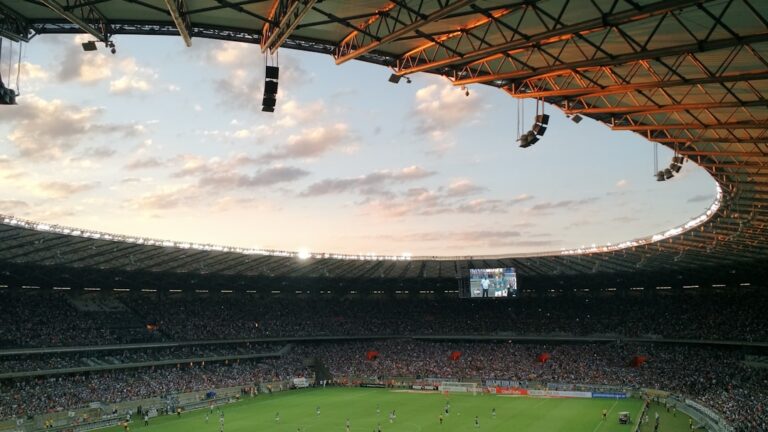
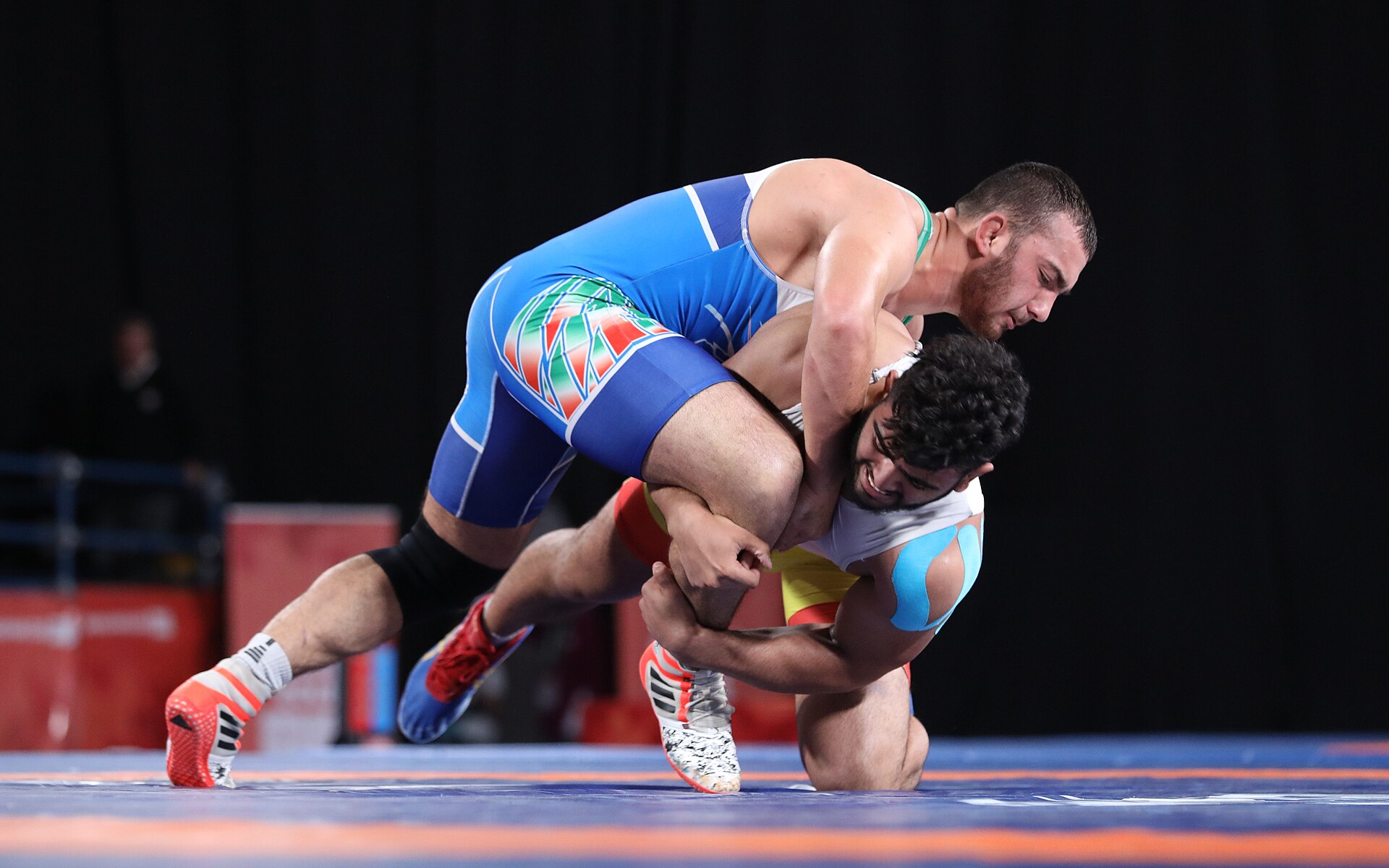
The final whistle at Arena Zagreb carried through the concrete ribbing of the roof like an echo from another century. Amir Hossein Zare walked the edge of the circle, lifted his right arm slowly, then bowed toward the Iranian corner where coach Pezhman Dorostkar was already wiping his eyes. The 125-kilogram final had lasted six minutes and ended 5-0 in favour of the Iranian. On the scoreboard, those five points looked clean and orderly; in the throat of the arena, they sounded like the closing of a long argument about who the heaviest man in freestyle wrestling actually is.
Azerbaijan’s Giorgi Meshvildishvili had come into the bout with a reputation for shutting down the attacks of heavier men through sheer torso strength. For two periods he tried. For two periods Zare circled, pawed at the wrists, and waited. When the Iranian finally committed, it was an inside-leg trip followed by a turn, and Meshvildishvili spent the rest of the evening chasing a match that had already left the building.
That victory, on 16 September 2025, did more than decorate a medal ceremony. It moved Zare — at 24 years old — into a specific and historically crowded corner of Iranian sport: the roster of three-time world champions. Only a handful of Iranians stand in that room, and the men beside him include Gholamreza Takhti and Abdollah Movahed. Whatever Zare does for the rest of his career, he has already written his name in granite.
A Child of the Mazandaran Forest Country
Zare was born on 16 January 2001 in Amol, the principal city of Mazandaran province, on the narrow coastal strip between the Alborz range and the Caspian Sea. Mazandaran is to Iranian freestyle wrestling what Dagestan is to Russian, or Iowa is to American: a specific geography that keeps producing specific body types and specific mentalities. Rice farming, dense humid forest, wet winters, long family dinners, and a regional dialect thick with its own wrestling vocabulary — these are the ingredients behind the sport’s heaviest names.
His father and uncle had both practiced varzesh-e bastani, the ancient strength discipline performed in the octagonal pit of the zoorkhaneh. As a boy Zare watched them swing the mil, the wooden clubs weighing between 10 and 25 kilograms, and rotate the kabbadeh, the weighted iron bow with its chain of rings. The zoorkhaneh did not teach him freestyle holds, but it built a specific kind of rotational core strength and a specific relationship with rhythm and breath. When he eventually walked into a freestyle room at age 11, he carried shoulders and wrists already shaped by two years of swinging those clubs.
The freestyle part came quickly. By 18, he was U23 world champion. By 20, he was senior world champion for the first time, beating Russia’s Sergey Kozyrev in the 2021 Oslo final. By 20, he was also an Olympic bronze medallist, having lost a heartbreaking semifinal to Gable Steveson at Tokyo before pinning his way back through the repechage. A bronze at 20 would be a career for most heavyweights. For Zare it was merely the first line of the biography.
The Long Shadow of Taha Akgul
To understand what Zare accomplished in Zagreb, it helps to understand what the 125kg division looked like before he arrived. For roughly a decade, Turkey’s Taha Akgul was the weight class — Olympic gold in Rio, five consecutive European titles, a 2019 world title, and a way of wrestling that combined gate-keeper physicality with an unusual capacity to finish the rare scoring chance he gave himself. The path to the top of the heavyweight division ran through Akgul and was blocked by him.
When Zare, still a teenager, first crossed the Turkish champion at the 2020 Individual World Cup, the technical gap was not small. Akgul controlled the tie-ups, set the pace, and Zare looked, correctly, like a young man still figuring out his own limbs. The story of the next four years is effectively the story of a youngster growing into his frame, adding mass to his chest without sacrificing foot speed, and developing the one skill every heavyweight ultimately needs: the patience to wait out the clinches and punish the first tired breath. By 2023 it was Zare who was doing the punishing.
The Zagreb Bracket
The road to the 2025 world title was not a coronation. It was a bracket full of young, hungry heavyweights who were themselves trying to write new stories. Zare’s first match was against Puerto Rico’s Jonovan Smith, dispatched 11-0 by technical superiority inside three minutes. Then came Solomon Manashvili of Georgia, another 10-0 verdict, this one even quicker.
The quarterfinal — against Bahrain-flagged Russian Shamil Sharipov — was the one that made the Iranian coaching corner exhale hard. Sharipov scored early, caught Zare in a front headlock, and led by two with two minutes remaining. What followed was a controlled demolition: a takedown to tie, a pushout, a gut wrench for two, another pushout, 7-3 on the scoreboard, and Sharipov walking off with the dazed face of a man who has just been out-wrestled rather than overpowered.
In the semifinal, Zare met American Mason Parris. The bout was tight, physical, and decided by a second-period takedown Zare set up by feigning a shot and circling left. He won 3-1, and walked to the Iranian bench with a small nod. There was no chest-pounding. There rarely is. Zare treats every round as a separate piece of work, the way a journeyman carpenter treats every door he hangs.
The Final: Six Minutes Without a Point Given Up
Meshvildishvili, like Zare, had arrived in Zagreb as a serious medal contender. The Azerbaijani had spent two years making the move up from 97 kilograms pay off, and at 125 he brought a torso strength few in the category could equal. His game plan for the final was readable from the whistle: tie up, grind against the edge, shorten the exchanges.
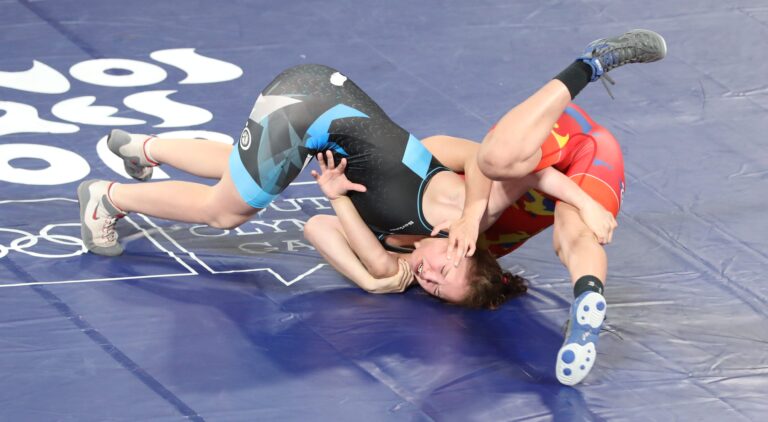
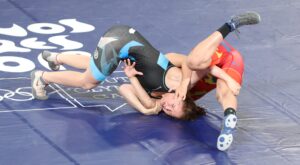
Zare answered by keeping distance. He pawed at the wrists, changed levels without committing, and let the Azerbaijani’s own forward momentum create the opening. Midway through the first period he caught Meshvildishvili reaching, dropped his level, and drove through with a low single that ended against the edge. Two points. A step-out. A passivity call. By the end of the first period the scoreboard read 3-0 and Meshvildishvili had not touched Zare’s back once.
The second period was the same picture redrawn. A second takedown off a re-shot, another edge pushout, and six minutes of defensive wrestling that gave away nothing. 5-0. Gold. The Iranian wrestling federation staff in the stands stood up as a single mass, and somewhere in that crowd a man was holding up a photograph of Gholamreza Takhti.
The Training System Behind the Hand-Raised Moment
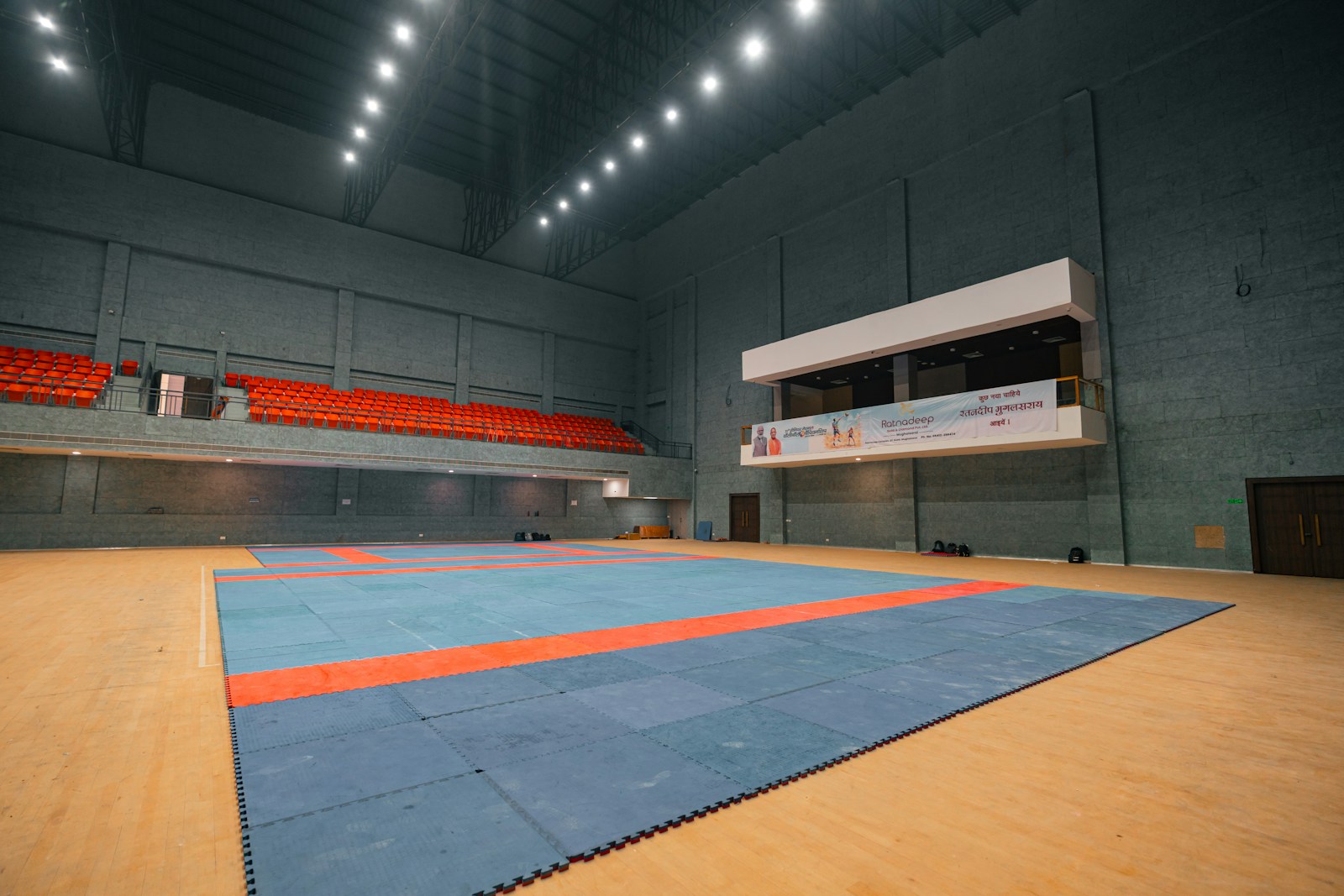
The architecture of an Iranian heavyweight’s year is no secret, because the Iranian federation has for decades been almost public about it. The period from October through February is devoted to raw-strength work — Olympic lifts, controlled heavy pulls, the kettlebell and club traditions, and two mat sessions per day at moderate intensity. February through May is domestic competition, including the Takhti Cup and the famed Dan Kolov & Nikola Petrov tournament in Bulgaria, both scheduled to build toward March or April peaks. From June the national camp opens at the federation’s facility near Tehran, and the pace shifts to specific match preparation, video breakdowns of probable opponents, and eight-minute live goes designed to simulate the championship format.
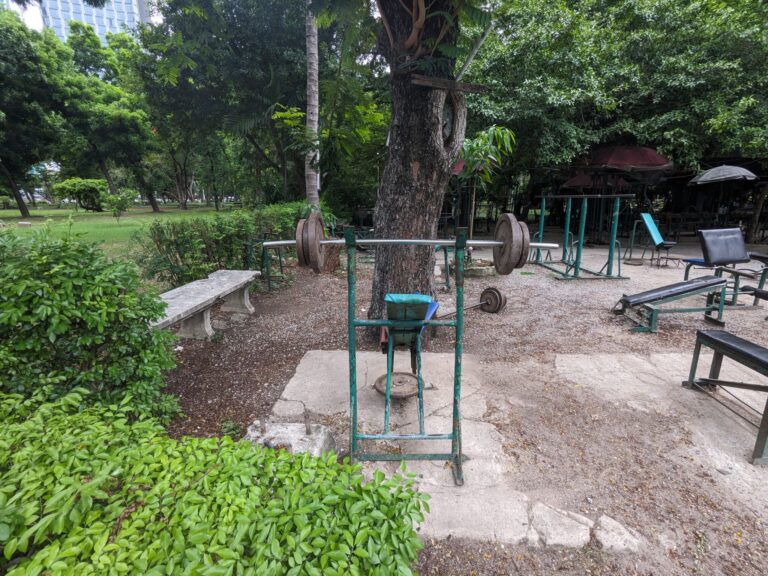
Zare’s personal modifications to the template are modest but telling. He is known to do one session per week in a zoorkhaneh in his home region of Mazandaran — a concession to his father’s tradition and, he has said in interviews with Iranian state media, a way to stay mentally anchored. He avoids heavy bench pressing. His conditioning emphasis is hill sprints on the sandy slopes outside Amol. And his diet, by reports from national team nutritionists, is surprisingly restrained for a man walking around at 135 kilograms — built mostly around lamb, rice, dairy, and the pomegranate molasses khoresh that Mazandaran families consume as a seasonal staple.
What Three World Titles Actually Mean
With 2025 gold, Zare’s career count stands at three world titles, one world bronze, one Olympic bronze, and a growing list of continental golds. The Iranian federation’s statistical register now places him, at 24, fourth on the all-time Iranian freestyle honours list. Above him sit Abdollah Movahed with five world titles, Gholamreza Takhti with two world titles plus his Olympic gold, and Rasoul Khadem with a more complex hardware profile. Below him, lined up in the national wrestling hall of fame in Tehran’s Azadi district, are generations of heavyweights who did not quite reach three.
The milestone matters for two reasons. First, because in Iran the number three has long functioned as the threshold between a champion and a pahlevan — a folk hero, a man who enters the popular lexicon. Second, because Zare now has two full Olympic cycles ahead of him. A man who wins world gold at 20, 22 and 24 is simply not the same category of athlete as one who peaks once. The LA 2028 campaign is already, quietly, under construction.
The 125kg Landscape Heading Into LA 2028
If Zagreb was the confirmation, what comes next is the defence. The 125kg division remains one of the deepest in world wrestling. The United States has Mason Parris, a collegiate phenomenon who will be in every major final for the next four years. Russia’s Sergey Kozyrev — currently flagged for Russia in neutral status — is a former world champion in full possession of his powers. Turkey is developing a new generation in the wake of Akgul’s retirement, and Georgia is perpetually in the mix.
Zare’s own path probably runs through two more serious tests: the 2026 Asian Games on home soil in Riyadh, where the Iranian heavyweight tradition carries real psychological weight, and the 2027 World Championships, which will function as the de facto Olympic dress rehearsal. The federation has already signalled that no domestic wrestler will be allowed to challenge him inside the weight class at the national selection events through 2027. That kind of insulation has worked in the past for Iranian champions and occasionally not — but with Zare it is a bet most wrestling analysts consider sound.
The Man Beyond the Mat
Zare is reserved in a way that can read as distant to foreign journalists. He gives short, uncomfortable press conferences, delivers his answers in Farsi through an interpreter, and rarely expands beyond one or two sentences. In Iranian media he opens up more, and the portrait that emerges is specific: a man who still lives most of the year in Amol, who is close to his brothers, who avoids Tehran whenever his schedule allows, and who donates a portion of his prize money to the family of Hadi Norouzi — the former Persepolis football captain from his home region who died at 30 in 2015.
He has spoken, carefully, about his religious practice, which is Shia in the particular Mazandaran folk form that is interwoven with the pahlevan ethical code. He has said that he takes the responsibility of being a wrestling champion as a moral burden rather than a celebrity privilege, because “in my region that is the contract.” It is an old-fashioned thing to say in 2026. He means it.
Iran’s Wrestling Ecosystem in 2026
Zare’s gold arrived during a larger Iranian wrestling revival. In the Zagreb team classification, Iran’s freestyle team won its first world team title in ten years, ending a drought that had lasted since 2015. The contributions came from every weight: Rahman Amouzad and Mohammad Nokhodilarimi at the lower weights, Amirmohammad Yazdanicheragh in the middle, Amir Ali Azarpira at 97kg, and Zare at 125kg. It was, in the cumulative, the kind of team performance Iranian wrestling fans had been waiting a decade to see.
Behind that success sits a federation that has, in the last four years, modernised its data and video infrastructure, brought in sports-science consultants from Europe, and finally moved away from the selection-style camps that used to tear wrestlers down in the name of toughness. The new head coach, Pezhman Dorostkar — himself a former world bronze medallist — has been credited with introducing a calmer, longer-horizon planning model. Zare is its poster child, and possibly its biggest argument.
Inside the Iranian 125-Kilogram Tradition
To understand Zare’s place in the Iranian heavyweight lineage, it is useful to look back at the men who held that weight class before him. Hossein Rezazadeh, though a weightlifter rather than a wrestler, established the modern template for what an Iranian heavyweight national champion looked like — reserved in public, devout in private, explosively powerful when the circumstances demanded it. Before Rezazadeh, in the wrestling mat specifically, the line ran through Gholamreza Takhti at 87 and 97 kilograms, Abdollah Movahed at lighter weights, and a cluster of 1970s and 1980s heavyweights who captured sporadic world medals without quite establishing a dynasty.
The 125-kilogram class in its current form — or the 130-kilogram class as it was sometimes configured before the UWW’s 2017 weight reform — has been an Iranian target for roughly three decades. Alireza Heidari took world gold at 96 kilograms in the late 1990s. Komeil Ghasemi captured a world and Olympic medal at 120 kilograms in the 2010s. Parviz Hadi contested the class at world level throughout the Tokyo cycle. Zare’s dominance is the longest sustained Iranian run at the top of the freestyle heavyweight class in the modern era, and the first time since the Abdollah Movahed years that an Iranian freestyler has held a world title in three separate calendar years before turning 25.
Behind him in the domestic pipeline are two young heavyweights — Amir Reza Masoumi, 21, and Yousef Ghahramani, 22 — who are already on the national team’s extended roster. Neither is expected to challenge Zare at the senior selection events through 2027, but both are building the kind of international resume that will give Iran a credible backup plan at LA 2028 if Zare’s body does not hold up across the full cycle. The Iranian federation has been careful in recent years to avoid the kind of one-wrestler dependency that defined the Kimia Alizadeh situation in women’s taekwondo, and the depth at 125 is part of that strategy.
The Weight of the Crown
In Iranian sporting culture, the title of pahlevan is not granted lightly. It is not a trophy the federation hands out. It is whispered through generations, added to a name the way an honorific is added in old Persian court documents. The previous men to carry it unambiguously were Gholamreza Takhti and, depending on whom you ask, Hossein Rezazadeh. Whether Zare will be given the same honour in the collective memory of his country is, ultimately, not a question of medals. It is a question of character over decades.
What Zagreb established is that he is in the running. Three world titles, an Olympic bronze, and no public scandal at 24 is a career profile a lot of nations would take. But in Iran the metric is stricter, and the man himself knows it. Asked on the mat, after the Meshvildishvili bout, whether he felt he had already done enough to be called a great wrestler, Zare gave the shortest answer his interpreter could render: “Not yet. We keep working.”
Coach Dorostkar’s Long Game
Pezhman Dorostkar, the current head coach of the Iranian national freestyle wrestling team, is arguably the second-most important figure in Zare’s Zagreb story after the wrestler himself. Dorostkar took over the senior program in early 2024 after a difficult stretch in which the team had cycled through three head coaches in four years. A former world bronze medallist himself, Dorostkar built his coaching reputation at the youth and junior levels, where he was credited with identifying and developing the generation that now forms the core of the senior squad. His appointment to the top job was both a continuity choice and a generational statement.
His relationship with Zare predates his appointment. The two worked together during Zare’s U23 and early senior years, and the training vocabulary they share is, by most accounts, close to familial. Dorostkar is known within Iranian wrestling for a calm tactical approach on the corner, an insistence on video study as a core part of the weekly routine, and a willingness to let his wrestlers make their own in-match adjustments rather than overmanaging from the sideline. All three of those attributes suit Zare’s personality and style. The Zagreb final — where Zare clearly controlled his own pace and shot selection rather than executing a scripted gameplan — was a textbook example of the partnership working as intended.
Dorostkar’s stated objective for the LA 2028 cycle, communicated publicly in federation press conferences through 2025, is to build a team capable of finishing in the top three of every weight class rather than chasing spectacular individual gold medals at the cost of overall team depth. That philosophy matches the quietly accumulative approach Zare himself favours, and it contrasts with the more volatile approaches of some earlier Iranian coaching regimes. If the Zagreb team title can be repeated in 2026 and 2027, the Iranian freestyle program will have locked in its first genuine dynasty since the early 2000s.
Zare’s Career at the World Championships
| Year | Host City | Weight | Result | Final Opponent |
|---|---|---|---|---|
| 2019 (U23) | Budapest | 125 kg | Gold | Various |
| 2021 | Oslo | 125 kg | Gold | Kozyrev (RUS) |
| 2022 | Belgrade | 125 kg | Bronze | — |
| 2023 | Belgrade | 125 kg | Gold | Parris (USA) |
| 2025 | Zagreb | 125 kg | Gold | Meshvildishvili (AZE) |
Frequently Asked Questions
How many world titles has Amir Hossein Zare won?
Three senior world titles — 2021 in Oslo, 2023 in Belgrade, and 2025 in Zagreb — plus the 2019 U23 world title. The three senior golds place him among the most decorated Iranian freestyle wrestlers of the modern era.
Who did Zare defeat in the 2025 final?
Azerbaijan’s Giorgi Meshvildishvili, 5-0, over two periods of a tightly controlled 125-kilogram bout at Arena Zagreb on 16 September 2025.
Where is Zare from?
He was born 16 January 2001 in Amol, Mazandaran province, northern Iran, on the Caspian coastal plain. He still lives there most of the year between national-team camps.
What is his Olympic record and his LA 2028 outlook?
Bronze at Tokyo 2020, bronze at Paris 2024, and he is already considered the favourite in the 125-kilogram division heading into Los Angeles 2028. Two full Olympic cycles of championship form put him in rare company.
Sources
- United World Wrestling: Zare Amir Hossein Abbas profile
- Tehran Times: Iranian wrestling coverage
- Wikipedia: Amir Hossein Zare
Related coverage on Sports Persia
Arman Petrosian covers combat sports, wrestling, and strength athletics for Sports Persia. He writes from Tehran and Yerevan.