
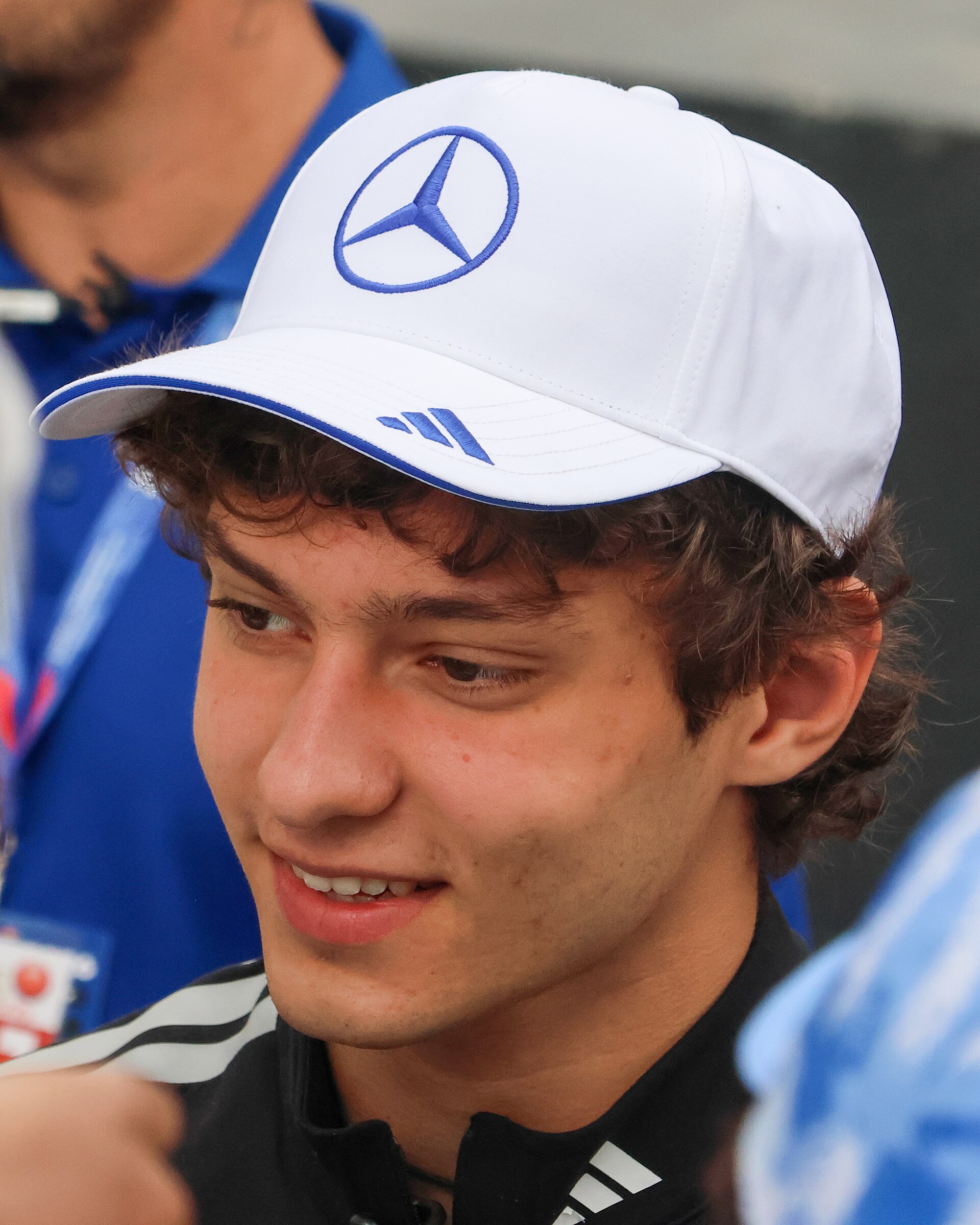
At nineteen years and two hundred and sixteen days old, Kimi Antonelli sits where no teenager has ever sat before. Not metaphorically. Literally. The top of the Formula One Drivers’ Championship standings. The youngest driver to lead the world championship at any point in the sport’s 75-year history. Two consecutive victories. A Mercedes team reborn around him. And a paddock full of seasoned professionals quietly coming to terms with the fact that the kid from Bologna is not a fluke, not a flash, not a feel-good story that will fade by mid-season. He is the real thing.
The Japan Grand Prix at Suzuka was supposed to provide clarity about the championship picture. It did. Just not the kind most people expected.
The Race
Suzuka stripped the ambiguity from this season’s narrative in 53 laps. Antonelli started from pole — his third of the campaign — and controlled proceedings from the front with a composure that made veteran commentators reach for comparisons they had been reluctant to make until now. His opening lap was textbook controlled aggression: fast enough to open a 1.8-second gap over Oscar Piastri before the first sector was complete, measured enough to protect his tires through the high-energy Esses that punish anyone who arrives with more ambition than precision.
The pit stop on lap 20 was the fulcrum of the race. Mercedes brought Antonelli in for hard-compound tires that would need to survive 33 laps on a circuit notorious for front-left degradation. The stop was 2.4 seconds — the fastest of the afternoon — and he emerged with his lead intact. From there, the race became a masterclass in management. Piastri, on softer rubber, closed to within two seconds on lap 35 and briefly threatened an undercut that never materialized. Antonelli responded by finding three tenths in the final sector, extending the gap back to four seconds with three laps remaining. He crossed the line 4.2 seconds ahead of Piastri, with Charles Leclerc a further four and a half back in third.
George Russell finished fourth for Mercedes, confirming the W17 as the car of the moment. Lando Norris was fifth. Lewis Hamilton sixth. Pierre Gasly seventh. And Max Verstappen, the man who won 19 of 22 races two seasons ago, finished eighth. That last result tells its own story.
Japan Grand Prix — Top 10
| Pos | Driver | Team | Gap |
|---|---|---|---|
| 1 | Kimi Antonelli | Mercedes | 1:28:34.221 |
| 2 | Oscar Piastri | McLaren | +4.218s |
| 3 | Charles Leclerc | Ferrari | +8.741s |
| 4 | George Russell | Mercedes | +12.033s |
| 5 | Lando Norris | McLaren | +14.567s |
| 6 | Lewis Hamilton | Ferrari | +19.882s |
| 7 | Pierre Gasly | Alpine | +24.109s |
| 8 | Max Verstappen | Red Bull | +28.443s |
| 9 | Fernando Alonso | Aston Martin | +33.210s |
| 10 | Carlos Sainz | Williams | +37.891s |
The Kid from Bologna
Andrea Kimi Antonelli was born on August 25, 2006, in Bologna, Italy — the same city that gave the world Ducati, Lamborghini, and the oldest university in continuous operation. His father, Marco, raced in Italian touring cars without distinction. His mother, whose name he keeps private, taught mathematics. The combination of competitive instinct and analytical intelligence runs through everything Antonelli does behind the wheel, and it was visible almost from the moment he first sat in a kart at the age of six.
The karting results are the stuff of legend in junior motorsport circles. Italian champion at eight. European champion at eleven. WSK Super Master Series winner at twelve, against fields that included drivers four and five years his senior. By the time he turned fourteen, every major Formula One academy had sent scouts to watch him race. Mercedes won the bidding war, signing him to their junior program in 2020 and beginning a development trajectory that was designed, from the very beginning, to produce a world champion.
The Formula 2 campaign that preceded his F1 promotion was perhaps the most dominant junior season in recent memory. Antonelli won the title by 73 points — a margin so vast that he clinched the championship with three rounds remaining. His qualifying record was absurd: pole position in 10 of 14 rounds, with an average gap to second place of three-tenths of a second. In the feature races, he either won or finished second in 11 of 14 events. The numbers did not suggest readiness for Formula One. They demanded it.
Toto Wolff, who has overseen the careers of Lewis Hamilton, Nico Rosberg, and Valtteri Bottas at Mercedes, described his first extended conversation with the teenage Antonelli as “the most impressive meeting I have ever had with a young driver.” The statement carried weight precisely because Wolff does not deal in hyperbole. When he signed Antonelli to replace the departing Hamilton, the motorsport world split into two camps: those who thought it was visionary, and those who thought it was reckless. Six races into the season, the skeptics have gone quiet.
Comparisons He Does Not Want
The inevitable question arrives in every press conference, phrased slightly differently each time but always reaching for the same comparison: is Kimi Antonelli the next Max Verstappen?
Antonelli dislikes the question. Not because the comparison is unflattering — Verstappen is a three-time world champion and one of the most naturally gifted drivers the sport has ever produced — but because it reduces his story to a sequel of someone else’s. “I am not the next anyone,” he said after his first victory, two races ago. “I am the first me.” The line was delivered with a smile, but the steel behind it was unmistakable.
The statistical parallels are striking nonetheless. Verstappen won his first Grand Prix at 18 years and 228 days — a record that still stands. Antonelli won his first at 19 years and 202 days, making him the third-youngest race winner in history behind Verstappen and Sebastian Vettel. But Antonelli’s start to his career has been more consistently excellent than Verstappen’s was at the same stage. Verstappen’s first full season produced four wins and a fourth-place championship finish; Antonelli, six races in, has two wins and leads the standings. The trajectories are different, and that matters.
Fernando Alonso provides perhaps a more instructive comparison. Alonso became the youngest world champion at 24 in 2005, driving a Renault that was not necessarily the fastest car on the grid but was the best-suited to his particular driving style. The Spaniard’s early career was defined not by raw speed alone — though he had that in abundance — but by an almost preternatural ability to extract maximum performance from the car he was given on any particular day. Antonelli shares this quality. His tire management at Suzuka, where he kept front-left degradation within optimal windows for 33 laps on hard compounds, is the kind of sophisticated racecraft that most drivers take years to develop. Antonelli appears to have arrived with it fully formed.
And then there is the Hamilton comparison, which is the one that carries the most emotional weight because Antonelli is literally sitting in Hamilton’s old seat. Hamilton won his first championship at 23, two years older than Antonelli is now, driving a McLaren in a season that went down to the final corner of the final lap of the final race. The seven-time champion’s early career was defined by spectacular overtaking, fearless wheel-to-wheel racing, and a raw competitive intensity that occasionally tipped over into controversy. Antonelli’s style is different: smoother, more calculated, less dramatic but no less effective. Where Hamilton attacked corners, Antonelli flows through them. Where Hamilton fought his rivals, Antonelli simply drives away from them.
Mercedes Rising
The story of Antonelli’s emergence cannot be separated from the story of Mercedes’ resurgence. The W17 is arguably the best car on the current Formula One grid, and the team’s transformation from midfield also-rans under the previous regulations to championship leaders under the new ones represents one of the most impressive organizational turnarounds in recent motorsport history.
The new engine regulations, which introduced revised power unit specifications and aerodynamic constraints, reshuffled the competitive order in ways that punished teams who tried to evolve their existing concepts and rewarded those who started from scratch. Mercedes, stung by the relative struggles of the W14 and W15 eras — seasons where Hamilton and Russell fought for podiums rather than victories — invested enormous resources into understanding the new rules and built the W17 from a blank sheet. James Allison and the Brackley engineering team targeted three specific areas: low-speed mechanical grip, power deployment efficiency, and aerodynamic stability through high-speed corners. At Suzuka, where all three qualities are essential, the W17 was the class of the field by a comfortable margin.
Russell’s consistent fourth and fifth-place finishes provide the benchmark that makes Antonelli’s performances so remarkable. Russell is a proven quantity — fast, intelligent, experienced, a former race winner. The gap between the two Mercedes drivers is approximately two-tenths per lap in qualifying and one-tenth in race conditions. Those are not the margins of a rookie outperforming a struggling teammate. Those are the margins of a generational talent outperforming a very good driver in identical machinery.
The Constructors’ Championship standings reflect the team’s resurgence: Mercedes lead with 149 combined points, five ahead of McLaren on 144 and 24 clear of Ferrari on 125. Red Bull, the dominant force of the previous era, sit fourth with 75 points. The hierarchy has been inverted. The old order has been dismantled. And at the center of the new order, with his hands on the wheel of the fastest car on the planet, sits a nineteen-year-old from Bologna who looks like he belongs there.
Championship snapshot: Antonelli leads with 87 points, 11 ahead of Piastri (76) and 16 clear of Leclerc (71). Norris sits fourth on 68, Russell fifth on 62, Hamilton sixth on 54, and Verstappen seventh on 41. Six races in, four different winners, three teams genuinely competing for the title. This is the season the sport has been craving.
What the Engineers See
The onboard data from Suzuka tells a story that the naked eye cannot fully capture. Antonelli’s steering inputs through the Esses — a sequence of five linked high-speed corners that demand absolute commitment at over 200 kilometers per hour — were notably smoother than those of any other driver in the field. Smaller corrections. More progressive application of steering lock. Less peak load on the front tires during direction changes. The result is measurably better tire preservation over a long stint: where Piastri lost three-tenths per lap in the Esses from lap 35 onwards due to front-left degradation, Antonelli’s sector times remained consistent until the final lap.
This smoothness is not a limitation. It is a technique. Antonelli does not carry less speed through corners than his rivals; he carries the same speed with less mechanical violence. The difference is the same as the difference between a pianist who hammers the keys and one who coaxes the same volume with a lighter touch. Both produce the same sound. One wears out the instrument.
Mercedes engineers have compared his data traces to Hamilton’s early seasons and found a striking difference in approach. Hamilton, at 22, was renowned for his aggressive braking and late turn-in — a style that produced spectacular qualifying performances but sometimes compromised race-day tire management. Antonelli, at 19, has married Hamilton’s qualifying speed with a race-management sophistication more reminiscent of Alain Prost, who prioritized efficiency over pyrotechnics and won four world championships doing it. It is an unusual combination for any driver. For a teenager in his first full season, it borders on the inexplicable.
The Road Ahead
The championship moves into its European phase, with circuits that will test different aspects of the competitive order. Street circuits will ask questions about the W17’s low-speed performance that Suzuka’s flowing layout did not. Power tracks will test Mercedes’ engine deployment strategies against Honda’s and Ferrari’s. Rain, which has been absent from the opening rounds, will eventually arrive and reshuffle the pack in ways that no simulation can fully predict.
Piastri and Norris at McLaren have the machinery to mount a sustained challenge. Leclerc’s Ferrari has won a race this season and will be formidable at circuits that suit its rear-limited aerodynamic philosophy. Verstappen, for all his struggles, remains the most naturally talented driver on the grid, and if Red Bull find even 80% of their lost performance, the Dutchman will be a factor in the championship conversation once more.
But the momentum belongs to Antonelli. Two wins. A championship lead. A car that appears to improve with each upgrade. A team that has organized itself around his particular strengths with a precision that suggests long-term strategic thinking rather than short-term opportunism. And a driver whose ceiling, at nineteen years old, is so far above his current level that the thought of what he might become in three or four years’ time is enough to make his competitors lose sleep.
Formula One has found its next defining figure. The debate is no longer about whether Kimi Antonelli is ready for the sport. The sport is adjusting to the fact that he arrived ready — and that everything from this point forward is about how high the ceiling reaches. The teenager from Bologna has rewritten the record books at Suzuka. He has no intention of stopping there. And in the world of global motorsport, where legends are measured not by potential but by results, Kimi Antonelli is delivering results that the sport has rarely seen from anyone, at any age, this early in a career.
He is nineteen. He leads the world championship. And the most remarkable part is that this does not feel like an ending. It feels like the first chapter of something that could define a generation.
Frequently Asked Questions
How old is Kimi Antonelli and what records has he broken in Formula One?
Kimi Antonelli is nineteen years old, born in Bologna, Italy. He has become the youngest race winner in modern Formula One history with his victory at the Japanese Grand Prix at Suzuka. He is also the youngest driver to lead the World Championship standings, surpassing records previously held by Sebastian Vettel and Max Verstappen.
What car does Kimi Antonelli drive and how competitive is the Mercedes this season?
Antonelli drives for Mercedes-AMG Petronas Formula One Team in the W17 chassis. The car has shown significant improvement through the early rounds of the season, benefiting from major aerodynamic upgrades. Mercedes appears to have the most efficient car in high-speed corners, and the team has optimized the setup specifically around Antonelli’s driving style.
What makes the Suzuka Circuit so challenging for Formula One drivers?
Suzuka is widely regarded as one of the most demanding circuits on the calendar. The figure-eight layout features high-speed esses, the demanding 130R corner, and significant elevation changes. The track rewards car balance, driver bravery, and mechanical grip, making it a circuit where the most complete driver-car packages tend to excel.
What are the current Formula One World Championship standings?
After his victory at Suzuka, Kimi Antonelli leads the Drivers’ Championship. Max Verstappen and Lando Norris remain close behind, with the title fight expected to continue through the European swing of the calendar. The Constructors’ Championship sees Mercedes, Red Bull, and McLaren locked in a tight three-way battle.
When and where is the next Formula One race after the Japanese Grand Prix?
The Formula One calendar continues with the Chinese Grand Prix in Shanghai, followed by races in Miami and Imola as the season enters its European phase. The intense run of races through April and May will be critical in determining whether Antonelli can maintain his championship lead through the middle portion of the season.
Race results and championship standings verified through Formula1.com official records. Technical analysis informed by publicly available telemetry commentary from ESPN F1 and paddock reporting. Biographical details reflect verified public sources. Performance comparisons and driving style analysis represent the author’s editorial interpretation of available data.