

There was no goalkeeping coach standing behind either goal when Nasser Hejazi played his best football. There was no video session breaking down positioning frame by frame, no dedicated shot-stopping drill lifted from a manual, no specialist at all in the modern sense. What there was, instead, was a goalkeeper who worked the answers out himself, in an era when the position was still mostly left to instinct, and produced a version of the job good enough that coaches still point students at the footage decades later.
Nasser Hejazi played the position across the 1970s and into the 1980s, first for Taj Tehran and then, after the club was renamed Esteghlal, for the same institution under its new name. He won 62 caps for the national team and appeared at the 1978 World Cup in Argentina, a tournament remembered in Iran for the team’s struggles rather than for individual performance, though his own reputation had already been set well before it.
What follows is not a highlight reel. It is an attempt to describe, in terms a goalkeeping coach would recognize, what Hejazi actually did with his positioning, his command of the area and his distribution, in a period before any of those things had a coaching manual attached to them.
- Era. Playing career through the 1970s and into the early 1980s, before specialist goalkeeping coaching existed as a role.
- Clubs. Taj Tehran, continuing at the same club under the name Esteghlal after the 1979 revolution.
- National team. 62 caps, including the 1978 World Cup in Argentina.
- What survives on film. Positioning that anticipates the shot rather than reacting to it, and a willingness to command the box that was unusual for the period.
- Why it still gets taught. The habits look modern precisely because they were not borrowed from a modern manual; they were worked out from first principles.
A position with no coaching manual behind it
Goalkeeping in the 1970s was, in most countries, treated as a specialism the goalkeeper himself was responsible for developing. Outfield players trained under increasingly organized methods; the goalkeeper often trained alongside them, doing a version of the same running and shooting practice, with little that addressed the specific mechanics of the position: footwork on crosses, angle play on breakaways, distribution under pressure.
Where a goalkeeper of that era became genuinely good at the position, the improvement had to come from repetition, from watching others, and from a personal willingness to treat the position as something worth studying on its own terms rather than as a lesser, reactive role within the team. Hejazi’s game reads, on the footage that survives, as the product of exactly that kind of self-directed study.
Positioning that reads the shot before it arrives
The single trait most often pointed to when older observers describe Hejazi’s game is anticipation: a positioning habit that adjusted to the angle of the attack before the shot was struck, rather than a reaction to the ball after it left the boot. This sounds like a small distinction and it is, in practice, most of what separates a goalkeeper who looks calm from one who looks busy.
A goalkeeper reacting to the shot has to cover the full angle available at the moment of the strike, which means more ground to close and less time to close it. A goalkeeper who has already narrowed that angle by correct positioning beforehand needs a smaller, faster movement to make the save, and looks unhurried doing something that is mechanically identical to what a poorly positioned goalkeeper is doing at full stretch.
This is the part of Hejazi’s game that modern goalkeeping coaching would now teach explicitly, through structured angle drills and video review of shot locations. In his era it had to be self-taught through repetition and, evidently, a sharp read of the game in front of him.
Command of the area, before the phrase existed
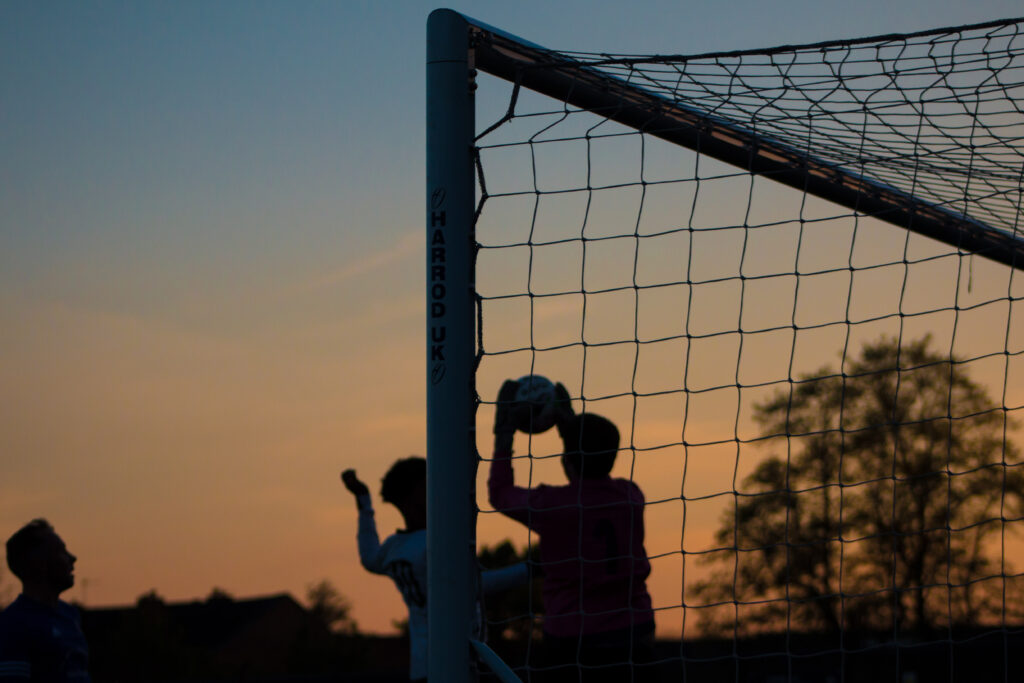
Modern goalkeeping talks about command of the box as a specific, trainable attribute: the willingness and ability to leave the goal line to intercept a cross before it becomes a shot, organizing the defensive line in front of the goalkeeper rather than behind it. In the 1970s this was not a named skill so much as a personality trait some goalkeepers had and others avoided.
By the accounts of teammates and opponents from the period, Hejazi was firmly among those who claimed the area rather than defended the line. That kind of assertiveness carried more physical risk in an era with looser rules around contact on goalkeepers than the modern game allows, which makes it a notable choice rather than an obvious one: a goalkeeper of that period who came for crosses aggressively was accepting a level of physical challenge that a more line-bound goalkeeper simply avoided.
The tactical payoff was straightforward even without modern language to describe it. A goalkeeper who deals with a cross before it becomes a shot removes a scoring chance entirely, rather than merely saving one, and a defense that trusts its goalkeeper to do this consistently can set a slightly higher defensive line than one that cannot.
Distribution as an attacking weapon, not a formality
Goalkeeping distribution in most of the world through the 1970s was a functional afterthought: get the ball away from danger, restart play, hand possession to a teammate wherever convenient. Watching a goalkeeper’s distribution as a deliberate part of a team’s attacking structure was, outside a handful of sides, not yet standard thinking.
Accounts of Hejazi’s game describe a goalkeeper who treated a save and the throw or kick that followed it as connected actions, looking to start a move quickly rather than simply clearing the danger. This habit, unremarkable by today’s standards where distribution drills are a fixed part of every goalkeeping coaching syllabus, was closer to advanced thinking for the period, and it is one of the reasons his game is described by older coaches as ahead of its time rather than merely solid for its era.
The 1978 World Cup, and what the tournament actually showed
Iran’s run at the 1978 World Cup in Argentina is remembered domestically for the team’s difficulties rather than for any individual performance, and it would be a distortion to present the tournament as a personal showcase. It was, all the same, the moment Hejazi’s game reached its widest audience, played against opposition and in conditions well outside anything Iranian domestic football offered at the time.
A tournament like that tests a goalkeeper in a specific way that domestic football rarely does: unfamiliar attackers, unfamiliar service into the box, and a level of technical quality in the finishing that a goalkeeper cannot prepare for through repetition against players he already knows. Whatever the team’s collective result, the positioning habits and command of the area described above did not need adjusting for the step up, which is itself informative about how well-founded they were.
The broader context of that tournament also matters to how the performance should be read. Iran arrived with limited exposure to opposition of that caliber, a compressed preparation period by modern standards, and a squad drawn almost entirely from domestic football rather than from players based abroad against stronger weekly competition. A goalkeeper’s individual composure in that setting carries more weight, not less, precisely because so much of the surrounding structure offered him little to lean on.
None of this converts a difficult tournament into a triumph, and it should not be read that way. It simply isolates the one part of the campaign, the goalkeeper’s own technical control, that held up independently of results the team could not produce collectively.
Nasser Hejazi goalkeeper: a career after the goal line
The phrase nasser hejazi goalkeeper undersells a public life that extended well past his playing career. After retiring from the pitch, he moved into coaching and, separately, into journalism and outspoken political commentary, becoming a figure known in Iran as much for his willingness to criticize as for his goalkeeping.
That second career is outside the technical scope of this piece, but it is relevant to why the footage from his playing days is still discussed with the weight it carries. A public figure who remained visible and vocal for decades after leaving the pitch keeps his playing reputation in circulation in a way that a quieter retirement rarely does, and it is part of why younger goalkeeping coaches in Iran can still reference him by name to a room that recognizes it immediately.
Why the reference has persisted this long
| Trait on the footage | Modern equivalent taught explicitly | Why it still holds up |
|---|---|---|
| Positioning ahead of the shot | Angle play and narrowing the shooting window | Reduces movement required at the moment of the save |
| Aggressive claiming of crosses | Command of the box, sweeper-keeper instincts | Removes chances before they become shots |
| Fast, purposeful distribution | Building attacks from the goalkeeper | Converts a save directly into an attacking opportunity |
| Consistency under a hostile crowd | Composure training, mental preparation | Kept technique intact where less composed keepers unravel |
None of these traits were unique to one goalkeeper even in that period, but the combination, held consistently across a long career and at the highest level Iranian football then reached, is what turned personal instinct into something coaches could point at and describe as a model, long after formal goalkeeping coaching had made the underlying ideas standard teaching.
What no statistic from that era can confirm
It is worth being direct about the limits of this kind of profile. Save percentages, shot-stopping data and structured match analysis, the tools a modern assessment would lean on, simply do not exist in usable form for domestic Iranian football of the 1970s. What survives is match footage of variable quality, the testimony of teammates and opponents, and a reputation that solidified over decades of retelling.
That is a real constraint, not a footnote to wave away. A claim that a goalkeeper from this period was statistically the best of his generation cannot be verified the way a similar claim about a modern goalkeeper could be, against a full season of tracked shots and expected-goals models. What can be said with more confidence is narrower and more useful: the specific habits visible on the footage that survives, positioning, command of the area, distribution, are consistent across multiple matches and multiple observers, which is a reasonable basis for a technical description even without the statistical layer a modern subject would have.
This is also why the profile focuses on mechanism rather than on ranking him against goalkeepers from other eras or other countries. A mechanism, how the positioning worked and why it produced fewer wasted movements, holds up regardless of the surrounding statistical gap. A ranking would not.
What a modern goalkeeper can still take from the footage
The specific technical detail of 1970s goalkeeping, the gloves, the surfaces, the rules around contact, has dated in ways that make direct imitation pointless. What has not dated is the underlying discipline: positioning that anticipates rather than reacts, a willingness to own the space in front of the goal rather than retreat into it, and treating every save as the start of the next attack rather than the end of the previous one.
Those are teachable principles regardless of era, which is exactly why a goalkeeping coach today can still use clips of a player who never had a goalkeeping coach of his own to teach them.
Frequently Asked Questions
Which clubs did Nasser Hejazi play for?
He played for Taj Tehran, which continued as the same institution under the name Esteghlal after the 1979 revolution, spending his club career at that one organization across both names.
How many caps did he win for Iran?
62 caps, including an appearance at the 1978 World Cup in Argentina, the tournament that gave his game its widest international exposure.
What made his positioning unusual for the era?
He read the angle of an attack and adjusted his position before the shot was struck, rather than reacting afterward, a habit modern coaching now teaches explicitly through angle drills.
Did goalkeeping coaching exist during his playing career?
Not in the specialized, modern sense. Goalkeepers of that era largely developed their own technique through repetition and observation rather than through a dedicated coaching syllabus.
Why is he still referenced by coaches today?
Because the habits visible on surviving footage, anticipatory positioning, command of the box, purposeful distribution, match what modern goalkeeping coaching teaches directly, despite predating that coaching by decades.
The manual he never had is now written, and much of it describes, without meaning to, the goalkeeper who worked it out before anyone wrote it down.