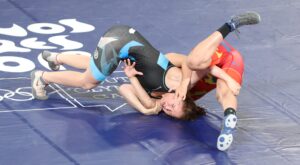


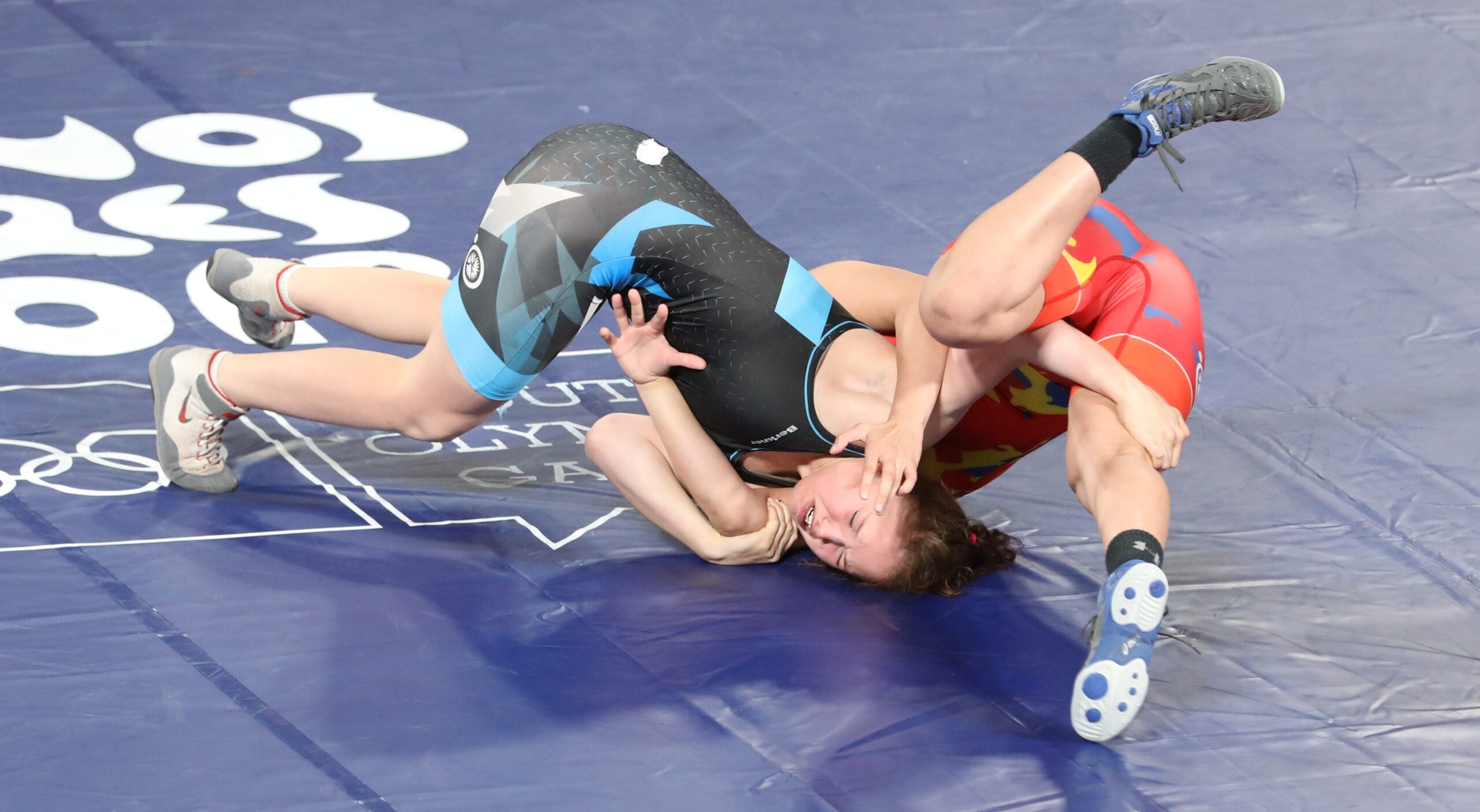
Most completed careers get summarised by a medal. This one is better summarised by a movement: a low entry to one leg, taken from a collar tie, finished by running the far hip. Watch enough of the footage and the same attack arrives from three different setups and ends in three different ways, and almost nothing else does.
Specialising that narrowly is a risk. An opponent who knows what is coming can build a whole match around denying one attack, and against a wrestler with two weapons that plan fails. Against a wrestler with one, it should work.
It did not work often enough, and the reasons are technical rather than mystical. What follows is the attack taken apart, the scoring environment that made it worth building a career on, and why a coach today teaches the same entry with different instructions.
The attack, broken into four movements
- The tie. A collar or wrist control that occupies the opponent’s hands and fixes his posture for a beat.
- The level change. Hips drop, chest stays tall. This is the movement that fails most often and is coached least.
- The penetration step. Lead foot between the opponent’s feet, head on the outside, hands meeting behind the knee.
- The finish. Three options from the same position, chosen by what the opponent gives rather than decided in advance.
- The exit. Immediate work toward the next score, because in that era a takedown alone rarely settled a bout.
A wrestler built for one entry
The physical profile explains the choice. A light weight class rewards speed of entry over strength in the tie-up, and a wrestler who is compact through the hips can drop below an opponent’s centre of gravity faster than he can be pushed away from it. Height that would be a disadvantage in an upper-body exchange becomes an advantage the moment the contest goes low.
An Olympic freestyle title at the turn of the century, won in a light class, is the line in the record that most people know, and the career summary after it moved into the administrative side of the sport rather than into coaching. The interesting part is not the medal. It is that the medal was won with a technique that every opponent had seen and prepared for.
That combination is rare and it is instructive. A technique that works while being expected is a technique whose success does not depend on surprise, which means it depends on execution quality, timing and the setup that precedes it. Those three things can be taught, which is why the footage remains in circulation in training halls.
Why the low single fits a short, fast wrestler
The single-leg family divides roughly by the height of the attack. A high single takes the leg above the knee and finishes standing, which favours strength. A low single takes the ankle or the leg just below the knee and finishes on the mat, which favours speed and depth.
The low version has one structural advantage that matters against a taller opponent: it attacks the part of the body furthest from his hands. A defender’s first response to a leg attack is to get his hands on the attacker’s head or shoulders and push down. If the attack has already passed below that plane, the push arrives late and adds nothing.
The cost is exposure. A failed low single leaves the attacker on the mat under a defender who is still standing, which is the worst position in the sport. That risk is what makes the level change and the setup non-negotiable rather than decorative.
The setup: hands, ties and the collar tap
Almost every recorded version of the attack begins with the opponent’s hands occupied. A collar tie on one side, a wrist control on the other, or a short tap on the head that provokes a hand to come up. The purpose is not to control the opponent. It is to make his hands late by a tenth of a second.
The second function of the tie is postural. A wrestler being pulled forward at the head has weight over his toes, and weight over the toes is weight that cannot be taken backwards quickly. The defender who sprawls best is the one standing square with weight over his heels, and the tie exists to make sure he is not standing that way when the attack starts.
The tap deserves its own note because it is the least imitated part. A short strike or pull to the head or the crown, repeated, trains a reaction: the hand comes up to clear it. Repeat it four times and the fifth repetition draws the hand up while the hips drop. The attack looks instantaneous on film and was set up over the preceding thirty seconds.
The level change is the whole attack
Ask a coach where a leg attack fails and the answer is almost never the finish. It is the change of level, which is a vertical movement performed while the torso stays upright.
The fault is universal and it is bending at the waist. Bending drops the head, and a dropped head is a handle: the defender gets a front headlock, and the attack becomes a defensive scramble. The correct movement is knees and hips dropping while the chest stays over the hips, so that the head is lower in space without being lower relative to the spine.
The measurable version, for anyone coaching it, is that the shoulders should end up below the opponent’s shoulders before the lead foot moves. If the foot moves first, the wrestler is reaching rather than penetrating, and the difference between the two is the difference between a takedown and a sprawl.
Penetration step and where the head goes
The step is short. The instinct is to lunge, and a lunge covers ground while destroying the ability to change direction, which the attack requires immediately afterwards.
Head placement is the detail that separates the versions. On this attack the head goes outside the leg being attacked, against the opponent’s hip, not inside. Head outside puts the attacker’s spine in line with the direction of the finish and keeps it away from the front headlock. Head inside is a different attack with a different finish and much less margin for error.
Hands meet behind the knee or around the ankle, elbows in, and the elbows are the part people forget. Elbows flaring turns a locked grip into a stretched one, and a stretched grip is what allows a defender to hop out. The classic drilling correction is to have a wrestler hold a towel between elbow and ribs while running the entry.
Finishing: running the pipe and the alternatives
From that position the same three finishes recur, and the choice is dictated by the defender’s reaction rather than chosen beforehand.
If the defender’s weight stays back, the attacker runs the pipe: he drives forward along the trapped leg while turning the corner toward the far hip, and the defender’s remaining leg cannot travel fast enough to stay under him. If the defender hops toward the attacker to relieve pressure, the attacker changes direction and takes him down the same side, using the hop as momentum. And if the defender manages to square up and sprawl, the attack is abandoned into a scramble for the far ankle rather than defended, which is the habit that keeps a failed shot from becoming a conceded score.
The pattern in the footage is that the decision is made in under a second and is never wrong twice in the same way in the same bout. That is a reading skill, and it is developed by drilling all three finishes from the same entry until the choice stops being a choice.
What the Alireza Dabir wrestling era rewarded
The scoring environment of the period is essential context and it is routinely ignored. Alireza Dabir wrestling belongs to a rule set in which a takedown was worth a single point, not the two it is worth today, and in which bouts were commonly decided by narrow margins with long passages of no scoring.
In that environment, one reliable scoring action was worth more than a broad repertoire of unreliable ones. A wrestler who could produce a takedown against anyone, once, in a bout that might be decided by one point, had a complete competitive plan. The modern equivalent would need two or three scores to achieve the same certainty.
The other feature of the era was a heavier reliance on positional control after the takedown, with more of the contest spent on the mat and more value in staying on top. An attack that finished with the attacker in a strong top position, as this one does, was therefore worth more than its point value suggests.
Defending it, then and now
The classical defences have not changed: sprawl the hips back, get the head up, control the wrists, circle away from the trapped side, and attack the grip rather than the body.
What has changed is urgency. Under the current rules, giving up a takedown costs two points and hands the opponent a position from which further scoring is likely, so defending a leg attack is worth roughly twice what it was. Defensive drilling has increased accordingly, and the average opponent today has drilled sprawl-to-front-headlock far more than the average opponent of that era.
There is also a rule-driven change in the cost of a failed shot. A wrestler who repeatedly attacks and fails is not penalised for the failure itself, but the modern passivity and activity-clock arrangements reward the wrestler who forces the exchange, which slightly favours the attacker. The current rule text is maintained by the international federation and is amended more often than most spectators realise.
Why the same entry is coached differently today
Three changes have altered the instructions attached to the same movement.
First, the value of the takedown doubled, which shifted the whole sport toward leg attacks and made defending them a priority for everyone. A single reliable entry is no longer a complete plan; it is one of the two or three a competitive wrestler needs.
Second, same-day weigh-ins and the tightening of weight rules changed who is available in the light classes, and the physical profile that suited the technique is less often produced by wrestlers who once cut heavily to reach it. Third, the emphasis on continuous scoring means the finish is now coached as a transition rather than as an endpoint: the wrestler is taught what to do in the two seconds after the score, not just how to get it. Coaches working through the differences between the styles tend to teach the entry first and the exit second, which is the reverse of the older order.
A progression for a fifteen-year-old
The technique is age-appropriate early, provided it is built in order. The table below is the order most halls use, with the criterion that has to be met before the next stage is added.
| Stage | What is drilled | Criterion before moving on |
|---|---|---|
| 1 | Level change on the spot, no partner | Chest stays over hips through twenty repetitions |
| 2 | Penetration step to a knee, no partner | Short step, head up, immediate recovery to stance |
| 3 | Entry on a static partner | Head outside, elbows in, hands locked behind the knee |
| 4 | Run the pipe from a fixed position | Finish without releasing the grip |
| 5 | Three finishes on reaction | Correct finish chosen without hesitation |
| 6 | Setups: collar tie, wrist, tap | Entry follows a hand reaction, not a count |
| 7 | Live from neutral, restricted | Failed shots end in a scramble, not a conceded score |
The stage most often skipped is the second, and skipping it produces the wrestler who reaches for legs from a standing posture for the rest of his career. The stage most often rushed is the last, because live wrestling is more enjoyable than drilling, and rushing it is how bad habits get made permanent.
Frequently Asked Questions
Is a single attack enough at senior level today?
Not on its own. With takedowns worth two points, opponents defend leg attacks far harder and matches are higher scoring, so a wrestler needs a second reliable entry from a different angle. One attack executed to a very high standard remains a strong foundation, which is not the same thing as a complete plan.
Why is the head outside on this entry?
To keep it away from the front headlock and to line the spine up with the direction of the finish. Head inside is a different technique with different finishes and a much smaller margin if the shot stalls.
What is the most common fault when it is learned?
Bending at the waist instead of dropping the hips. It lowers the head without lowering the shoulders relative to the opponent, which turns the attack into a reaching motion and hands the defender a grip on the head.
Does the technique suit heavier wrestlers?
Less well. The low version depends on speed of descent and on getting below an opponent’s hands, and both get harder as mass increases. Heavier wrestlers tend to use higher variations that finish standing, where strength in the lift compensates for a slower entry.
How much of this is drilling and how much is live wrestling?
Early on, heavily weighted toward drilling, because the fault patterns are motor rather than tactical. Once the entry is clean the balance shifts, but even at senior level the entry is drilled daily, in the same way a shooter dry-fires.
One attack, drilled to the point where being expected did not matter, is a strange foundation for a career and a very good teaching object. It is why the footage still gets played in halls where nobody watching was born when it was recorded.