

Two competition programmes, one shooting line, the same seventy metres and the same target face. That coincidence is the reason the career of Zahra Nemati is worth studying as a technical case rather than as an inspirational one. The distance did not change when she moved between programmes. The equipment barely changed. What changed was the field, the schedule and the format.
She came to the bow late and from another sport. A road accident in her teens left her using a wheelchair, and the taekwondo career she had been building ended with it. Archery began several years later, in Kerman, on a recurve bow, and it produced a Paralympic title in London in 2012 that made her the first Iranian woman to win a gold medal at either the Olympic or the Paralympic Games.
What follows is the technique underneath that, assembled from the way recurve archery is actually coached: the setup, the draw, the release, and what each of those has to do differently when the lower body cannot contribute.
The profile in short
- Discipline. Recurve, the Olympic bow, shot with a clicker, a stabiliser system and a simple sight pin.
- Distance. Seventy metres at a 122-centimetre target face, which is the standard for both programmes at senior level.
- Background. Taekwondo first, archery second, with the change forced by injury rather than chosen.
- Breakthrough. London 2012, individual recurve, the first gold by an Iranian woman at either Games.
- Rio 2016. Competed in both programmes in the same city in the same summer, and carried the flag at the Olympic opening ceremony.
- Technical interest. A shot built entirely from the torso, shoulders and back, with no leg drive available to stabilise it.
From the taekwondo hall to a bow
The switch is less strange than it looks. Taekwondo trains distance judgement, a tolerance for repetition and the habit of executing under a clock, and all three transfer. What does not transfer is the movement itself, and an archer who arrives from a dynamic sport usually has to unlearn the instinct to add effort at the moment of execution.
Archery rewards the opposite. The shot is a sequence that is set up, held and then allowed to complete. Adding force at the release is the most common fault in a new archer with an athletic background, and it produces a pull to one side that no sight adjustment can fix.
The second adjustment is volume. A serious recurve programme is measured in arrows per week, in the hundreds and then in the thousands, at an intensity that is physically low and mentally demanding. That is a different kind of training day from a combat sport, and it takes a season or two to accept.
The Zahra Nemati archery setup, piece by piece
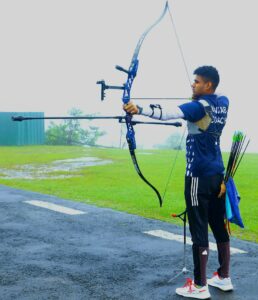
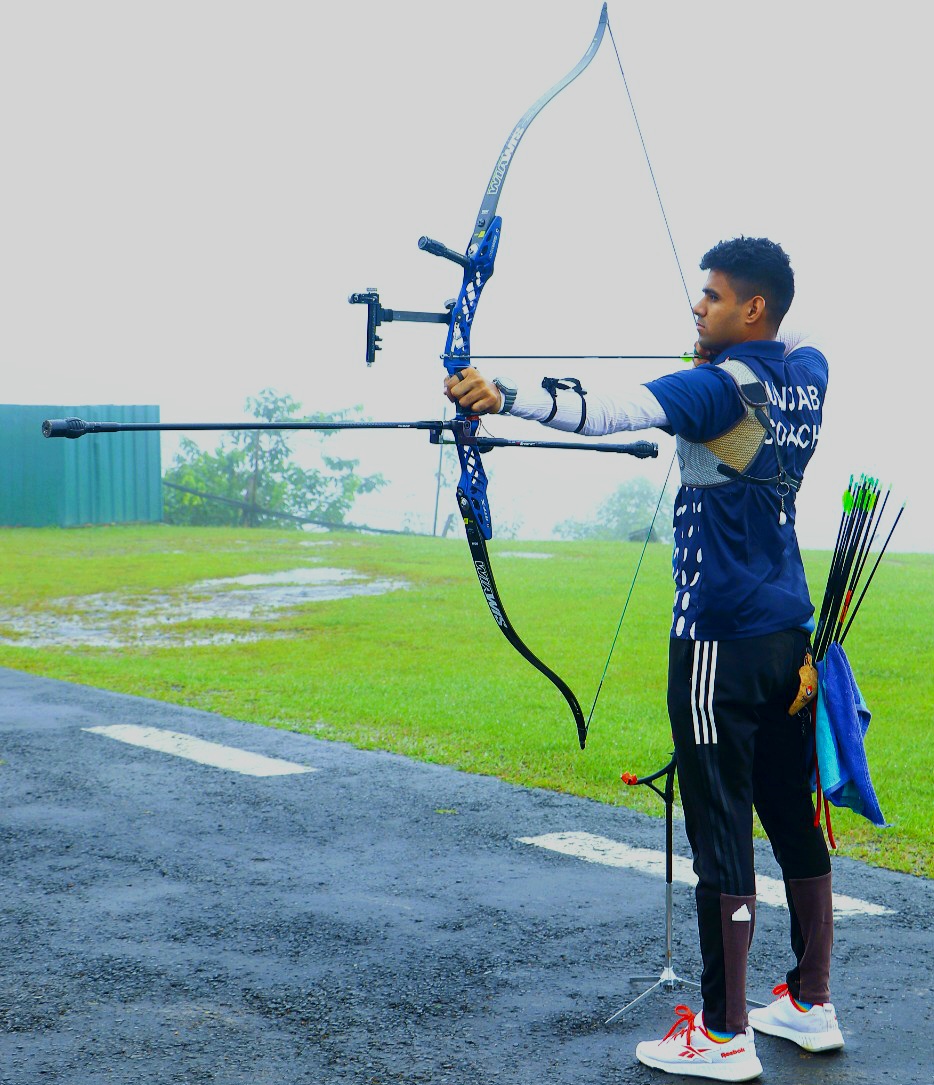
The Zahra Nemati archery setup is a conventional Olympic recurve rig, which is the point: the bow does not compensate for anything. A takedown riser with two limbs, a plunger button, an arrow rest, a sight with a single pin, a long rod stabiliser with side rods, and a clicker mounted on the riser.
The recurve bow is drawn and held under load for the whole shot, unlike a compound, which lets off most of the weight at full draw. That distinction decides the training: a recurve archer needs shoulder and back endurance, because every arrow in a seventy-two arrow ranking round is held at full weight.
Draw weight is selected to be repeatable at the end of a long round rather than comfortable at the start of one. An archer who chooses a weight she can only hold cleanly for the first thirty arrows will lose the round in the last twenty-four, and the loss will look like concentration rather than what it is.
Why the same distance means the same technique
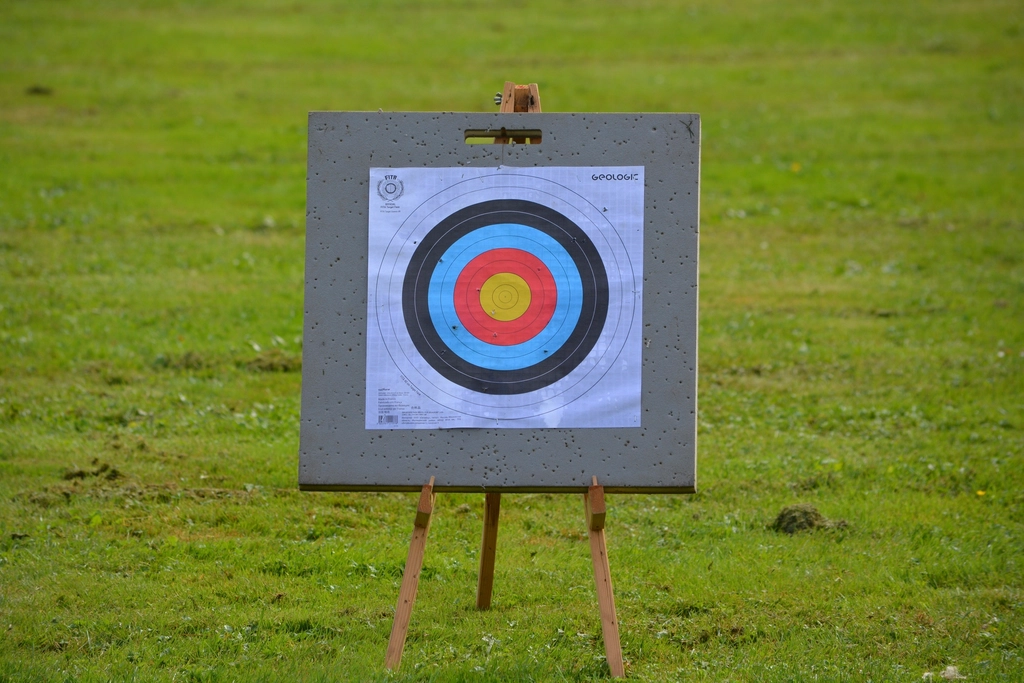
Senior recurve competition in both programmes is shot at seventy metres at the same target face, and that single equivalence removes any argument that the two are different sports. The arrow has to cover the same ground, the wind does the same thing to it, and the ten ring is the same size when it gets there.
What that means practically is that a sight mark set for one competition is the sight mark for the other, that the arrow spine and point weight do not change, and that a coach preparing an archer for one programme is preparing her for both. There is no separate technical syllabus.
The differences are competitive rather than technical. The field is larger and deeper in one programme, the qualification route is different, and the schedule places the two events in different weeks. None of that changes what happens between the anchor and the release.
Shooting without leg drive
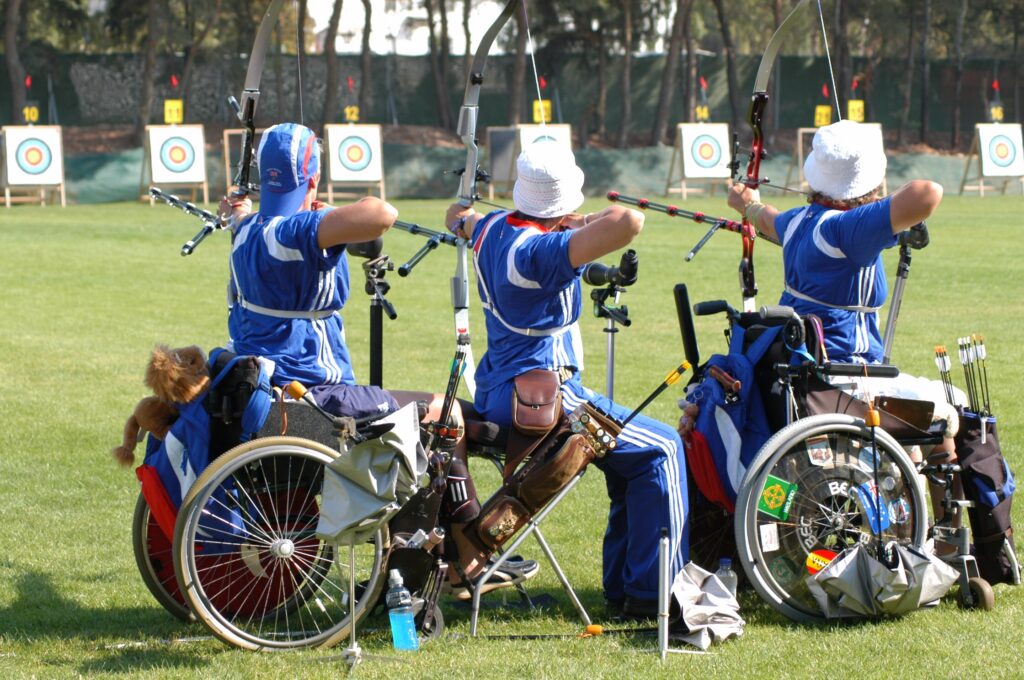
A standing archer builds a shot from the ground up. The feet set the line, the hips and legs provide a stable base, and the torso rotates against that base. Remove the legs from the chain and the base has to be created somewhere else, which is the central technical problem of wheelchair recurve.
The solution is a torso that is held rather than braced from below. The archer sits square, the back is long, and the shoulders sit down rather than lifted. Any sway is corrected by the trunk, and there is no lower-body counterweight to absorb the recoil of the string leaving the fingers.
The practical consequence is that trunk endurance becomes the limiting factor. A seated archer late in a long round loses posture before she loses aim, and the loss of posture shows up as a shot that lands low. Off-bow conditioning for the trunk and the scapular muscles is therefore not supplementary work; it is the base of the technique.
The draw, the anchor and the clicker
The draw is a rotation, not a pull. The string hand travels back along a line under the chin while the drawing elbow moves around and behind the shoulder, and the load transfers progressively from the arm into the back muscles between the shoulder blades. An archer who pulls with the arm runs out of strength and also runs out of consistency, because the arm has more ways to be wrong than the back does.
The anchor is the fixed reference: the string touching a defined point on the chin and nose, the hand set against the jaw in the same place every time. If the anchor moves by a few millimetres, the arrow moves by a great deal more at seventy metres, which is why coaches spend more time on this one detail than on aiming.
The clicker is a thin blade on the riser that falls off the arrow point when the archer reaches a set draw length, producing an audible signal. Its function is to standardise draw length and to remove the decision about when to release. It is also the single hardest piece of equipment for a new archer to accept, because it takes the timing of the shot out of conscious control.
Release and follow-through when the base cannot move
The release is a relaxation of the string fingers, not an opening of the hand. Done correctly, the string leaves because the fingers stopped holding it, and the drawing hand continues backwards along the neck under the tension that was already there. Done incorrectly, the hand pushes forward or flies outward, and the arrow follows.
Follow-through matters more for a seated archer, not less. The body cannot absorb the small forward lurch that a poor release produces, because there is no leg to check it. The result is a slight loss of posture that carries into the next arrow, which is how a single bad shot becomes three.
Coaches therefore train the release as a continuation rather than an event. The instruction is not to let go at the click but to keep expanding through it, so that the click happens in the middle of a movement rather than at the end of one.
Equipment: what gets adjusted and what does not
The adjustments in wheelchair recurve are small and specific. Chair position and stability matter, and the classification rules define what support is permitted. Stabiliser length and weight distribution can be tuned to change how the bow settles after the shot, which is more valuable to a seated archer because the settling has to happen without lower-body damping.
Everything else follows standard recurve practice. Arrow spine is matched to draw weight and draw length. The plunger is tuned so the arrow leaves cleanly. The sight is marked for distance, and the marks are rewritten whenever the bow weight or the arrows change.
What does not get adjusted is the target. That is the part supporters most often assume is different, and it is the part that has stayed identical across both programmes at senior level for years.
Two programmes, two competition formats
| Element | Olympic recurve | Recurve open, Paralympic programme |
|---|---|---|
| Distance | 70 metres | 70 metres |
| Target face | 122 cm, ten rings | 122 cm, ten rings |
| Ranking round | 72 arrows | 72 arrows |
| Head-to-head | Set system, three arrows per set | Set system, three arrows per set |
| Bow type | Recurve with clicker and sight | Recurve with clicker and sight |
| Field | Larger entry, deeper qualification | Smaller entry, classification-based eligibility |
The set system rewards a different kind of consistency
The ranking round is a straight accumulation of seventy-two arrows, and it decides seeding rather than medals. The knockout matches that follow are scored in sets of three arrows, with two set points for winning a set and one each for a tie, and the match ends when an archer reaches six set points.
That format changes what a bad arrow costs. In a cumulative round, a seven is a three-point deficit that can be recovered over sixty more arrows. In a set, a seven usually loses the set outright, and the loss is worth the same as losing it by twenty points. Consistency across three arrows matters more than a high average.
It also compresses the mental problem. An archer can win a match while shooting a lower total than her opponent, which happens often enough that coaches prepare for it specifically. The instruction is to shoot each set as a separate three-arrow event and to refuse to carry the previous one onto the line.
The training load behind a ranking round
Seventy-two scoring arrows is the visible part. The preparation behind it is measured in weeks of high-volume, low-intensity repetition, with the emphasis on the identical execution of one movement rather than on variety.
A typical block mixes blank-bale shooting at close range, where there is no target and the archer attends only to form, with distance work for sight marks and scoring rounds for pressure. The blank-bale portion is the part that separates a scoring archer from a consistent one, and it is the part that beginners skip.
Conditioning runs alongside it. Trunk and scapular endurance, shoulder health and grip are the standing priorities, and the loading is deliberately conservative, because a shoulder injury in a recurve archer costs months rather than weeks. Wider practice in adaptive sport has moved in the same direction: less novelty, more repeatable load.
What the career changed off the shooting line
The competitive record is one thing. The organisational effect is another, and it is easier to observe. A single archer competing in both programmes forces the two structures to work with each other: the same coach, the same training group, the same national federation calendar, one athlete moving between them.
It also changed what a provincial club can plausibly offer. Kerman is not the capital, and a pathway that ends in a national programme rather than in a relocation is worth more to a regional federation than any number of promotional campaigns. The pattern is visible across several disciplines in the record of Iranian women in competition.
The flagbearer role at an Olympic opening ceremony belongs to that second category as well. It is a scheduling and protocol decision rather than a sporting one, and it puts an athlete from one programme at the front of the other.
Frequently Asked Questions
Is the Paralympic recurve event shot at a shorter distance?
No. Senior recurve open is shot at seventy metres at the same 122-centimetre face used in the Olympic programme, with the same seventy-two arrow ranking round and the same set-system knockout format.
What is the clicker for?
It standardises draw length and removes the decision about when to release. The blade falls off the arrow point at a set draw, and the archer releases in response to the sound rather than choosing a moment. It is the main tool against creeping short on a long round.
Why is a recurve harder to hold than a compound?
A compound bow lets off most of the draw weight at full draw through its cam system. A recurve holds full weight throughout, so every arrow in a long round is shot under load. That is why recurve training emphasises back and shoulder endurance so heavily.
How does a wheelchair archer stay stable without leg drive?
Stability comes from the trunk instead of from the ground. The archer sits square with a long back and controls sway with the torso, so trunk and scapular endurance become the limiting factors late in a round rather than arm strength.
Can an athlete really compete in both programmes at the same Games?
Eligibility for the Paralympic programme depends on classification, and eligibility for the Olympic programme depends on qualification through the open route like any other archer. The two are not mutually exclusive, and archery is one of the sports where the technical demands are close enough to make it practical.
The reason coaches keep returning to this career is not the medal count. It is that the technique is orthodox, the equipment is standard, and the distance is the same as everyone else’s, which leaves nothing to explain away.