

A club buys a camera, films twenty matches, and discovers in February that none of the footage answers the question the coach is asking. The players are in frame, the ball is in frame, and the shape of the team is invisible because the camera was standing on the touchline at the height of a person.
That is the ordinary failure, and it is not a resolution problem. Footage becomes useful for analysis when it shows the relationship between players who are nowhere near the ball, and that depends almost entirely on where the camera is and how much of the pitch fits in the frame.
What follows compares the three setups a club will realistically consider, on the measures that actually decide the purchase: coverage, usability for coding, the true cost including storage and transfer, and the minimum specification below which the recording is not worth making.
What to settle before buying anything
- The question first. Footage for individual technique, for team shape and for opposition scouting are three different recordings.
- Height before pixels. A camera four metres higher improves the analysis more than doubling the resolution does.
- Coverage before zoom. If both penalty areas are never in frame together, the tactical questions cannot be answered at all.
- Frame rate. Fifty frames per second for technique, twenty-five is adequate for shape.
- Storage. Roughly four and a half gigabytes per hour at 1080p and ten megabits per second. Multiply by matches and by seasons before deciding.
- Transfer. Getting the file to the analyst the same evening is a recurring cost that nobody budgets for.
Height beats resolution, every time
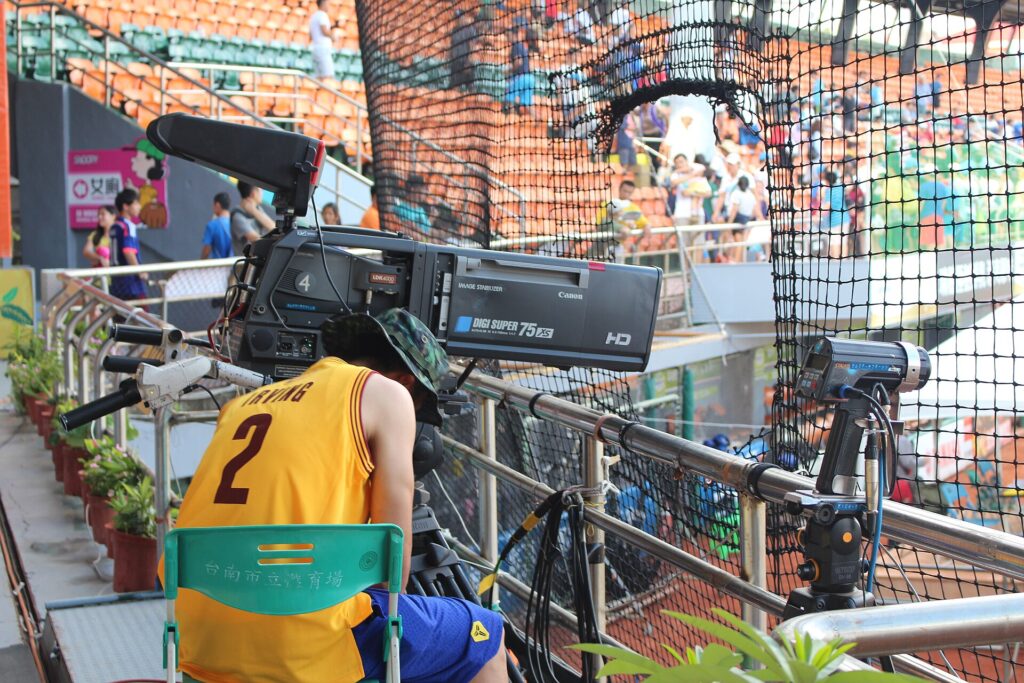
A camera at eye level on the touchline sees a compressed image in which players at the far side overlap players at the near side. Depth disappears, and distances between lines, which is the single most useful thing to measure in a football match, cannot be judged at all.
Raising the camera separates the players in the frame. At roughly six metres the near and far sides begin to separate usefully; at ten to twelve metres, the standard height of a permanent broadcast gantry, the whole defensive line and the whole midfield line can be seen as lines rather than as a crowd.
The arithmetic behind that is the field of view intersecting the ground plane. A camera close to the ground has its horizontal view cut by the players nearest to it; a raised camera looks down onto the surface and the same lens covers far more usable pitch. That is why an inexpensive camera on a high mast produces better analysis footage than an expensive one on the touchline, and it is the single most common mistake in a first purchase.
The football video analysis camera, option by option
A football video analysis camera setup comes in three practical forms, and the choice between them is mostly a choice about who operates it and where it can be mounted.
A tripod setup is one camera, one operator, panning to follow play. An elevated fixed setup is one camera on a mast, gantry or stand position, wide enough that it needs no operator. A panoramic setup is two or more fixed cameras whose images are stitched into a single wide view, from which a following view can be generated afterwards in software.
Cost rises across that list and so does the amount of ground covered per second of footage. What does not rise in a straight line is usability, because each option fails in a different way, and the failure modes matter more than the specifications.
Option one: a tripod at the halfway line
The cheapest workable arrangement is a consumer camera on a fluid-head tripod, placed as high as the ground allows, at the halfway line, with somebody panning. It costs the least, it can be moved between venues, and it produces footage that is immediately watchable.
Its strength is image quality on the ball. A panned camera can stay tight enough to see a first touch, a body shape at reception and a defender’s foot position, which makes it the best of the three for individual technical work and for player feedback.
Its weakness is structural. A panned camera shows the ball and roughly a third of the pitch, so every question about what happened away from the ball is unanswerable. It also depends on an operator: a volunteer who follows the ball tightly produces footage that is useless for shape, and one who stays wide produces footage in which nobody can be identified. Elevation is the fix, and most grounds allow a tripod at the back of a stand rather than at pitch level.
Option two: an elevated fixed position
The second option removes the operator. A wide-angle camera is fixed at height, framed once to include both penalty areas and both touchlines, and left running for the whole match.
What that buys is completeness. Every player is in every frame, so off-ball movement, defensive line height, the distance between units and the shape of a press are all visible and measurable. It is the setup most analysts would choose if they could have only one, and it is the one that makes coding possible rather than merely convenient.
Its cost is detail. Fitting a hundred and five metres of pitch into a frame makes each player small, and at 1080p a fixed wide view will not support close technical work on an individual. That is the argument for running it alongside a tripod rather than instead of one, and for choosing a higher resolution sensor specifically to allow cropping into the fixed frame afterwards.
Option three: a panoramic array
A panoramic setup uses two or three fixed cameras with overlapping views, stitched into a single very wide image. From that image, software can generate a virtual following camera, so a club gets a broadcast-style view and a tactical view from one recording.
The advantages are real. Nothing is missed, since the whole pitch is always recorded; there is no operator; and the same file serves the analyst, the coach and any highlights work. Where a system includes automatic tracking, the same footage can feed positional data as well.
The costs are equally real and are mostly not the hardware. Stitching requires processing before anyone can watch, which adds hours between the final whistle and the review; the files are several times larger; and the mounting has to be rigid and permanent, because a stitched image from a mast that moves in the wind produces visible seams. It is a fixed installation at a home ground, not a solution for away matches. Clubs adopting the broader current generation of sports technology usually reach this stage after two seasons of simpler recording, not before.
What “usable for coding” actually means
Coding is the process of tagging events in footage so that they can be counted, filtered and reviewed. Whether footage supports it comes down to four tests, and they are worth applying to a sample clip before any purchase.
Can both penalty areas be seen in the same frame during a settled possession. Can the defensive line be counted without pausing. Can an individual player be identified by number, or at least by position and movement, anywhere on the pitch. And is the timecode continuous, with no gaps at drinks breaks or card changes.
Footage that fails the first two tests can still be watched and cannot be coded for anything tactical. Footage that fails the third can be coded for team events and not for individuals. Footage that fails the fourth wastes an analyst’s afternoon on synchronisation, which is the least visible and most common cost of a cheap recording setup.
Frame rate, shutter and the two settings people get wrong
Two settings decide whether the recording is technically usable, and both are routinely left on an automatic mode that fights the purpose.
The first is frame rate. Twenty-five frames per second is enough to see shape and to code events. Fifty is materially better for anything involving contact, a first touch or a foot planting, because the moment of interest falls between frames at the lower rate. The cost is roughly double the file size.
The second is shutter speed, and it is the one that ruins footage. A camera left on automatic in bright conditions will use a slow shutter and produce motion blur on every fast movement, which makes frame-by-frame review worthless. A shutter fixed at around double the frame rate, or faster, gives a crisp frame at the cost of some light. Under floodlights the trade-off tightens, and this is where a larger sensor earns its price rather than in daylight.
Storage arithmetic, done once

Storage is the cost that arrives quietly and then dominates. The arithmetic is simple enough to do before buying anything.
A recording at ten megabits per second consumes thirty-six thousand megabits in an hour, which is four and a half gigabytes. A two-hour match file at 1080p is therefore around nine gigabytes. Twenty home matches in a season is a hundred and eighty. Add a second camera and it is three hundred and sixty; move to 4K at fifty megabits per second and a single match approaches fifty gigabytes.
Two conclusions follow. A club needs a retention policy, not a bigger disk: full match files for the current season, clipped and tagged sequences kept permanently, and everything else deleted on a schedule that somebody owns. And it needs two copies of anything it intends to keep, in two places, because a single external drive holding a season of footage is a single point of failure that eventually fails.
Getting the file from the ground to the analyst
The step between recording and analysis is where most amateur setups lose their time. A nine-gigabyte file does not travel over a mobile connection at a provincial ground, and an analyst who receives footage two days later is delivering a review nobody acts on.
The workable arrangements are physical or planned. A second memory card handed to a staff member who leaves at full time; a laptop at the ground copying while the team showers; or an upload scheduled overnight from the club’s own connection. Each is unglamorous and each removes a day from the cycle.
The other half of the problem is naming and filing. Footage that arrives as an unlabelled file from a camera is a small tax every single time; a fixed naming convention including date, opponent, half and camera position costs one decision and pays for itself within a season. The same discipline underpins any wider use of performance data, where the analysis is rarely the bottleneck and the file management usually is.
Three setups on the same measures
| Measure | Tripod, operated | Elevated fixed | Panoramic array |
|---|---|---|---|
| Pitch in frame | About a third | All of it | All of it |
| Detail on the ball | Best | Limited | Limited without cropping |
| Operator needed | Yes, for the whole match | No | No |
| Portable to away grounds | Yes | Sometimes | No |
| Ready to watch | Immediately | Immediately | After processing |
| Storage per match | Lowest | Moderate | Highest |
| Best suited to | Individual technique | Team shape and coding | Everything, at a home ground |
The minimum specification worth buying
Below a certain point a recording is not worth making, and the threshold is lower than salespeople suggest. A camera capable of 1080p at fifty frames per second, with manual shutter control, a genuinely wide lens, external power and continuous recording longer than a half without stopping, is enough to produce codable footage.
What matters more than the body is everything around it. A mounting position at six metres or higher. A fluid head if anyone is going to pan. Mains power or a battery solution proven for two hours in cold weather. A memory card fast enough for the bitrate, and a spare. And a fixed framing that somebody has checked from the seat where the camera will actually sit.
Spending above that threshold is worthwhile in one direction only: resolution that allows cropping into a fixed wide frame, which gives a club both the shape view and a usable close view from a single camera. Spending on anything else before the mounting height is solved is money placed against the wrong constraint, which is the same error that shows up in tracking system purchases across the sport.
Frequently Asked Questions
Is a phone good enough to record a match?
For individual clips, yes. For analysis, the limits are the lens, the lack of manual shutter control and the recording duration. A phone mounted high with a wide adapter and manual settings is closer to workable than a phone held at pitch level, which is not.
How high does the camera need to be?
Six metres is the point at which the near and far sides separate usefully; ten to twelve is where lines can be read as lines. Any increase in height improves the footage more than an equivalent increase in resolution.
Is 4K worth it?
Only for a fixed wide setup where cropping into the frame gives a second, closer view. For an operated tripod camera the extra data buys very little and multiplies the storage and transfer cost.
Why does footage look sharp on a phone and blur when paused?
Because the shutter speed was left on automatic and set slow. Fix the shutter at around double the frame rate or faster and each individual frame stays crisp, which is what frame-by-frame review requires.
How much storage does a season need?
Around nine gigabytes for a two-hour match at 1080p and ten megabits per second, so roughly a hundred and eighty for twenty matches from one camera. Plan for two copies and a deletion schedule rather than for one very large disk.
The camera is the smallest decision in the whole arrangement. Where it is mounted, what fits in the frame, and who moves the file after the final whistle are the three things that determine whether anyone ever watches it.