


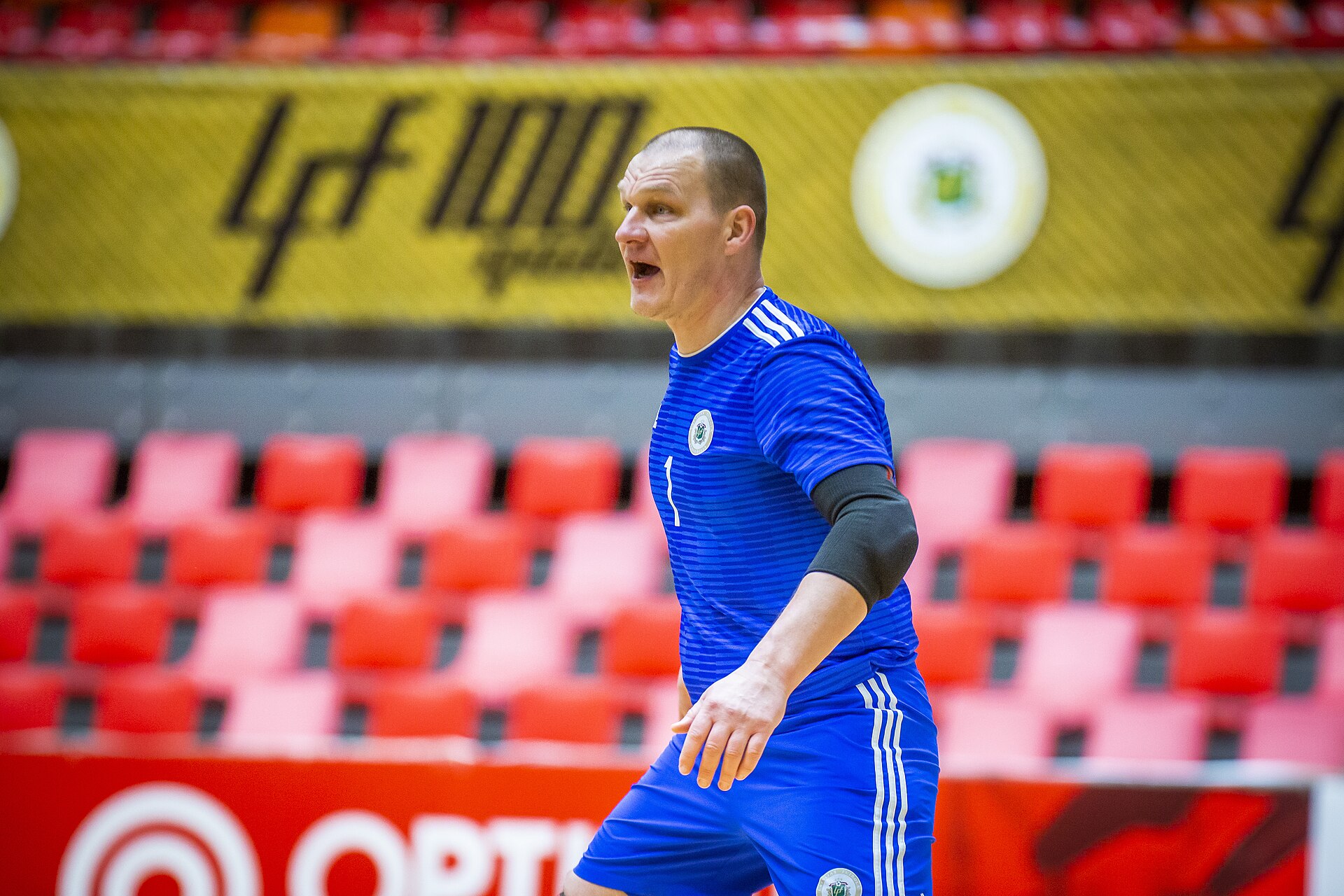
A finisher’s reputation usually rests on a highlight reel of spectacular strikes, but the more useful measure of a career like Vahid Shamsaei’s is the shot nobody remembers individually: the same far-post run, arriving at the same moment, finished with the same low, first-touch strike, repeated so many times across so many seasons that opposing defenses knew it was coming and still could not consistently stop it.
Shamsaei’s career as one of the most prolific finishers in the history of the national futsal team was built on a small number of technical patterns executed with unusual reliability rather than on a wide, unpredictable repertoire. That distinction matters for understanding why junior coaches still use footage of specific movements from his career as a direct teaching reference decades into the sport’s development in the country.
What follows is a look at the technical mechanics behind that reliability: the positioning at the far post, the movement off the pivot player, and the specific shooting technique required on a ball that behaves very differently from an outdoor football on a hard indoor court.
- Position. Attacking specialist, primarily finishing from around the six-metre area and the far post.
- Signature pattern. A far-post run timed off the pivot player’s hold-up play, finished first-time.
- Technical core. First-touch finishing under pressure, positioning off the pivot, and shooting mechanics adapted to a low-bounce ball.
- Career context. A prolific international scoring record across a long national team career in the sport.
- Why it matters here. The specific movement pattern remains a coaching reference for developing Iranian futsal finishers today.
Why futsal finishing rewards pattern over improvisation
Futsal’s compressed playing surface and continuous defensive pressure make pure improvisation a less reliable route to consistent scoring than it can be in the more spacious outdoor game, since a defender in futsal is rarely more than a stride or two away from closing down an attacker regardless of where on the court he receives the ball. A finisher who relies on creating something unexpected from a standing start faces defensive pressure arriving too quickly for that improvisation to reliably succeed.
This is why the sport’s most consistent finishers across its history have tended to build their scoring around a small number of well-rehearsed movement patterns rather than a broad, creative repertoire, since a pattern executed at speed and with precise timing beats defensive pressure more reliably than invention attempted under the same time constraint.
Coaches who have studied the sport’s most productive finishers across different eras and countries note a consistent theme in how these players describe their own game afterward: fewer distinct movements than a casual observer would assume, repeated with a precision that made them difficult to stop even once thoroughly scouted.
The far-post run: timing off the pivot
Shamsaei’s signature movement began with the pivot, the player positioned with his back to goal holding up the ball under close defensive pressure, and depended on Shamsaei timing his run to the far post to arrive at the exact moment the pivot’s touch or lay-off created a passing lane. Arriving too early let a defender track and close the run down before the ball reached him; arriving too late meant the pivot’s touch had already been defended or the passing window had closed.
This timing was refined over thousands of repetitions in training specifically with the players who most often occupied the pivot role during his national team career, building a shared understanding of exactly when a run should begin relative to a specific type of pivot touch, a partnership-specific timing that a generic coaching manual describing the pattern in the abstract cannot fully capture.
A newer partnership between a finisher and a pivot, even two technically excellent players individually, typically needs a genuine adjustment period before this specific timing clicks reliably, which is part of why national coaching staff have historically been reluctant to break up an established pivot-finisher pairing once it has proven effective over a full season or more.
Positioning at the far post: patience before the run
Before the run itself, positioning at the far post required a specific kind of patience, staying wide enough to remain outside a near-side defender’s immediate attention while staying close enough to the goal that the eventual run covered only a short, explosive distance rather than a longer approach a defender would have more time to read and react to. This balance between staying unnoticed and staying dangerous was itself a coached skill rather than an instinctive habit.
Younger players learning this pattern today are often shown footage specifically illustrating this positioning phase, the seconds before the actual run begins, since the visible run itself is the easy part to imitate while the quieter positional discipline that sets it up is what separates a finisher who executes the pattern occasionally from one who executes it reliably match after match.
This patience is genuinely difficult to teach, since a young, eager finisher’s natural instinct is to drift toward the ball whenever it is nearby rather than holding a disciplined position that only pays off once the timing of the eventual run is right, and coaches report that this specific habit often takes longer to correct than the technical shooting mechanics that come later in the sequence.
First-touch finishing under defensive pressure
Once the ball arrived, the finish itself depended on a clean first touch that redirected the ball toward goal in a single motion, since futsal’s tight spaces rarely allow a second touch to set up a shot before a recovering defender closes the gap. A finisher who needs two touches to convert a chance in this sport is giving a defense a second chance it did not have to earn, and the gap between a one-touch and a two-touch finish in terms of actual conversion rate over a career is considerable.
Shamsaei’s reputation for reliability rested heavily on this specific skill, converting the far-post pattern with a first-time finish often enough that opposing coaches had to specifically instruct defenders to anticipate the run rather than simply react to it once it had already begun.
The margin for error on a first-touch finish under this kind of pressure is genuinely small, since the ball typically arrives at an awkward height or pace dictated by the pivot’s touch rather than a perfectly weighted pass, which means the finishing technique has to adapt to whatever ball actually arrives rather than assuming an ideal delivery every time.
Vahid shamsaei futsal: shooting mechanics on a low-bounce ball
The ball used in vahid shamsaei futsal era competition, and in the sport generally, is specifically designed with reduced bounce compared with an outdoor football, which changes the mechanics of an effective finish considerably: a shooting technique that works well against a livelier, higher-bouncing ball can produce a weak, easily saved effort against futsal’s flatter, lower ball behavior. Adapting to this difference is one of the more underappreciated technical adjustments a strong outdoor finisher has to make when moving into serious futsal competition.
The technique that suits this ball favors a firmer, more compact striking motion through the lower half of the ball rather than the fuller swing an outdoor finish often uses, a mechanical detail coaches now teach explicitly to young futsal specialists rather than assuming it develops naturally through general practice with the sport’s specific ball.
What a long international career actually demonstrated
Sustaining a prolific scoring record across a long international career in a sport where opposing coaches had years to study and specifically prepare for a well-known finishing pattern is itself evidence that the pattern’s effectiveness rested on more than surprise. Defenses that knew the far-post run was coming still struggled to consistently stop it, which points to the execution quality, the specific timing refined through years of repetition, rather than any element of surprise as the real source of its reliability.
This longevity against increasingly well-prepared opposition is precisely why the pattern remains a coaching reference today rather than being treated as a dated tactic specific to an earlier, less tactically sophisticated era of the sport.
Longevity in the finishing role also required a level of physical conditioning specific to the repeated, explosive nature of the pattern, since a run of that intensity performed dozens of times across a single match, repeated across an entire international career, places a cumulative physical demand that a less disciplined training regimen would not have sustained for nearly as long.
Comparing outdoor and futsal finishing technique
| Aspect | Outdoor football finish | Futsal finish |
|---|---|---|
| Ball behavior | Livelier, higher bounce | Reduced bounce, flatter behavior |
| Typical touches before shot | Often two or more | Frequently one, due to tight defensive pressure |
| Striking technique | Fuller swing through the ball | Firmer, more compact strike |
| Space to improvise | Generally more available | Very limited, favoring rehearsed patterns |
Why junior coaches still use this specific footage
Coaches working with developing Iranian futsal finishers today continue to use footage of the far-post pattern specifically because it isolates a teachable sequence, positioning, timing, and a first-touch finish adapted to the sport’s specific ball, into a single repeated example rather than requiring a young player to abstract the same lessons from more chaotic, less clearly patterned match footage. The clarity of the pattern is what makes it useful as a training reference, independent of the era it comes from.
Breaking the sequence into its three component parts, the positioning phase, the timed run, and the finishing technique, gives a coach a concrete progression to drill separately before combining them, rather than asking a young player to absorb the entire movement as a single, harder-to-isolate skill.
What the pattern required that statistics alone do not show
A career scoring record captures outcomes but not the specific technical discipline required to produce them consistently: the restraint to hold a far-post position rather than drifting toward the ball out of impatience, the trust in a pivot partner’s hold-up play, and the mechanical precision needed to convert a low-bounce ball first-time under defensive pressure. None of this shows up directly in a goals total, which only records that the pattern worked, not how demanding it actually was to execute reliably.
This gap between the visible statistic and the underlying technical demand is a large part of why coaches, rather than statisticians, remain the primary source for understanding what actually made a finishing career like this one effective over such a long period.
Interviews with former teammates and opposing players from the same era consistently mention the same detail when asked what made the pattern so hard to stop even once well known: not surprise, since every opponent eventually knew the run was coming, but a consistency of execution under pressure that few other finishers in the sport’s domestic history have matched over a comparably long stretch of competition.
Frequently Asked Questions
What made Vahid Shamsaei’s far-post movement so difficult to defend?
Precise timing built through years of repetition with specific pivot partners, combined with a reliable first-time finish that gave defenders very little time to react even when they anticipated the run.
Why does futsal require different shooting mechanics than outdoor football?
The futsal ball has reduced bounce compared with an outdoor football, which favors a firmer, more compact strike through the lower half of the ball rather than a fuller outdoor-style swing.
What is the role of the pivot in this scoring pattern?
The pivot holds up the ball under pressure with his back to goal, and his touch or lay-off creates the passing lane that a far-post run is timed to arrive into.
Why do coaches still use this specific pattern to teach young players?
It breaks cleanly into three teachable parts, positioning, timed movement and finishing technique, making it easier to drill than more chaotic general match footage.
Is improvisation less valuable than pattern play in futsal specifically?
Not entirely, but futsal’s tight spaces and fast defensive closing distance make a well-rehearsed pattern more reliably effective than pure improvisation under the same pressure.
The goals blur together in a highlight reel. What does not blur, for the coaches still teaching from this era, is the exact moment a run had to begin, and the discipline it took to wait for it.