


Go to any youth pitch in the country in the years after the middle of the last decade and you would see the same move attempted several hundred times an afternoon: receive with the back to goal, roll the sole of the foot across the ball, turn out of the pressure and go.
Almost all of those attempts failed, which is the interesting part. A generation of juniors was copying a pattern whose visible element, the turn, was the easiest thing about it and the least important. The part that made it work happened before the ball arrived and was invisible from the touchline.
This is a technical profile of a completed career: what Ali Karimi was actually doing when he received the ball, which parts of it were teachable, and why the version that spread through junior football was the wrong half of the technique.
The profile in four habits
- The scan. Repeated shoulder checks in the seconds before the pass arrived, not a single glance.
- The body shape. Receiving half-turned, so that one touch could take the ball forward rather than requiring a second to turn.
- The first touch. Directed into space away from the nearest defender, treated as a pass rather than as a control.
- The dribble. Many small touches at close range, then one large change of direction, rather than a series of tricks.
- The role. An attacking midfielder who operated between the opposition’s midfield and defensive lines, at clubs including Persepolis and, in the mid-2000s, Bayern Munich.
- The recognition. Asian Footballer of the Year in 2004, at the height of the period this article describes.
The role he actually occupied
The position was the one that has largely disappeared from modern team sheets: a genuine number ten, operating in the band between an opponent’s midfield and defensive lines, with a licence to drift and no fixed defensive station.
That role was built on a specific structural condition. It requires a team that will hold possession behind him and a midfield willing to cover the space he leaves, and it repays them with a player who can turn a controlled possession into a chance in one action. Where those conditions did not exist, the same player looked peripheral.
The role also explains the technique. A player receiving in that band is almost always facing his own goal with a defender behind him, in a congested area, with less than a second before contact. Everything distinctive about how he received the ball is an answer to those three conditions rather than a stylistic preference.
Ali Karimi playing style, reduced to what happens before the ball arrives
The Ali Karimi playing style is usually described in terms of dribbling, and the description is backwards. The dribbling was possible because of the information he had gathered before the ball reached him.
Watch a sequence with the ball obscured and the pattern is obvious. In the seconds while a teammate is preparing a pass, the head turns repeatedly over both shoulders. Not once, and not at the moment of receiving, but several times in the two or three seconds beforehand, with the last check falling just before the ball leaves the passer’s foot.
What that produces is a decision made in advance. The player is not looking for a solution when the ball arrives; he already knows where the nearest defender is, which shoulder is free, and where the space is. The first touch is then an execution rather than an assessment, and that is the entire reason it looks unhurried in a crowded area.
The scan, and what it was for
Scanning is now a coached behaviour with a body of research behind it, and the finding that matters is simple: players who check more frequently in the moments before receiving make better and faster decisions with the ball, and the effect is strongest for central midfielders in congested areas.
What the checks gather is not a picture but a set of relationships. Where the nearest opponent is and, critically, which way his hips are pointing, because a defender’s hips determine which direction he can move quickly. Where the second opponent is. Whether the space behind the receiving position is open or covered.
The last check is the important one and it is the one juniors omit. A check taken two seconds before the ball arrives is stale by the time it does; a check taken as the passer strikes the ball is current. The difference between a player who scans early and one who scans late is the difference between remembering the pitch and knowing it.
Receiving on the half-turn
The second habit is body shape, and it follows from the first. A player who knows where the pressure is coming from can open his body before the ball arrives so that he is side-on rather than square, with the back foot ready to take the ball across himself.
The gain is one touch. A player who receives square to the passer must control the ball and then turn, which is two actions and roughly a second; a player who receives half-turned can take the ball in the direction he intends to go with the same touch. In a band where a defender arrives in under a second, that saving is the whole margin.
The half-turn also changes what the defender can do. A player receiving square invites a challenge from behind, since the defender knows he must turn; a player already half-open forces the defender to commit to one side, which creates the situation the rest of the technique exploits.
The first touch is a pass to himself
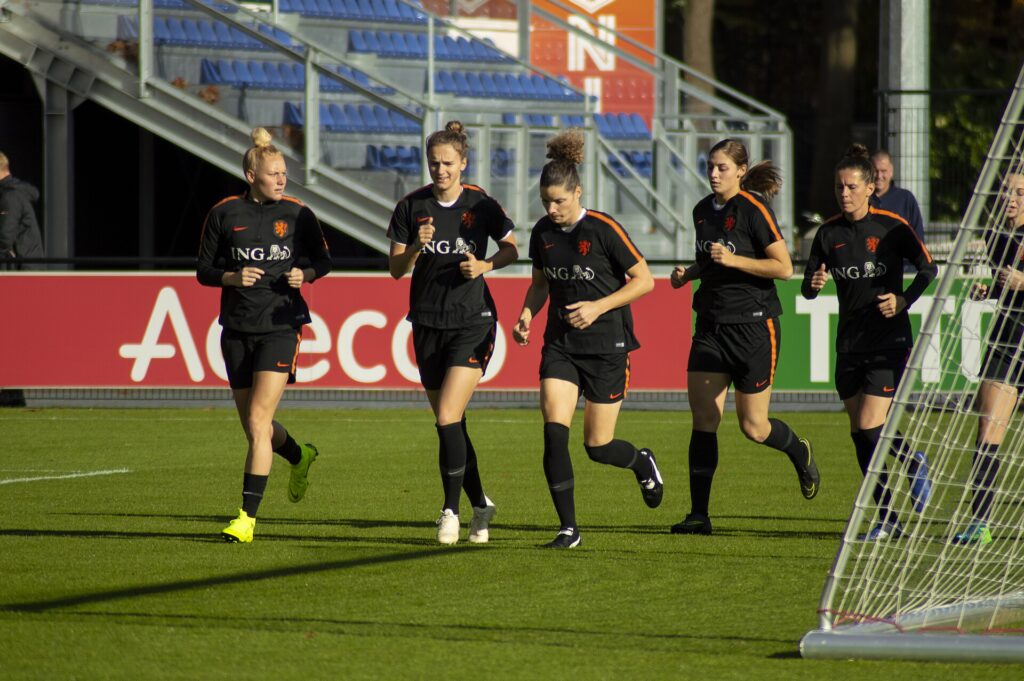
The third habit is the one worth teaching above all the others. The first touch was not a control that stopped the ball; it was a directed touch that moved the ball into the space the scan had identified, usually away from the nearest defender and often at an angle rather than straight ahead.
A stopping touch surrenders the advantage immediately. It puts the ball under the receiving player’s feet, gives the defender the time he needs to close, and makes the next action a struggle in a small space. A directed touch does the opposite: it moves the ball a metre or two into a place the defender cannot reach without changing direction, and it arrives already moving.
The distances involved were small. Not a large push into open space, which is a different technique for a different situation, but a metre and a half at most, taken with the outside of the foot, keeping the ball inside playing distance while removing the immediate pressure. That single detail is what allowed the dribble to begin from a position of advantage rather than from a fifty-fifty.
The dribble: small touches, one large change of direction
The dribbling pattern was consistent enough to describe as a formula. A series of very short touches, the ball rarely more than a stride ahead, in a rhythm that kept a defender in a reactive posture. Then, at a chosen moment, one abrupt change of direction of far greater magnitude than any of the touches preceding it.
The short touches were not an attempt to beat anyone. They were a way of holding the defender at a fixed distance while the situation around them developed, and of ensuring that the ball was always available for the sudden change when it came.
The change itself was almost always timed to a defender’s weight transfer rather than to a fixed count. The cue was a planted foot or a shoulder committing, and the response came in the same instant. That timing is the part of the pattern that cannot be drilled in isolation, because the trigger belongs to the opponent and not to the player practising.
Why the sole of the foot did so much work
The rolled sole is the visual signature, and it has a mechanical justification that its imitators mostly missed.
Dragging the ball with the sole keeps it in contact with the foot rather than pushing it away, which means the player retains the option to stop, reverse or accelerate at any point during the movement. A touch with the inside or outside of the foot commits the ball to a direction; a sole roll delays that commitment.
In a congested band between the lines, delay is the resource in shortest supply. Keeping the ball attached for an extra fraction of a second while a defender commits is worth more than any amount of speed, which is why the technique appears most often in tight areas and almost never when a player has space to run into.
What followed the dribble
The part least remembered is what happened after the ball came out of the tight area, and it is where the value actually was.
The dribble was almost never the end of a sequence. It was a device for eliminating one or two opponents in order to arrive at a moment where a pass could be played into a space that had not existed a second earlier. The characteristic finish was a first-time ball, often disguised, released the instant the defender had been beaten rather than after another touch.
That combination is what made the profile valuable rather than merely entertaining. A player who dribbles and then dribbles again is a problem for his own team; a player who dribbles to create a passing angle and then releases immediately is a mechanism for turning possession into a chance. The distinction is the one most junior imitators never absorbed.
The part of the job he did not do
A profile that leaves out the limitations is a promotional document rather than an analysis, and the limitations here are specific and structural.
The role carried little defensive obligation. A player operating between the lines and drifting to find the ball is not available to press in a coordinated way or to occupy a defensive station, and the team behind him absorbs that cost. In a side with two disciplined central midfielders it is affordable; in a side without them it is not.
The output was also uneven by design. A player whose value is concentrated in a handful of decisive actions will have quiet matches, and the quiet ones look worse than a steady player’s average performance even when the season total is far higher. That trade is inherent in the role and it is why the position has been squeezed out of most modern structures rather than because the players stopped existing.
Why the pattern spread through junior football

The imitation was real and it was widespread, and the reason has more to do with visibility than with coaching.
A turn is legible. It happens in one place, in about half a second, and it can be recognised, named and attempted by a ten-year-old who has watched it twice. A scanning habit is invisible on television, a half-turned body shape is difficult to see from behind a camera, and a directed first touch looks like an ordinary control unless you know what to look for.
So the visible half spread and the invisible half did not. Thousands of juniors learned to roll the ball with the sole and very few learned to check their shoulder three times before receiving, which is why the move failed for most of them: the turn was being attempted without the information that makes it a decision rather than a gamble.
The correction is a coaching problem rather than a talent one, and it is well understood now. Practices that constrain a player to receive on the half-turn, that add a defender behind rather than in front, and that reward a directed first touch teach the invisible half directly, and they are standard in the kind of syllabus described in work on structured coaching methods.
What was imitable and what was not
| Element | Teachable | Why |
|---|---|---|
| Scanning before receiving | Yes, and early | A habit built by constraint, not a gift |
| Half-turned body shape | Yes | A mechanical position that can be drilled |
| Directed first touch | Yes | Depends on the two habits above |
| Close-range touch rhythm | Largely | Volume of repetition in tight areas |
| Timing the change of direction | Partly | The cue belongs to the opponent |
| Balance under contact | Partly | Trainable base, individual ceiling |
| The pass immediately after | Yes, and rarely coached | A decision rule, not a skill |
What the footage is still used for
Coaches keep the clips for one reason, and it is not nostalgia. The sequences are unusually clean examples of a receiving problem that every central player faces and that is difficult to demonstrate with a diagram.
Shown with the sound off and paused before the pass arrives, the footage asks a useful question: where is the defender, which shoulder is free, and where should the ball go. Restarted, it answers it. That is a better teaching device than any amount of instruction, because the player watching has already committed to an answer.
What the footage does not teach is the finishing quality of the individual sequences, which belongs to a specific player and is not transferable. The transferable content is the first two seconds, and it applies to a fourteen-year-old in a provincial club exactly as it applied at the top of the sport. The generation that followed, tracked in coverage of current senior prospects, inherited a more disciplined version of the same role.
Frequently Asked Questions
What made the first touch different from an ordinary control?
Direction. A control stops the ball under the player’s feet; this touch moved it a metre or two into space away from the nearest defender, arriving already in motion. That single difference removes the pressure before it is applied rather than after.
Is scanning something a young player can actually learn?
Yes, and it is one of the more reliably coachable habits in the game. Practices that reward information gathered before receiving, and that punish a player who looks only when the ball arrives, build the behaviour within a season.
Why did so many juniors fail with the turn?
Because they copied the visible half. The roll of the sole is easy to see and easy to attempt; the shoulder checks and the open body shape that make it a decision rather than a gamble are invisible on television and were not being copied.
Why has the number ten role become rare?
Because the defensive cost stopped being affordable. Higher pressing and a single holding midfielder demand that every attacking player contributes without the ball, and a role defined by freedom to drift does not fit that requirement easily.
What should a coach take from the footage?
The first two seconds. Where the player looks, how his body is angled when the ball arrives, and where the first touch goes. The dribbling that follows belongs to an individual; the receiving habit belongs to anyone prepared to drill it.
The move that spread across a generation of pitches was never the move. It was the three shoulder checks nobody could see, and the touch that had already decided where the ball was going before it arrived.