Watch the footage with the sound off and the first thing you notice is how little happens. Long passages of nothing, two athletes circling at a distance that looks too far apart to be dangerous, and then a single exchange lasting under a second in which one of them scores and the other is still recovering his balance.
That was the shape of a Hadi Saei bout. He built a career at the top of the sport on one answer to one question — what to do when the opponent commits first — and then rebuilt the same answer twelve kilograms heavier when he moved from the 68-kilogram category to 80. He finished with Olympic titles in both, which is the part everyone remembers, and with a method that is still taught, which is the part worth explaining.
This is that method: the distance, the cue, the counter, and what had to change when the opponents got taller.
Four things happen before the kick lands
- The distance is set early. Held at the edge of the opponent’s reach, so that any attack requires a step and a step is visible.
- The cue is read, not guessed. The support foot pivots before the kicking leg moves. That pivot is the trigger.
- The retreat is small. A short slide backwards, not a step, so the rear leg stays loaded and available.
- The counter fires off the back leg. Longer path, more mass behind it, and it arrives while the opponent is still on one foot.
- The guard never moves. The rear hand stays on the body line throughout, which is why the exchange only scores in one direction.
The problem the back-leg counter solves
In a scored striking sport with a limited target area, the athlete who attacks first accepts a specific disadvantage. To reach an opponent, he must close distance, and closing distance means standing on one leg for a moment with his own target area exposed and unable to change direction.
Most competitors accept that trade because the alternative — waiting — surrenders initiative and, in a bout scored by human judges, risks looking passive. The counter-fighter’s answer is to make the wait productive: to stand at a distance where the opponent’s attack cannot land without an extra movement, and to treat that extra movement as the opening.
The difficulty is that countering is a decision made with almost no time. By the time an attack is unmistakable, it is too late to answer it. The whole craft lies in reading the preparation rather than the attack, which is why the section that follows is about feet and not about kicks.
Distance is the technique, before the kick is
The working distance in this style is defined by the rear leg, not by the arms. If an opponent standing square can reach the chest guard with a turning kick without adjusting his feet, the distance is too close. If he needs a step or a switch to arrive, the distance is correct.
Holding that line is a continuous job. The opponent will try to close it by half a foot at a time, using small steps that do not look like attacks, and the counter-fighter answers with equally small adjustments backwards and sideways. Most of a bout is this negotiation, and it is invisible unless you watch the feet.
Two errors end the strategy immediately. The first is retreating in a straight line under pressure, which walks the athlete into the boundary of the contest area, where there is no distance left to give. The second is retreating too far, which resets the exchange and hands the opponent a free reset as well.
The correct answer to sustained pressure is lateral movement — stepping off the line of the attack at an angle rather than backwards — and it is the single hardest habit to build, because the instinct under a fast kick is to go straight back.
The counter, movement by movement
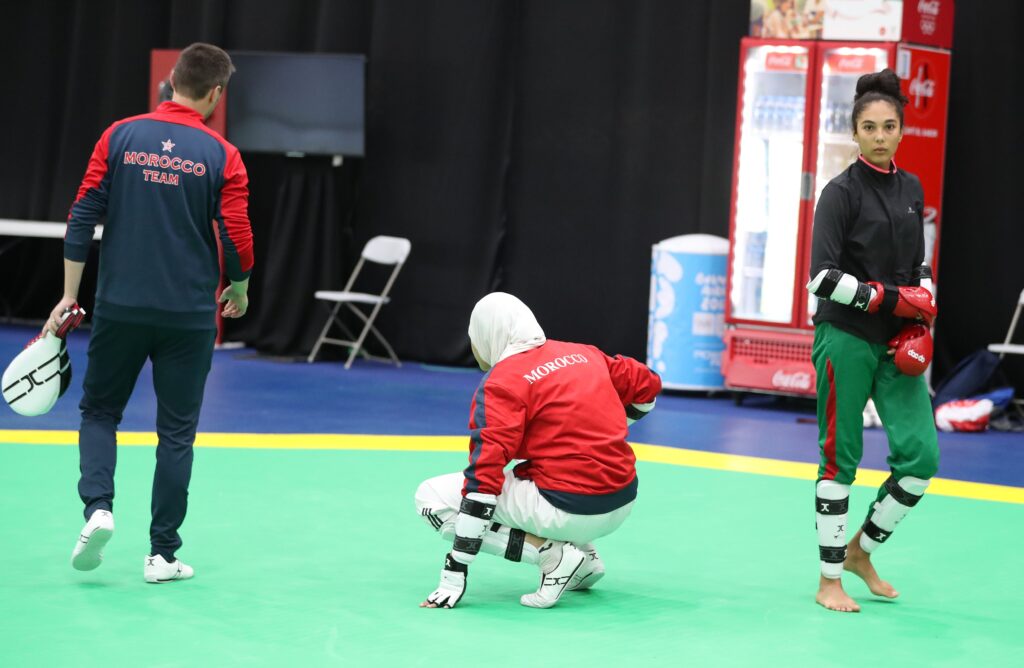
Broken into beats, the sequence is short. It has to be, because the whole exchange occupies less than a second.
The first beat is the read. The opponent’s support foot rotates outward, or his rear shoulder drops fractionally as he loads. That happens before the kicking leg leaves the floor and it is the only warning available.
The second beat is the withdrawal. Not a step, a slide: the front foot pulls back a short distance while the weight settles onto the rear leg. The purpose is to make the incoming kick fall short by a hand’s width rather than by a metre, because a kick that misses narrowly leaves the attacker committed and a kick that misses widely lets him recover.
The third beat is the launch. The rear leg fires as the opponent’s kick reaches its extension — not after it lands, which is too late, and not before, which is a guess. The hip drives through and the support foot pivots to open the line.
The fourth beat is the landing. The counter-fighter recovers forward or to the side rather than backwards, so that the exchange ends with him in a stance and the opponent still turning. That last detail decides whether the counter is a single score or the start of a second one.
Reading the initiation cue
Everything above depends on the first beat, and the first beat is a training problem rather than a talent. There are three cues in most opponents and they appear in a consistent order.
The pivot of the support foot is the most reliable, because a turning kick cannot be thrown without it. The drop or rotation of the rear shoulder is second, and it appears in athletes who load their upper body before their hips. The third is a change in the rhythm of the bounce — a bouncing stance that suddenly steadies is a stance about to attack.
Cues differ between opponents, which is why bout preparation in this sport is largely footage work. The purpose of watching an opponent is not to learn his favourite technique; it is to find which of the three cues he shows and how much warning it gives.
Against an opponent who shows no usable cue, the counter-fighter has to create one. The standard method is to offer a target — a small opening in the guard, a half-step into range — and to time the counter on the invitation rather than on the read.
Why the guard hand mattered as much as the kick
A counter thrown off the back leg leaves the counter-fighter’s own body open for the duration of the kick. The rear hand is what closes that window, and in the footage it barely moves from the sternum through entire rounds.
This is the detail juniors discard first. A kick feels like the technique, so the arms drift out for balance, and against an opponent who is himself countering, a drifting guard is the target. Coaches who teach this material spend more correction on the hands than on the legs.
The lead hand does a different job. It stays low and loose, used to measure distance and to disturb the opponent’s line of sight rather than to block, and it retracts sharply the moment the counter fires so it does not travel across the scoring path.
What changed when he moved up a weight category
Moving from 68 to 80 kilograms is not a matter of carrying more mass into the same fight. Opponents in the heavier category are taller, their legs are longer, and the geometry of every exchange changes with them.
The first consequence is that the safe distance moves further out. An opponent with longer legs reaches the chest guard from a position that would have been harmless in the lighter category, so the whole negotiation happens a step further apart, and the counter has a longer path to travel.
The second is that the counter has to fire earlier. If the counter travels further to arrive, it must leave sooner, which means acting on a weaker read. The margin for a misread narrows at exactly the moment the read gets harder.
The third is a physical one. Heavier opponents are harder to displace, and in a sport where a visible effect on the target contributes to a score, a technically correct kick that does not move a larger athlete may not register. The adjustment is not more force; it is cleaner contact with the ball of the foot and a stronger hip rotation through the target rather than at it.
| Element | Lighter category | Heavier category | Adjustment required |
|---|---|---|---|
| Working distance | Closer, faster exchanges | Further out, longer reach | Reset the distance line by a half step |
| Initiation speed | Very fast, short warning | Slightly slower, longer warning | Read is easier, travel is longer |
| Counter timing | Fire at extension | Fire before extension | Commit on a weaker cue |
| Visible effect on target | Displacement comes easily | Displacement is harder | Contact quality over volume |
| Clinch and close range | Broken quickly | Frequent and physical | Strength work and exit footwork |
| Round conditioning | High tempo throughout | Bursts with heavier recovery | Repeat-effort rather than continuous work |
The technique itself did not change across the move. The distances, the timing and the physical preparation all did, which is the ordinary answer to how an athlete crosses two categories: keep the method, rebuild everything around it.
The scoring system of the era rewarded a different risk
His competitive career sits before electronic sensors in the body protector became standard, and that matters for how the counter was constructed. Points were awarded by corner judges pressing within a short window of each other, and a technique only scored if enough of them saw it clearly.
Under those conditions, one unmistakable technique was worth more than three ambiguous ones. Light contact that a sensor would now register was frequently invisible to a judge in the corner, so the athletes who prospered were the ones who threw fewer, cleaner and more decisive kicks — precisely the profile a counter-fighter has.
Head kicks were already worth more than body kicks in that era, and the differential widened after it. A counter-fighter with the timing to take the head off an incoming attack was therefore holding the highest-value technique in the ruleset, thrown at the moment it was least likely to be defended.
Anyone learning from this footage should hold that context in mind. The same restraint under a sensor-based system would leave points on the table, which is why the modern game rewards volume in a way the recorded bouts do not show. Reading the rules of the period is part of reading the technique, in taekwondo as in any scored sport.
Managing the clock and the point gap
A counter-fighter’s tactical position inverts at the moment he goes ahead. Behind on points, he must eventually initiate, which is the one thing his whole method avoids. Ahead, the opponent has to come to him, which is the situation the method was built for.
That produces a recognisable shape across three rounds. The first round is spent establishing the distance line and collecting reads at low risk. The second is where the counter-fighter tries to take the lead, because a lead converts the third round into an opponent walking into him. The third is management: holding distance, using the boundary, and refusing exchanges that do not fit the pattern.
The vulnerability is obvious and was exploited by good opponents. An athlete who is behind late and unwilling to lead is in trouble, and the answer is a small set of initiating attacks kept in reserve — usually a fast front-leg technique used to force a reaction rather than to score, turning an attack back into a counter opportunity.
One reason the Hadi Saei taekwondo footage stays in the syllabus
Coaching rooms keep this material for a reason that has little to do with the medals. The bouts are unusually legible: the distance work is visible, the cues are visible, and the counters are separated by long enough that a junior can watch one and understand what happened before it.
Compare that with modern high-volume bouts, where the exchanges arrive too quickly for a beginner to decompose. A teaching video needs space between events, and this footage has it. That is also why the same clips are used to introduce concepts a student will later apply under a different ruleset.
The wider Iranian record in the sport gives the material additional weight in local gyms — the country’s Olympic history in taekwondo runs from its earliest Games participation through to competitors such as athletes who continued their careers abroad. A method that produced results at that level is worth teaching even to students who will never fight the way it was designed for.
The progression that builds the counter, and the part to leave out
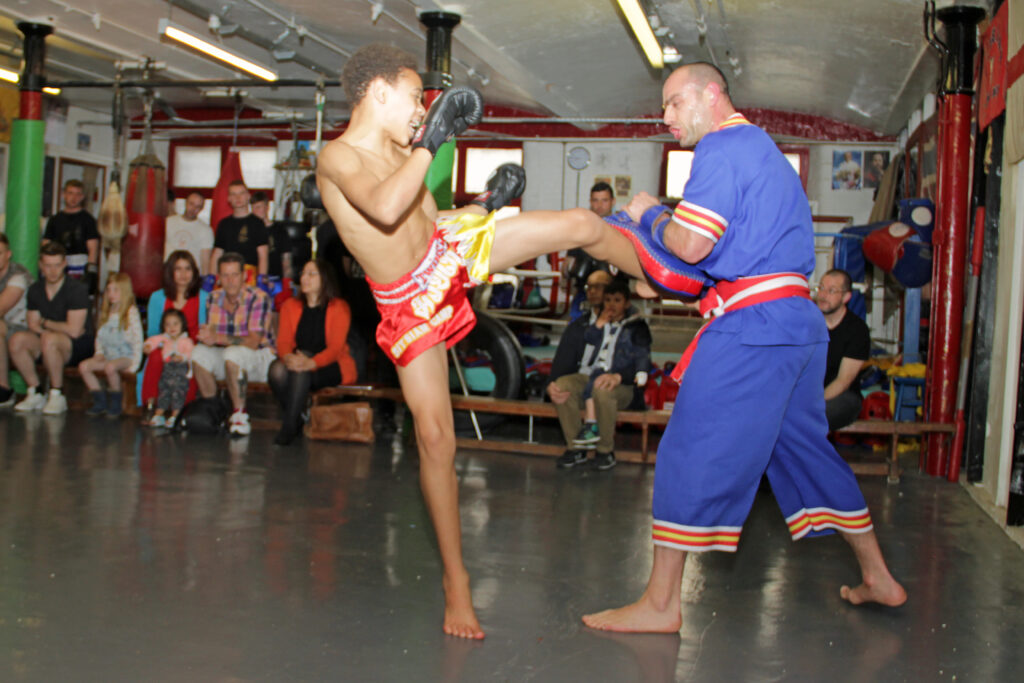
The counter is taught backwards, starting with the thing that is not the kick.
Stage one is distance alone: two students, no contact, one advancing and one maintaining a fixed gap, for a full round. It is dull and it is the whole foundation. Stage two adds the cue: one student throws a telegraphed attack, the other only steps back at the right moment, still without countering. Stage three adds the kick with a pad held in place. Stage four removes the pad and adds a partner attacking at a controlled percentage of speed. Only stage five is free sparring.
The part to leave out with junior athletes is head contact. Countering to the head is the highest-value version of the technique and the worst thing to rush, and every serious programme delays it until control, protective equipment and supervision are all in place. Head trauma in youth combat sport is a medical matter rather than a coaching preference, and the sequencing should be set by the club’s medical guidance and the federation’s rules for the age group.
The historical weight this sport carries in Iranian gyms — the same lineage that produced figures like the country’s most revered Olympic champion in an earlier era — tends to produce ambitious juniors and impatient coaching. The progression above exists to slow both down.
Frequently Asked Questions
Is a counter-fighting style still viable under electronic scoring?
It is viable but no longer sufficient on its own. Sensor-based systems register light contact that judges would have missed, which rewards volume, so a modern counter-fighter needs an initiating repertoire alongside the counter rather than instead of it.
Why fire the counter off the back leg rather than the front?
The front leg is faster and lands sooner, but it carries less and is easier to absorb. The back leg travels further and arrives with hip rotation behind it, which is what produces the visible effect a score depends on. Skilled athletes use both, and the choice is a distance decision.
How long does it take to build the timing?
The kick can be learned in weeks. The read cannot, because it is pattern recognition built from thousands of repetitions against different opponents. Coaches generally describe this as a multi-year skill, and the distance work is what carries a student while the timing develops.
Does moving up a weight class always require this much adjustment?
In striking sports, yes, because reach changes with height and reach sets every distance in the bout. The technique survives the move; the timing, the footwork spacing and the physical preparation all have to be rebuilt around new opponents.
What is the most common mistake when learning the counter?
Retreating too far. A large step back makes the opponent’s attack miss safely and also removes any chance of countering, because the distance to return is now too great. The correct retreat is measured in centimetres.
Can this be trained without a partner?
Partially. Footwork, distance drills against a mark on the floor and kick mechanics on a bag all transfer. The read does not, because it requires another person producing real cues under pressure. Solo work builds the tools; only partner work builds the timing.
What survives from those bouts is not a signature kick. It is an argument about where to stand, and a demonstration that an athlete who wins the argument about distance has already won most of the exchange before either of them moves.