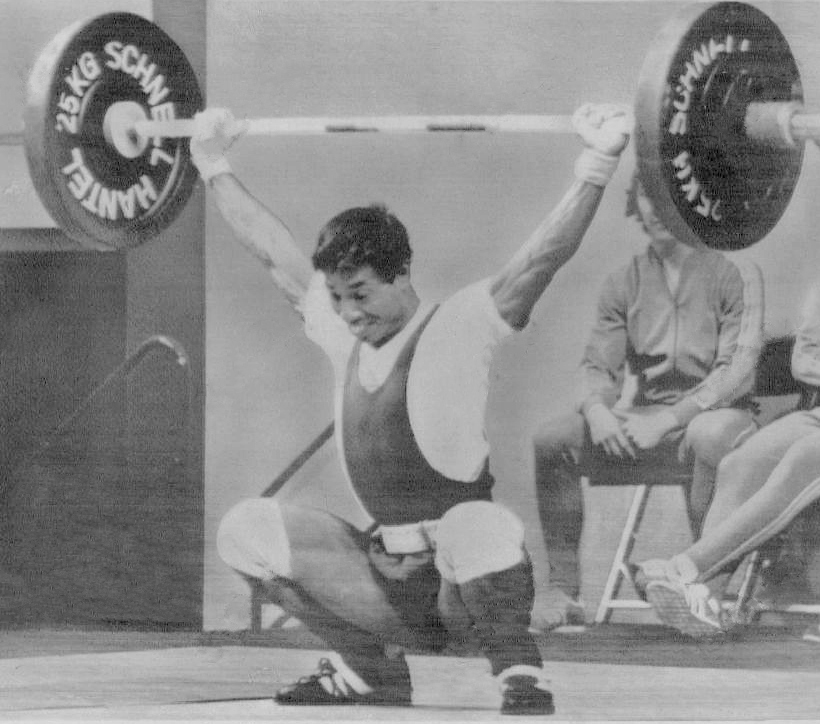
Every coaching room that teaches the snatch keeps a small library of side-on footage, and the same clips keep being paused at the same frame: the instant the plates leave the platform. It is a dull moment to a spectator and the most informative two-tenths of a second in the lift.
Hossein Rezazadeh, from Ardabil in the northwest, spent a completed career in the super-heavyweight category, and the reason his lifts remain teaching material has little to do with the numbers on the bar. It is that the positions look like the textbook at loads where almost everyone starts inventing compensations.
What follows is a rebuild of the movement from the floor upward: what the setup is solving, why the first pull is deliberately unhurried, where the invisible re-bend of the knees happens, and which parts of the model transfer to a lifter half that size. None of it is a training prescription. Maximal overhead lifting is a coached activity for good reasons.
What the footage is used to teach
- A setup that repeats. Same foot position, same grip check, same breath count, attempt after attempt.
- A slow first pull. The floor-to-knee phase buys position, not speed.
- The re-bend. Knees travel back under the bar as the torso comes upright, loading the thigh against the bar.
- Contact, not a jump. The bar is driven vertically by hip extension, with minimal horizontal loop.
- Speed under the bar. The turnover is fast even when the bar is not.
- A short bar path. A shallow S with small horizontal excursion, finishing over the middle of the foot.
The setup, and why mass changes the geometry
The snatch takes the bar from the platform to a locked-out overhead position in one movement, caught in a squat and stood up. Everything about the start position exists to make that single continuous action possible at a load the lifter cannot press.
The grip is wide, out toward the collars, with the thumb trapped under the fingers. Wide hands shorten the distance the bar has to travel and put the shoulders in a position from which the overhead lockout is reachable. The bar sits over the middle of the foot, close enough to the shin that the first movement is upward rather than backward.
Body mass changes what is available. A super-heavyweight cannot fold into the same start as a lightweight: there is more thigh and torso in the way, the hip cannot close as far, and the hips consequently start higher with the torso more inclined. That is not a flaw to be corrected. It is the correct solution to a different set of levers, and it explains why copying a lightweight’s start position at that size produces a worse lift, not a better one.
A first pull that looks slow because it is
From the platform to just above the knee, the job is arrival, not acceleration. The back angle stays roughly constant, the knees extend to clear a path, and the bar drifts a fraction toward the lifter as it rises. Watched at normal speed it reads as hesitancy. Watched frame by frame it is a lifter refusing to spend a position he will need in half a second.
The common error is the opposite. A fast rip off the floor arrives at the knee with the hips already high, the shoulders behind the bar and nothing left to extend. The bar then has to be finished with the arms, which is a losing arrangement at any weight and an impossible one at maximum.
There is a second reason for restraint at heavy loads. The heavier the bar, the longer the whole lift takes and the more the lifter depends on the sequence being correct rather than on the bar being fast. A slow first pull is not a stylistic choice; it is what allows the second pull to be violent.
The scoop most people miss on the first watch
As the bar passes the knee, something happens that a casual viewing reads as a single continuous pull. The knees travel forward and back under the bar while the torso rotates toward vertical. The knee re-bends. The thigh arrives against the bar.
This is the double knee bend, and it is the mechanical center of the whole movement. It puts the strongest hip and knee extensors into a shortened, powerful position at the exact moment the bar is high enough to be accelerated vertically. Without it, the lifter is trying to finish a heavy bar from a long, weak lever.
At maximal load the re-bend is small. It is measured in a few centimeters of knee travel and a fraction of a second of timing, and this is precisely why the footage is useful: at moderate weights the movement is exaggerated and easy to see, and at maximum it becomes a timing event that has to be recognized rather than copied.
Contact at the hip, not a jump
The second pull is a hip extension against a bar that is already moving. The bar brushes high on the thigh or at the hip crease, the torso finishes vertical, the shoulders shrug and the elbows begin to travel high and outside. The whole action is vertical.
The cue that ruins it is the word jump. A lifter told to jump drives the hips forward into the bar and sends it away from the body on a loop, which then has to be chased under. Feet stay in contact with the platform longer than most people assume, and when they do leave it, they move outward into the receiving stance rather than upward.
The mass question returns here. With more body in front of the bar, the bar has more to travel around, and a hard forward drive of the hips produces a larger loop than it would in a lighter lifter. The model on the footage keeps the contact shallow and the direction upward, which is the hardest thing to do at that size and the most valuable thing to show a student.
Speed under the bar, not speed of the bar
After extension the arms change function. Until that moment they are cables. From that moment they are the mechanism that pulls the lifter down, elbows rotating around the bar, shoulders driving up into a locked overhead position with the bar over or slightly behind the line of the ears.
Catch depth is a budget. A deep receive means the bar needs less height, which is a real saving. It also means standing up from the bottom of a squat with a maximal load on locked arms, and that cost scales with body mass. Super-heavyweights therefore tend to receive higher and to demand a better second pull in exchange, which is a bargain that only works if the extension is genuinely complete.
The lockout itself is an active position, not a passive one. Shoulders externally rotated, scapulae pushed up, the bar held motionless until the down signal. A lift that reaches the catch and then settles forward by a few centimeters is a lift that was never finished behind the head line, and no amount of grip strength rescues it.
The bar path drawn as a line
Trace the end of the bar across a side-on clip and the model produces a shallow S: slightly toward the lifter from the platform, a small excursion away at contact, then back toward the lifter as he pulls under, finishing above the middle of the foot. The horizontal travel across the whole lift is small, and shrinking it is most of what technical coaching is for.
| Fault on the path | Usual cause | What the model does instead |
|---|---|---|
| Bar loops forward after contact | Hips driven horizontally; the jump cue | Vertical extension, shallow contact, feet late off the platform |
| Bar swings out at the top | Over-extension of the trunk at finish | Finish upright and stop; the pull under begins immediately |
| Bar drifts away from the shins early | Loose lats, shoulders too far behind the bar | Lats engaged, shoulders slightly in front, bar kept close |
| Bar caught forward of the head | Incomplete turnover, soft shoulders | Active overhead lockout with the bar behind the ear line |
| Early arm bend | Attempting to lift the bar rather than accelerate it | Arms stay long until extension is finished |
| Feet jump wide and land late | Vertical jump replacing hip extension | Small, fast foot movement into the receiving stance |
Why Hossein Rezazadeh weightlifting technique survives as a teaching model
Plenty of exceptional lifters have won with movement patterns nobody should imitate. Idiosyncratic technique can be made to work by the person who owns it and is a poor foundation for a coaching curriculum. The value of Hossein Rezazadeh weightlifting technique for teaching is the opposite quality: at loads where compensations normally appear, the positions stay conventional.
That matters because heavy load is a test rather than a variable. At a comfortable weight a lifter can rescue a bad bar path with speed under the bar, and the error stays hidden. Near a limit, the path has to be right or the lift is simply not made. Footage from that range is therefore evidence, in a way that footage from a training session is not.
The second reason is repeatability. Watch several attempts in sequence and the setup ritual is identical every time: same stance, same grip, same rhythm from the moment the hands close to the moment the bar leaves the platform. Consistency of that kind is teachable in a way that raw strength is not, which is why coaches show the walk to the bar and not only the pull. Similar habits are visible in the same lift performed at a much lighter bodyweight, where the positions are easier for a student to reproduce.
What does not transfer to a lighter lifter
Three things on the footage are consequences of mass and should not be copied by anyone outside the heaviest categories. The high hip position at the start is one: a lighter lifter has the range to sit into a lower start and should use it. The relatively high receiving position is another, because a lightweight who can stand up comfortably from a deep catch is giving away free height by receiving above parallel.
The third is the warm-up structure. A super-heavyweight approaches an opener in few jumps, because each jump is enormous in absolute terms and because there is a finite number of near-maximal efforts in any session. A junior needs more repetitions, smaller increments and more time under the bar, and imitating a heavyweight’s sparse warm-up is a straightforward way to arrive at the platform cold.
What does transfer is the sequence, the patience in the first pull, the completeness of extension and the discipline of the overhead position. Those are universal, and they are the parts of the lift that every new group of lifters coming into the sport has to build first.
Three attempts and a clock that shapes the day
Competition structure constrains technique more than most spectators realize. A lifter has three attempts in the snatch, the loaded bar only ever increases through a session, and the order of lifting follows the weight on the bar rather than the entry list. A declared opener can be changed a limited number of times, and each change moves the lifter in the order.
Once called, the athlete has a minute to begin, or two minutes when following his own previous attempt. That difference decides warm-up strategy: a lifter who expects to follow himself plans a different rest pattern from one who will have four lifters in between.
The consequence for technique is the opener. It has to be a weight the lifter would make on a bad day, because a failed first attempt leaves two chances to record any total at all. Attempt selection is therefore part of the same discipline as bar path: both are about removing variance from a movement that has no margin.
Teaching the same idea to a fifteen-year-old
The progression coaches use runs backwards from the catch. Overhead squats and snatch balance establish a receiving position before any meaningful load exists, because a lifter who cannot hold the bar overhead in a squat has nowhere to put a successful pull. Positional work follows: pull to the knee and hold, snatch from mid-thigh, then from the floor.
Filming comes next, and the detail that makes it useful is boring. Same camera position, same height as the bar, same distance, every session. A path drawn from two different angles is not a comparison. The strength tradition the sport grew alongside in this country, the practice of the house of strength, made the same point about repetition long before anyone owned a camera.
The safety points are not decorative. Loaded overhead lifting concentrates force on the shoulder, the lumbar spine and the knee, and the risk is not evenly distributed across the movement: it clusters in the catch and in the failed rep. Qualified coaching, a proper platform, bumper plates and a rehearsed way of dropping a bar are the minimum conditions under which any of this should be attempted.
Frequently Asked Questions
Why does the first pull look so slow at heavy weights?
Because it is buying position rather than speed. The bar has to arrive above the knee with the shoulders still in front of it and the back angle intact, so that the hips and knees have something left to extend. Speed generated too early is spent before the phase that can use it.
What is the double knee bend actually doing?
Re-loading. As the bar passes the knee, the knees travel back underneath it and the torso comes upright, which returns the strongest extensors to a shortened, powerful position at the moment vertical acceleration is possible. It is timing rather than amplitude, and at maximum load it is small enough to miss.
Should the bar touch the hip?
Contact is normal and useful, provided it is a brush rather than a strike. A hard collision drives the bar forward and creates the loop that has to be chased under. The aim is a shallow contact on a bar that is already traveling upward.
Is a deep catch always better?
Mechanically it needs less bar height, which is a real advantage. It also costs more to stand up from, and that cost scales with body mass, which is why the heaviest lifters often receive higher and compensate with a more complete extension. For lighter lifters the deep receive is usually the right trade.
How much of this can be learned from video alone?
The faults can be identified from video; the corrections cannot be applied by it. A bar path drawn on a screen tells a lifter what happened, not what to feel, and the translation between those two things is the coach’s job. Video is a measuring instrument, not a method.
Does the technique change for the clean and jerk?
The pull is closely related, with a narrower grip, a higher receiving position on the shoulders and a different set of demands at the finish. The first pull and the re-bend are recognizably the same problem, which is why coaches teach them together and separate the codes only at the turnover.
The lifts remain on coaching-room screens for an unglamorous reason: they are a clean example of ordinary positions held at extraordinary load. That is a harder thing to demonstrate than strength, and it is the only part of the footage a student can actually take away.